
Damar Hamlin knew the risks of his job, just like so many of us do | Opinion
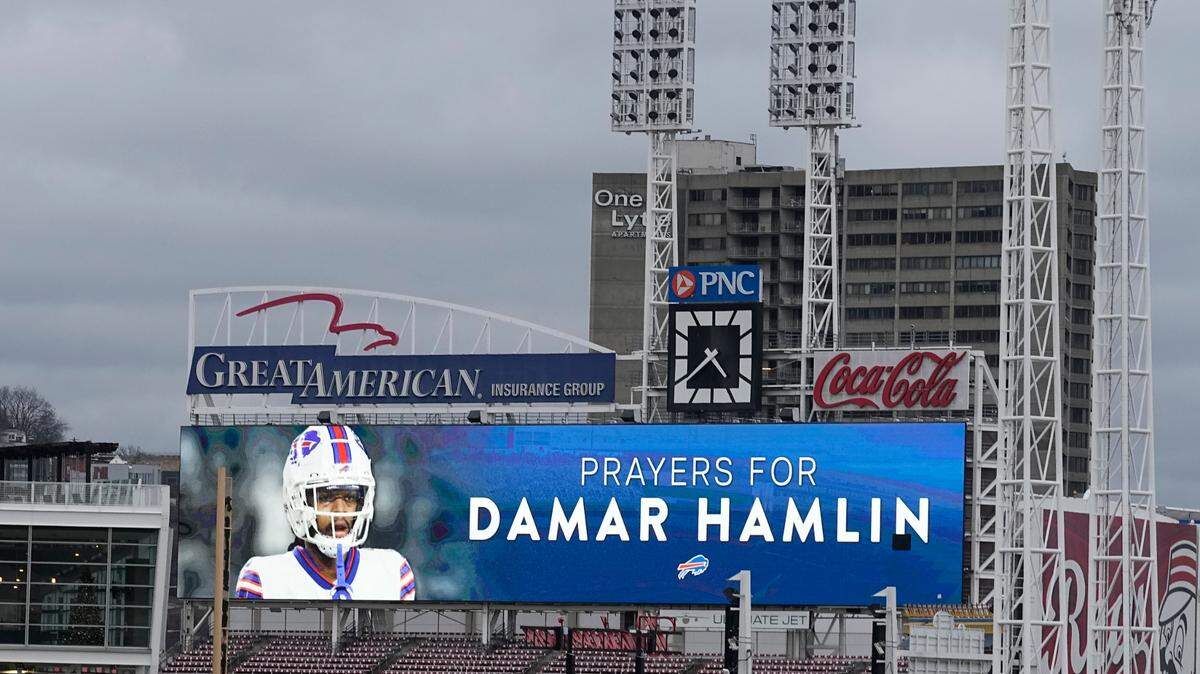
I can’t decide if my 10 years of experience as a football player, including twice watching an ambulance get involved during a game, makes me the perfect person to speak about what happened to Buffalo Bills player Damar Hamlin on Monday Night Football, or absolutely the wrong person. You should consider that struggle as you read the rest of these words.
Football is a brutal-beautiful sport.
I played organized football from middle school through college. I liked it a lot but never loved it the way many of my teammates did. Early on, I decided if I ever needed surgery to repair an injury, I would never suit up again. I never encountered such an injury. That doesn’t mean I went unscathed.
During a preseason game before my senior year in high school, I ran a 10-yard post route, dove for the ball, landed awkwardly on my right arm. My coach took one look at it, knew it was broken and called over the EMTs. They immediately took me to the hospital. I didn’t think it a big deal. I had broken the same arm in elementary school after falling off the monkey bars, though it did keep me sidelined for half of my senior season and limited my prospects for college scholarships.
The second ambulance I encountered as a player was harder to dismiss. It was during my sophomore year at Davidson College. I had just laid into a defender, blocking him on a play designed to give me a head start, to build up as much momentum as possible before crashing into him. It was the kind of play I had made several times, had it done to me. He didn’t get up. The game was momentarily suspended as the ambulance was driven onto the field. As he was being taken to the hospital, I was being urged to be proud of what had happened. I wasn’t. I was nonplussed.
Football was tough, I knew. I never required surgery but had the broken arm; a few bruised (or cracked) ribs; a torn left hamstring; a contusion that ballooned my right thigh to twice its normal size; swollen-bloodied lips; a couple of shoulder stingers and other bumps and bruises every player experiences as the season grows long. Here’s the thing. If I could go back and redo that part of my life, I wouldn’t change a thing. Not one thing.
I didn’t feel exploited, wasn’t exploited. I played because I wanted to, not because I had to.
Though I grew up in tough circumstances and football introduced me to colleges beyond the ones I had been considering, I didn’t need it to further my education. I also played the sport during a particularly stupid era. We’d have three-hour-long practices in the Southern heat and coaches who called us “soft” if we asked for water breaks, for instance. We know better now about the dangers of heat stroke, just as we better understand the risk of concussions to long-term cognitive health.
The game being played today is magnitudes safer than the one I played. That doesn’t mean it’s safe. It’s a collision sport, which is inherently risky. Safety measures must continue being advanced, even if it angers fans who hearken back to the days when blindside hits were not only allowed but encouraged and celebrated.
Sometimes I compare it to what my mother faced as a forklift driver in a Georgia Pacific paper plant in Russellville, S.C. I’ve had brothers and cousins work in truck manufacturing facilities, a sister in textiles, close friends and cousins serve in the military and as prison guards and police officers. I spent summers, along with a couple of my brothers, picking tobacco. I even watched a Golden Corral waitress in North Charleston, S.C., spill hot coffee water, likely deeply burning and scarring her arm, cry for a few minutes, wipe away her tears and get right back to refilling our glasses with sweet tea.
Risk? Those of us who’ve experienced hard things — and intimately know others who’ve faced even tougher situations — expect to grapple with risk as much as we expect the sun to show itself again sometime tomorrow morning. And as far as sports, most are risky. We’ve seen NBA player Paul George suffer a gruesome injury while playing for USA Basketball, know that the threat of concussion in women’s soccer is real, that an errant fastball to the chest or head of a baseball player is as well. NASCAR drivers didn’t get serious about protecting themselves from head and neck injuries until maybe their best and best-known driver was killed in a wreck he likely could have survived with better safety mandates. Simone Biles, maybe history’s greatest gymnast, wisely withdrew from the all-around competition during the Olympics because a mental health struggle made her susceptible to catastrophic injury, which was a possibility every time she suited up anyway.
What happened to Hamlin, whatever its cause, could have happened to me when I was running around in shoulder pads. Every football player knows it. But truth be told, what happened to him is rare in today’s game, and was even when I was playing during the stupid football era. That’s why it was so shocking to see him get up after what was a routine play, fall right back down and need emergency-expert medical attention to preserve his life. We simply haven’t seen anything like it, which is why it’s unlikely to happen when the Carolina Panthers suit up for the final time this season or when a new batch of players at West Charlotte High School in North Carolina or Myrtle Beach High School in South Carolina take to the field next summer and fall.
None of that excuses systemic societal problems. Given what we know about the cumulative effect of head injuries, there’s no reason to put elementary-age boys and girls in pads for contact football. In some areas, we spend far too much on high school football stadiums and facilities and haven’t done enough to ensure every student can receive a quality education. It’s unseemly that high-profile college coaches receive long-term multi-million dollar deals yet balk at the players who make those salaries possible receiving a larger slice of the revenue they generate. The NFL was slow to acknowledge the long-term risk of concussions, adopted a racist policy as it fought lawsuits brought by former players and its front offices and head coaching ranks aren’t nearly diverse enough.
It’s true that too many young black men have been convinced their best way out of horrific conditions in childhood is the brutal-beautiful sport of football, just as it was vile that my mother was shut out of greater opportunities because of Jim Crow and that white Golden Corral waitress had so few options she had to accept a scalding as part of her daily work.
Risk? Google “Waffle House employees and fight.” You don’t have to tell me, or any of them, what risk means. I suspect Hamlin doesn’t have to be schooled on the term, either.