
We’re turning judges into politicians in NC, and it’s harmful | Opinion
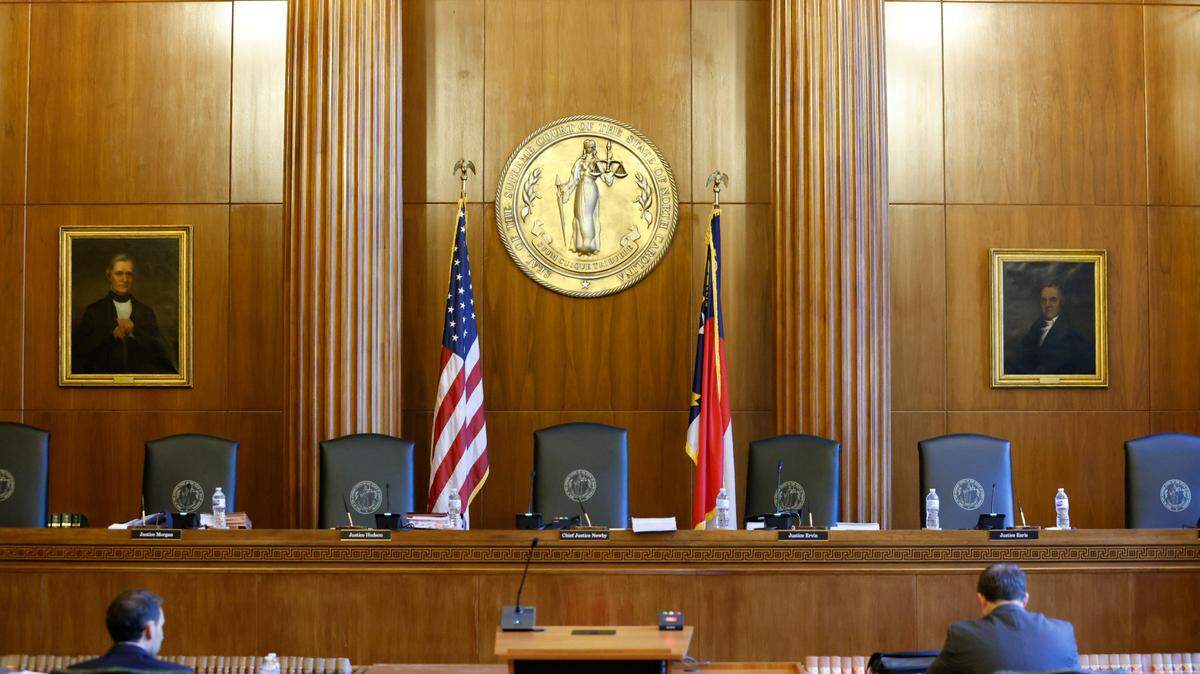
If Paul Revere were riding through North Carolina today, he might well be warning: “The ads are coming! The ads are coming!”
Though we are accustomed to recurring commercials for governor and legislative offices, ads for statewide judicial races have not landed at nearly the same pace.
Until now.
For the two open seats on our state Supreme Court in 2022, candidates and so-called “dark-money” groups with anonymous donors spent $17.75 million on television ads alone.

With this spending on judicial races came the fundamental change in how the ballot now displays judicial candidates to the voters.
From 2004 to 2016, statewide races did not display political party affiliation for any candidate for the bench. Legislators reversed this approach, and by the 2018 election every candidate running for the N.C. Court of Appeals and the Supreme Court would have an “R” or a “D” beside their name.
These changes, including the millions spent to elect judges, have a common feature — they’re an attempt to turn all those who pursue judicial service into politicians.
Yet the concept of judges as politicians runs contrary to our Founders’ ideal that those who preside in our courts would not serve partisan goals. In that critical respect, our judges stand apart from those who seek legislative and executive office. A judiciary independent of, not beholden to, any political party is integral to the genius of separating powers among the branches of our government, and central to our system of checks and balances. The abiding purpose of this design is to give the public an unshakable confidence in the impartial administration of justice.
As I advocate for judicial independence, I do not suggest a weakening of accountability. Each of our judges is accountable every day in the court of public opinion. Newspaper editors take on rulings they disagree with. Legislators can react to such rulings by changing the law. Our Founders had these elements in mind as they crafted the balance of powers on which our democracy depends.
The oath our judges take pledges allegiance to the Constitution and the rule of law. The oath does not mention a political party. What is the relevance of a political party — or the frequent counterpart “liberal” and “conservative” — to a breach of contract case, a domestic violence case, a contested eviction or a disputed will?
As Alexander Hamilton warned in The Federalist Papers, introducing “personal and party attachments and enmities into the judiciary fails to advance the interests of justice or the public good.” So it is today.
Making the picture worse, the supercharged partisanship in public discourse has brought an alarming uptick in criticizing judges along partisan lines.
Personal attacks against judges, especially along partisan lines, erode public confidence in the judiciary and undermine the rule of law.
Worse, these attacks have not just been verbal. There have been sharp increases in actual violence against both state and federal judges, with some judges or their family members being wounded or murdered.
Judges’ ability to be fair and impartial to all who appear before them depends on whether a judge will apply the law to each case, without fear or favor. Threats against judges and politicizing judicial elections undermine the independence that enables them to be fair and impartial.
When you reach the judicial section of the ballot, you will see an “R” or “D” beside each candidate. But whatever your politics, you also carry an “A” inside you — for American.
To fulfill the Founders’ vision for an independent judiciary, each of us must pledge to make a nonpartisan evaluation of each judicial candidate. To rely on a label betrays this pledge.
The decisions our judges make fundamentally shape our lives and our communities. To cast votes for judges worthy of our citizenship, we must become the strongest, most informed Americans we can be.