Power shifts, the Senate and more: 4 storylines to watch in NC politics in 2025 | Opinion
2024 was a big year for North Carolina politics. From an eventful election cycle to veto overrides and controversial legislation, there were plenty of decisions and developments that shaped our state, and many of those events will follow North Carolinians into the new year. Here are some of the biggest storylines to watch in 2025:
A ‘working supermajority’?
Democrats managed to chip away at the Republican supermajority in the 2024 election cycle. Republicans will be one House seat short of total control of the state legislature, which would have allowed them to override the vetoes of incoming Democratic Gov. Josh Stein.
Now, in order to override a veto, GOP lawmakers will need the support of at least one Democrat in the House. Republicans seem to believe that’s possible, and they have expressed confidence that they can coax support from House Democrats on at least some bills next year.
That means all eyes will be on more moderate Democrats who have voted with Republicans in the past, including Rep. Cecil Brockman, a Greensboro Democrat who has already clashed with his party more than once for missing key votes and siding with colleagues across the aisle. Since Republicans are just one vote shy of a veto override, every Democratic vote will count. Democrats will have to find a way to smooth things over with Brockman to avoid another Tricia Cotham-esque disaster.
Power grab bill’s fate
In the waning days of their supermajority, North Carolina Republicans overrode Gov. Roy Cooper’s veto of a sweeping bill that will strip power away from newly elected Democratic officials and change the way the state’s elections are administered. It’s a naked power grab that was tucked into legislation billed as “disaster relief,” and it will take effect in the new year.
It’s not the first time that Republican lawmakers have tried to rebalance power in their favor, and several of their previous attempts have been struck down in court. Cooper and Stein have sued over parts of the law that specifically strip oversight and appointment authority from the governor. The lawsuit was filed in state court, where its fate is uncertain. Past lawsuits have been struck down because they transferred too much power to the legislative branch, but this bill predominantly transfers power to Republicans elsewhere in the executive branch.
“That’s, to me, number one with a bullet for North Carolina stories in 2025, because if that bill holds, it’s going to fundamentally change who has access to the levers of power in our state,” Western Carolina University political science professor Chris Cooper told me. “It’s almost like the result of a constitutional convention, but it just comes out of one bill.”
A new House speaker
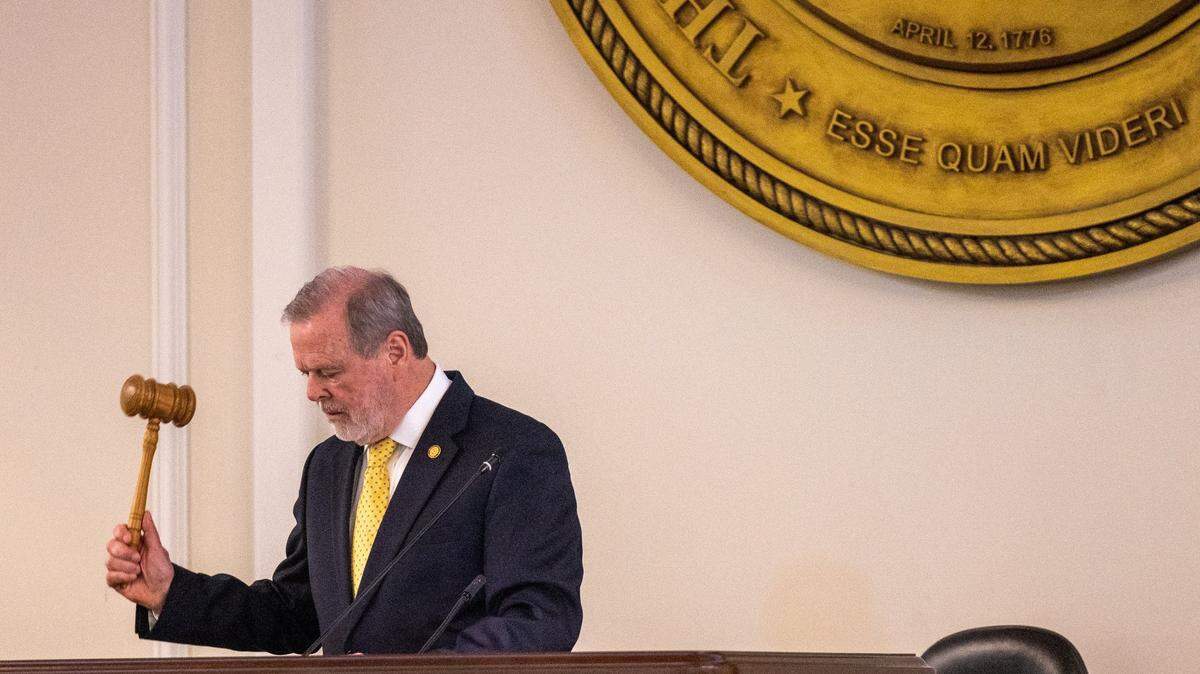
For the first time in a decade, the North Carolina House will have a new speaker. Republicans nominated Rep. Destin Hall to succeed outgoing House Speaker Tim Moore, who is heading to Congress. Hall received Moore’s support and has served as chair of the House Rules Committee — an influential position — for years. But Hall is still not Moore, and it’s been a long time since the leadership of the House and Senate changed. Will the tenor of the House, and its approach to legislating, change with it? Two Democratic lawmakers told me they have a positive working relationship with Hall and are optimistic about his speakership.
Cooper pointed out that Hall might generate fewer headlines than Moore did about his personal life and decision-making, which could impact his leadership.
“I’ll be very curious to see kind of how that plays out, and how, if at all, a quieter speakership changes the way we’re governed,” Cooper said.
Does Roy Cooper run for U.S. Senate?
North Carolina’s U.S. Senate race in 2026 will be one of the country’s most competitive, and Democrats’ chances will be impacted by who they choose to run against incumbent Thom Tillis. There’s plenty of speculation that outgoing Gov. Roy Cooper could be that person, and Cooper has made it clear that his political career is “not done.” Cooper recently told The New York Times that “everything is on the table for me” in terms of which office he might run for.
Cooper’s candidacy would make the race even more interesting, as Cooper is one of the few prominent Democrats to succeed in statewide elections — he hasn’t lost an election in his political career. But the race will also depend on how Tillis navigates a second Trump White House, and if he sides with the president enough to give Democrats fodder to campaign against him with.
Time will tell, too, whether any Republicans decide to mount a primary challenge to Tillis, who has faced criticism from within his party for being too moderate. Lt. Gov. Mark Robinson has been floated as a potential challenger, but it’s unclear whether his political career has any legs to stand on after a landslide loss to Stein in the gubernatorial election this year. Making Robinson the nominee would be a bad move for Republicans, but likely welcomed by Democrats, as Robinson’s loss suggests that North Carolinians aren’t interested in electing him to public office. Republicans should avoid repeating the same mistakes as their counterparts in Arizona with Kari Lake, a radical Trump ally who lost consecutive statewide elections for Senate and governor in 2022 and 2024.