
A Republican judge stands up to his partisan North Carolina colleagues | Opinion
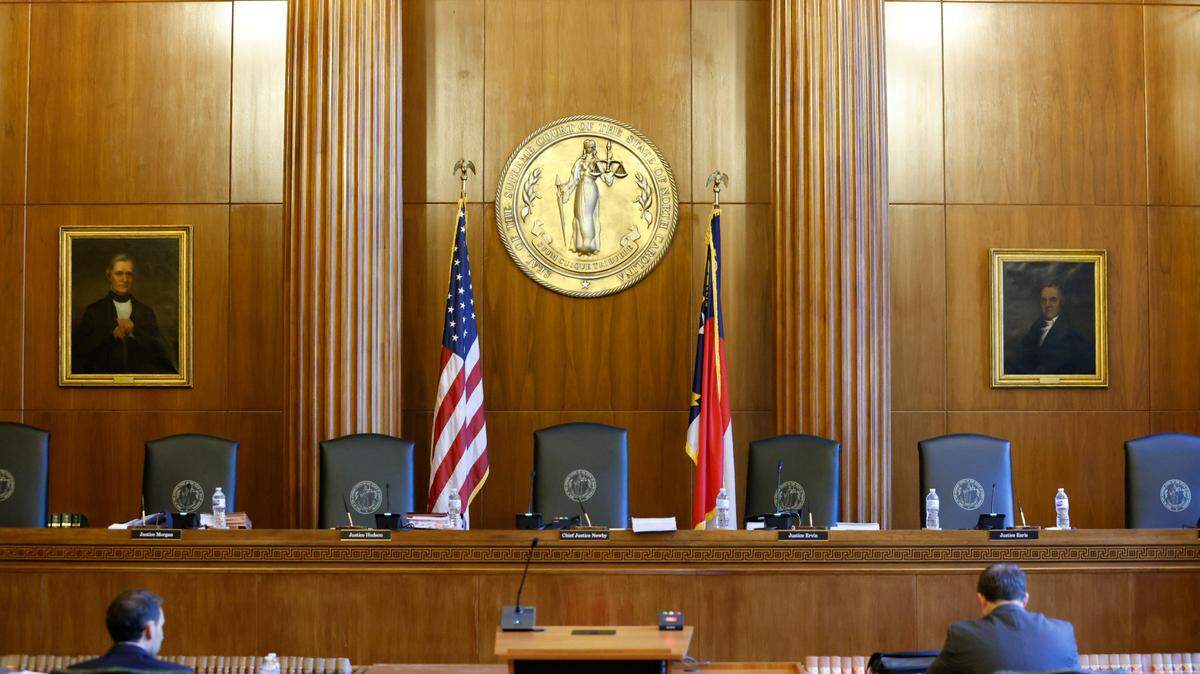
The North Carolina Supreme Court since its Republican recreation in 2023 has fallen from its traditional role as an independent, rule-of-law based institution of constitutional enforcement to a mere partisan enabler of the Republican crusade to destroy constitutional democracy in the Tar Heel State. I know that sounds extreme. And I know I’ve said and written it many times before. But that doesn’t make it less true or less urgent.
In at least four major cases, Harper v. Hall, Holmes v. Moore, Community Success Initiative v. Moore, and Robert F. Kennedy, Jr. v. Board of Elections, handed down in the last 20 months, the court has demonstrated, and even announced, its new status as a partisan, rather than a legal, entity. Other cases, of course, could be named and more are coming — think Leandro and the just-filed Cooper and Stein separation of powers cases.
For those (sensible) folks who don’t follow state Supreme Court decisions, the declared “course correction” has been accomplished, primarily, through a radical rejection of traditional norms of judicial decision-making (stare decisis, precedent, rule of the case, re-hearings of final judgments) and a proffered stunning deference to the “sacrosanct” products of the Republican N.C. General Assembly. Defying the 222-year-old precedent in Marbury v. Madison, Republican justices have created near-idolatrous presumptions of constitutional propriety that mock independent judicial review in favor of Republican lawmakers. What they preach as “course correction” is actually a stark violation of their oaths of office.
It should be noted that so bold is the rank partisanship of the Supreme Court that one of its new Republican members, Justice Richard Dietz, has effectively announced it’s too much for him. In the RFK, Jr. case, removing Kennedy from the ballot to help Trump so late that it violated North Carolina law, Dietz bolted from his cohort and dissented. He wrote, one would think non-controversially:
“I believe this Court’s role is to follow the law as it is written,” Dietz said. “The State Board of Elections properly determined that it would not be practical to reprint the ballots” before a deadline set by law.
I’m still a judge, Dietz seemed to say. And that, of course, set him apart from his other Republican colleagues.
It was no great surprise, then, that Dietz dissented, as did Justice Anita Earls, from last week’s breathtaking and indefensible order blocking the state certification of Justice Allison Riggs’ election as part of Judge Jefferson Griffin’s challenge to 60,000 ballots. She didn’t participate in the decision. Dietz, wrote, dead accurately:
Griffin’s post-election litigation “seeks to remove the legal right to vote from people who lawfully voted under the laws and regulations that existed during the voting process. The harm this type of post-election legal challenge could inflict on the integrity of our elections is precisely what (North Carolina legal) principle is designed to avoid.”
The good news is that North Carolina has one Republican justice who behaves like a judge. We should salute his courage. The bad news is he tried to convince his Republican colleagues to do their jobs instead of behaving like politicians, and it didn’t work. It’s hard to imagine a case more inappropriate for hyper-partisan judicial interference than one overturning an election to decide who should be on the very court petitioned. These folks now want to choose their own fellow justices.
Justices Paul Newby, Phillip Berger Jr., Tamara Barringer and Trey Allen seem not to understand that they can’t just rub their transgressions into the noses of North Carolinians. Do they think we’ll simply withdraw and allow them to finally defeat our democracy? They misunderstand Tar Heels.