
Republicans can save Charlotte from itself on transit | Opinion
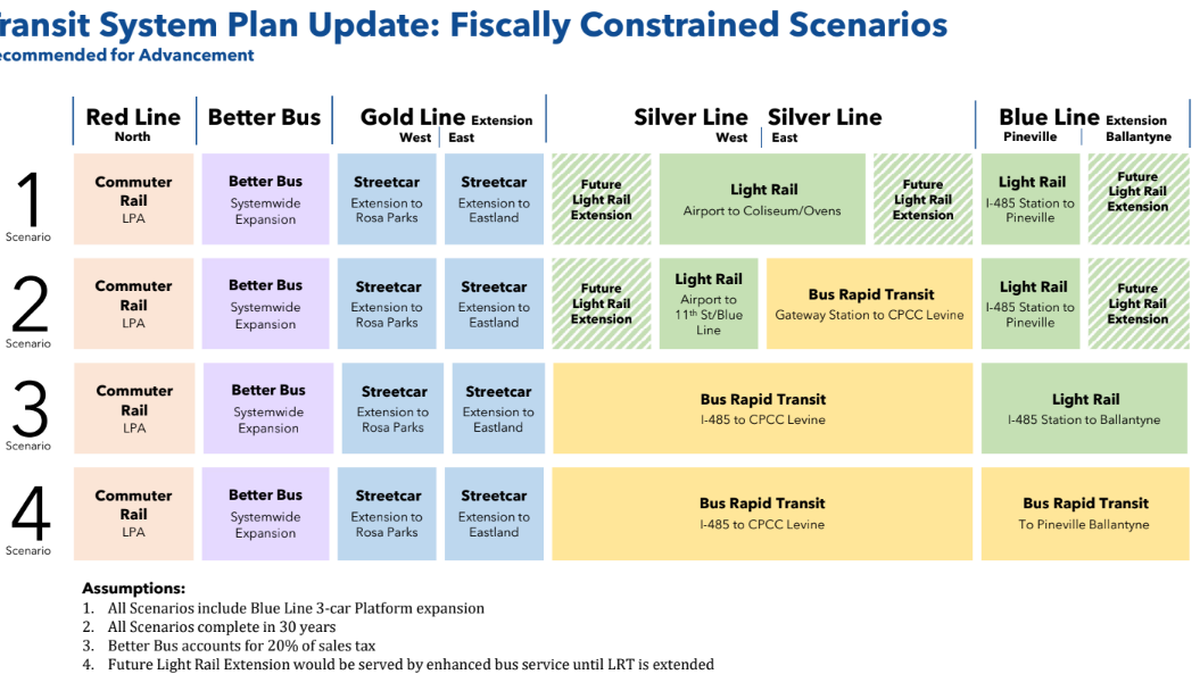
For close to a decade, Charlotte’s transportation dreams have been stuck in a loop.
The city pitches an ambitious, unworkable vision, then scrambles for buy-in. When that fails, they try again — each time with a bigger price tag. The cost has soared from $8 billion to $13.5 billion to $25 billion in the latest estimate, but the plan hasn’t gotten any more realistic.
Now, Charlotte is pressuring the General Assembly to approve a 1-cent sales tax increase via referendum this fall. City leaders are leaning hard on state lawmakers, but the plan’s current odds of passing seem awfully close to zero.
It’s time for a new approach. Republicans should take control of Charlotte’s transit plan, fix it, and take the credit.
This might be painful for the city to swallow, but it’s a compromise that yields the best possible results. Charlotte gets its long-sought transit investment. Republicans get a win. And North Carolina gets a transportation system that actually works.
It’s a Mess. Here’s Why
The divide between Charlotte and Raleigh on transit comes down to priorities. Raleigh sees transit as a way to move people. Charlotte sees it as a tool for real estate development.
That’s why we have the Gold Line streetcar, an expensive, slow-moving system that was never about transit — it was about “economic revitalization.” And it failed at both.
Charlotte didn’t always get this wrong. Back in the early 2000s, then-Mayor Pat McCrory approached transit as a transportation problem. His team identified five major travel corridors and picked the cheapest and most effective option for light rail — South Boulevard, where an existing freight corridor kept costs low.
The Blue Line wasn’t perfect. The budget ballooned, the timeline dragged, and ridership projections were optimistic at best. But at least it was based on moving people.
We all know what happened next. The light rail became the envy of Sunbelt cities and helped launch McCrory to the governorship. It also sparked a building boom that turned a run-down manufacturing district into one of the most desirable places to live and work in the entire city.
Ever since then, Charlotte’s City Council has only seen dollar signs. They started looking at transit as a development strategy first and a transportation solution second. Thus, the Gold Line — and why every single transit map since then has been determined on the neighborhoods it runs through, not what makes the most sense to alleviate traffic and stay under budget.
Yes, Charlotte has taken a few baby steps toward cooperating with the General Assembly. After then-House Speaker Tim Moore said two years ago that the city’s transit plan was “dead on arrival,” the city has updated its proposal to include more road funding. Charlotte’s also agreed to a governing authority to manage all the billions of dollars a 1-cent sales tax increase would generate.
But the chasm between the two sides is still incredibly wide. I spoke with City Councilman Tariq Bokhari while he was driving between a city transit workshop in Asheville and a trip to Raleigh to lobby lawmakers for the bill. His frustration was clear: The City Council still hasn’t gotten the memo.
Charlotte is pretending it has a workable road plan to satisfy the General Assembly, but it’s just a list of projects with no strategy. The transit governance model is even worse — a 27-member board where Charlotte and Mecklenburg County appoint nearly every seat.
Republicans in Raleigh have every reason to reject this outright. But there’s a better option: fix it and turn it into a political win.
The fix
The General Assembly holds all the power here. The Republican caucus should approve a transit referendum — but only on their terms.
First, change the governance model. Charlotte wants full control, meaning a board stacked with political allies. That’s a nonstarter. Instead, the board should include business leaders with actual infrastructure expertise, and key appointments should go to state lawmakers, not just the city and county. Regional buy-in should be mandatory.
This new authority should have the power to revamp and revise the transit plan with a broader, statewide perspective and rigorous analysis.
Finally, put an expiration date on any tax increase. The legislature should include a sunset provision —perhaps a 10-year term with a renewal option. If the city wants funding for the next three decades, it needs to prove it has a plan that will work in the future, not just repeat the mistakes of the past.
Could it work?
The last time the General Assembly tried to take control of a Charlotte asset — the airport — it turned into a legal battle. That fight was messy. This one doesn’t have to be.
Both sides get something out of this deal. Charlotte gets its transit funding. Republicans get a blueprint they can apply to Raleigh and other urban areas, ensuring that conservative governance shapes North Carolina’s cities, not just Democratic wish lists.
And perhaps most importantly: Republicans can prove they’re not just the party of “no” — they’re the party that makes things work.
This story was originally published February 4, 2025 at 6:00 AM.