The Silfab Solar saga is a mess of York County’s own making | Opinion
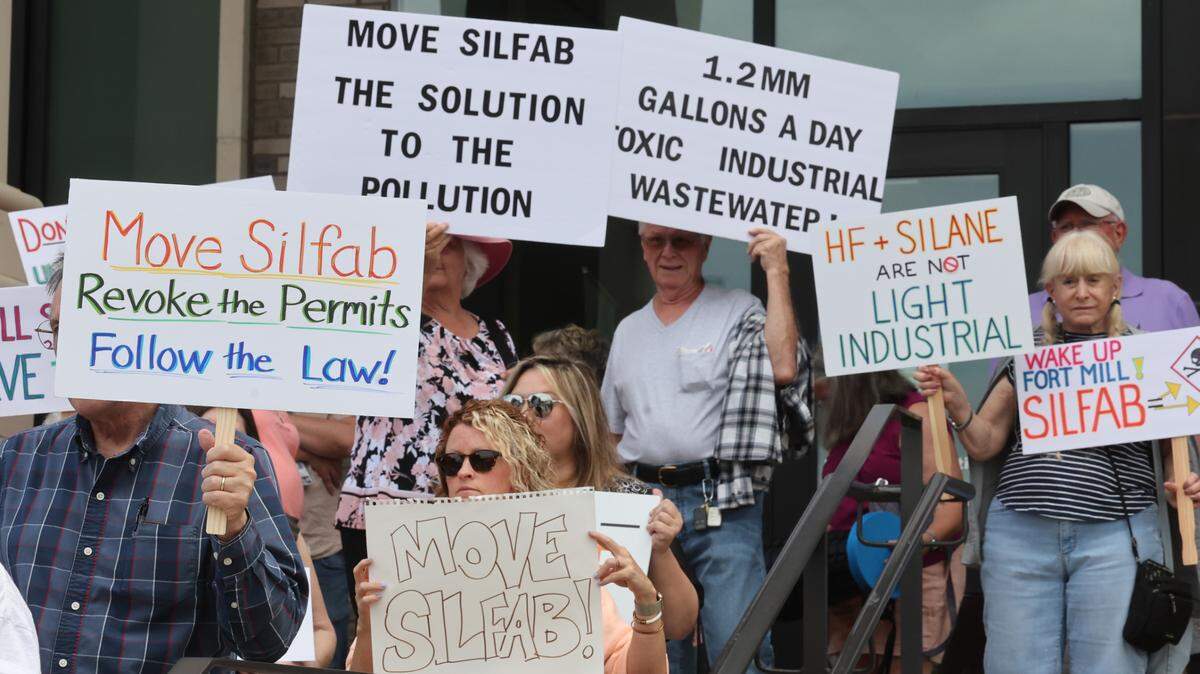
Silfab Solar, a Canadian solar panel manufacturer, kept controversy alive for years after construction was announced. Silfab builds a solar cell production hub in Fort Mill, several hundred feet from two blossoming schools. After two years, the controversy hasn’t died down.
It’s a long saga. There are reports of Fort Mill families leaving because of it. There are protests and lawsuits. All of this distracts from the point: York County appears to be choosing business interests over the safety of residents.
In 2023, county officials said solar cell manufacturing was allowed in areas zoned as ‘light industrial,’ which gave the green light to Silfab to obtain permits and begin construction at the site. They also gave Silfab an incentive package that included a 4% tax rate incentive for 30 years and a $2 million state economic development grant.
But last year, the York County Board of Planning and Zoning Appeals ruled that that solar panel manufacturing did not, in fact, qualify as ‘light industrial,’ but rather heavy industrial. County officials later said the ruling only applied to future construction, and not to Silfab, whose permits had already been approved.
It reads like an admission of guilt without action. Correct zoning is absolutely necessary to prevent the toxic capabilities a plant like this has. Light industrial zones are intended for things like packaging and food processing, which have a minimal impact on the surrounding environment. Something like that right next to a schoolyard wouldn’t be a problem at all.
But solar cell manufacturing is a chemical-heavy process that involves potentially hazardous waste. Silfab’s products are an alternative to thin-film panels, which are less toxic than some competitors. Still, Silfab’s manufacturing uses silane and hydrofluoric acid — both chemicals that are dangerous to humans. Silfab has said they ensure the chemicals are contained, even at the loading zone. But the plant has trucks and suppliers carrying in chemicals that burn skin near a school zone.
Then there are the worst case scenario reports. Under EPA guidelines, a worst case scenario is just one tank exploding. Both the University of South Carolina and Silfab have studies detailing what the worst possible chemical scenario could be. UofSC’s worst possible scenario involves a cloud of anhydrous ammonia that would affect a 2.2-mile radius — running well beyond just the neighboring schools. According to the report, hydrochloric acid could even run into North Carolina.
The Silfab report found the radius to be far closer. Their report was roughly half of the UofSC report’s estimate, figuring a 1.2-mile radius. That radius may be smaller, but it absolutely still reaches the schools. In a Rock Hill Herald article, a Silfab spokesperson said the USC article “reeked with bias.” The spokesman said that the study didn’t take into account the extra tanks that are in the facility. He also mentioned how the trees and the facility would stop the spread of chemicals.
But the most likely accident scenario, the UofSC report found, is a chemical spill in the parking lot when the chemicals are being transferred into the facility. Trees? Are we seeing the same property? They don’t even surround the perimeter.
Andrew Lytle is a Fort Mill resident and member of the Move Silfab Coalition, which has two lawsuits pending against Silfab and the county. Lytle has a background in civil engineering. At first, he was happy about a green energy manufacturer coming to his town. Then he started to question why the county allowed it to happen.
“At this that point, they didn’t want to admit that they weren’t doing their jobs,” Lytle said.
When he started looking, he says, he found that plant to have a worrying impact on the community. He thinks the county is motivated by profit to make dangerous safety exceptions with Silfab.
“It’s an investment for the county. It makes things a lot easier to add to that revenue line,” Lytle said.
The Move Silfab Coalition has two lawsuits pending, including one that is appealing the zoning appeals board’s decision that its ruling would not apply to Silfab retroactively.
The Silfab project is a major one that could bring 800 jobs to the area. But is that really worth risking the health and safety of residents? Some of the chemical concerns can be chalked up to fearmongering, but the larger truth is that none of this should be this complicated. It’s a mess of the county’s own making.