Roy Cooper may have found the winning issue for Democrats in 2026 | Opinion
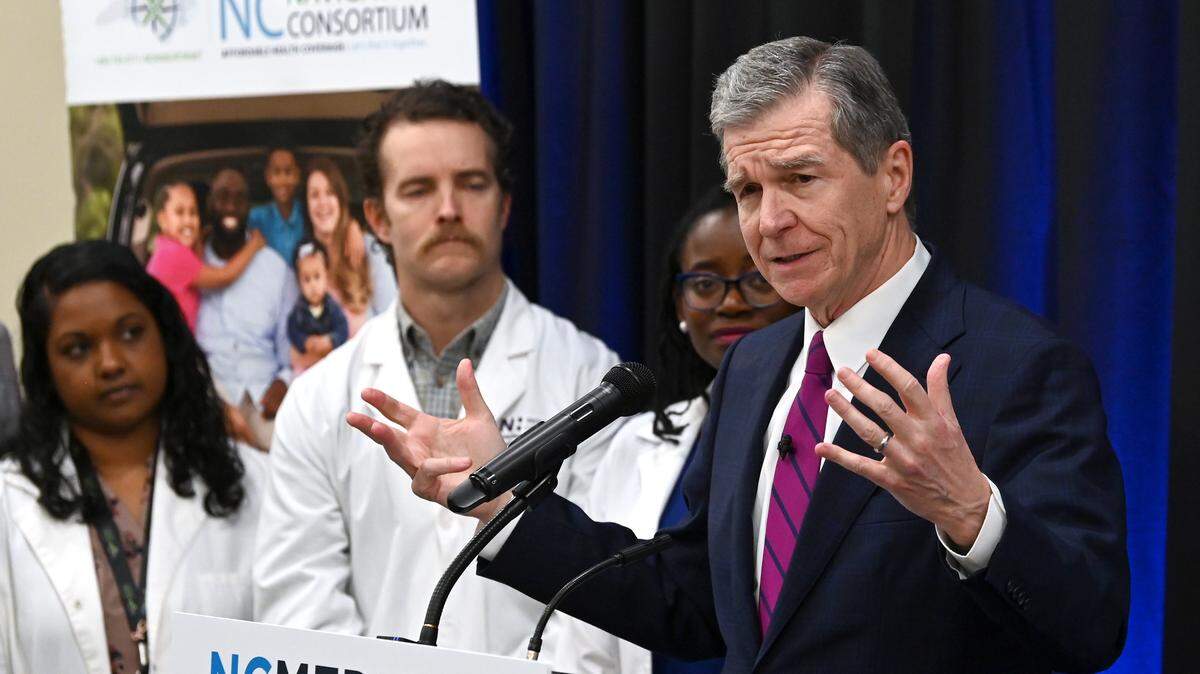
Former Gov. Roy Cooper is officially running for U.S. Senate with a focus on what could very well be a winning issue for Democrats in 2026: health care.
It’s an issue that’s likely to be of top concern for voters in next year’s election — and one that Cooper can be a reliable messenger for. After all, who better to run on the potential death of Medicaid expansion than the governor who cemented it as his legacy?
Cooper has already kicked off his campaign by highlighting Republican efforts to cut Medicaid. He began fundraising off of it before he even officially announced he was running. He mentioned it in a video declaring his candidacy. And in TV appearances shortly after the announcement, he made it clear he thinks it’s exactly what this race should be about.
“We knew we had accomplished something getting health insurance to people who had never had it before. Now, Washington Republicans are going to strip it away,” Cooper said in an appearance on MSNBC Monday. “And I think that is such a contrast in this race.”
His Republican opponent is expected to be Republican National Committee chair Michael Whatley, a staunch Donald Trump ally who will likely struggle to separate himself from the president’s agenda, particularly in an election that will serve as a referendum on Trump and his policies.
Health care is already front and center in this race, in part because of the candidate who is noticeably missing from it. U.S. Sen. Thom Tillis announced he would not run for reelection after voting against Trump’s “Big, Beautiful Bill” — a bill that, by his estimates, could strip health care coverage from hundreds of thousands of North Carolinians who benefit from Medicaid expansion. Tillis said that the bill would be “devastating” to North Carolina, breaking Trump’s promise to not touch Medicaid.
As the Republican candidate, Whatley will have to answer to that bill, which is already shown to be unpopular with the American public. He will have to explain whether he agrees with Tillis or with Trump. He will be asked whether he supports the cuts and whether he will fight to reverse them if elected.
It’s why Gary Pearce, a former journalist and Democratic strategist, thinks that Democrats should be relentless on health care in 2026.
“There’s 600,000 people who won’t be able to see a doctor or go to a hospital. If you can put meat on the bones of that issue, that is a powerful issue,” Pearce said. “And Cooper has a big advantage, because on health care, he’s basically saying what Thom Tillis said.”
He also has the advantage of being a champion for health care access, particularly Medicaid expansion, for much of his political career. Cooper took office in 2017 determined to finally expand Medicaid in North Carolina, but faced strong opposition from Republican leaders who had crafted a law that said Medicaid could not be expanded without the legislature’s approval. But he kept up the pressure throughout his first term and into his second, determined to change the minds of its opponents, until a bill expanding Medicaid was finally signed into law in 2023. Since then, more than 600,000 North Carolinians have gained health care coverage through expansion.
Cooper, who has never lost an election, has good political instincts. Throughout his career, he has found a seam that Democrats struggle with as a progressive who can appeal to conservative voters. It’s helped him win consistently in our purple state, and it’s why he outperformed Trump in 2016 and 2020. Focusing on issues like health care, which resonates with voters across the political spectrum, is in part how he’s achieved that success. National Democrats will be paying close attention to Cooper this year and in 2026.
This wouldn’t be the first time Democrats have focused on health care to win midterms in the Trump era. In 2018, Republican efforts to “repeal and replace” Obamacare backfired on them at the ballot boxes, with exit polls showing that health care was the most important issue to voters. That year, though, North Carolina didn’t have a Senate race on the ballot.
Pearce believes the issue is even more salient now.
“Then, the threat was they were going to repeal Obamacare, which had pluses and minuses, but taking away people’s Medicaid, or veterans’ health care, is a much more powerful issue this time around,” Pearce said. “Should everybody have the right to see a doctor without going broke? That’s a good issue to fight it out on next year.”
Paige Masten is an opinion writer for McClatchy and the Charlotte Observer.