
I walked 14 miles from Uptown to the SC border. Here’s what I learned about Charlotte
A few weeks ago, I shot pool with my friend Nate at the Thirsty Beaver and was a little too jovial about following a story idea. I put my keys on the table in mock desperation, and said that if I lost, I would walk the 14 miles from uptown Charlotte to the South Carolina border.
I’m bad at pool. It’s a 22-minute drive and, as I would later discover, an 8-hour-and-14-minute walk. Nate forgot about the bet, but I didn’t want the loss to just be a joke. I made the journey on a Saturday, without knowing there was a heat advisory in Charlotte that day. It was 100 degrees outside.
My path started along the Charlotte Rail Trail at 12:30 p.m. People with backpacks waited for the train, looking at their phones. Groups of women dressed almost exclusively in pink strolled around Uptown. There was a Mary Kay seminar at the convention center.
South End sidewalks are for the joggers. A man strolled languidly along South Tryon St. as they jogged past. Dawson Brooks moved to South End three months ago. He told me if he jogged, he “would die.” He’s 24, and works as an analyst. Brooks joked how he was practicing “athleisure” that day. I told him I was walking to the South Carolina border. He replied, “Today?”
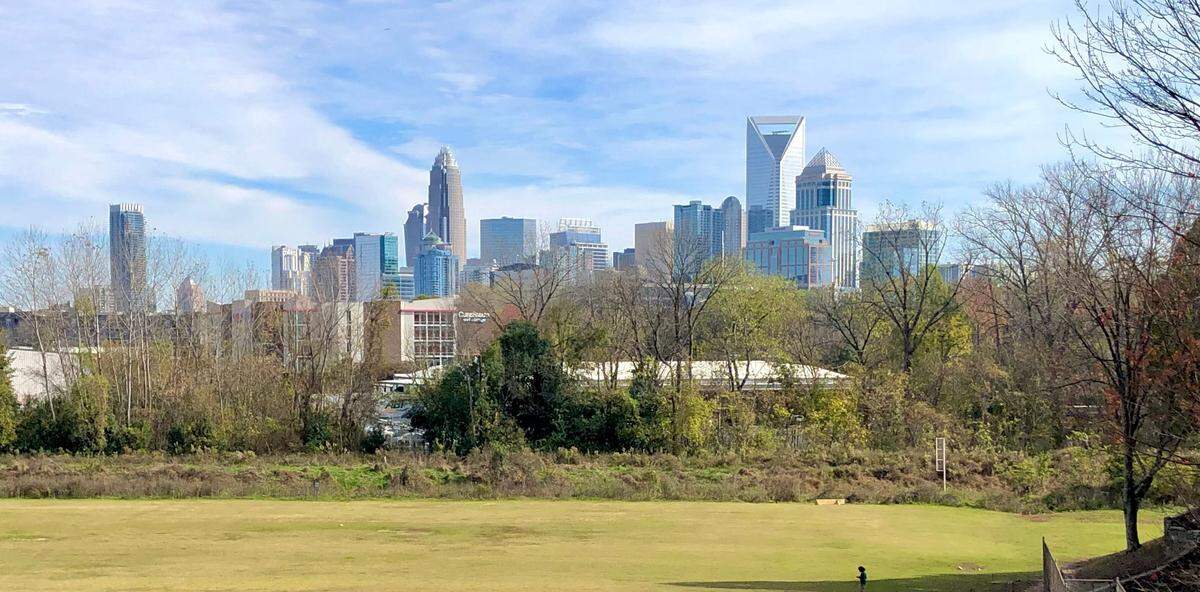
I asked what he thought Charlotte’s identity was. He said Charlotte has a culture of young people who are generally nice to each other. People seemed to enjoy themselves after work, even having full-fledged conversations in random places, he said. Brooks didn’t know if he was going to set down roots here yet. I told him I was worried about having heat stroke and was considering walking later tonight or not doing it at all.
“Yeah, man, well, you could just send it now and die today,” Brooks said.
South End becomes less gentrified when you cross into Lower South End, also known as LoSo. I stopped at a store called The Lamp Place for the air conditioning. I got some fresh air panting in a room full of lamps. I then stopped at a tattoo shop called Black Cloud and struck up a conversation with Monica Hurtsock, a piercer and a Charlotte local. She said that Charlotte could sometimes “just be a picture,” as opposed to a city full of people that care.
“It confuses me when people say, ‘I want to move to Charlotte,’” Hurtsock said. “Why? Do you want to see some buildings you don’t work in?”
At 4 p.m., I made it where Billy Graham Parkway meets I-77. It’s a plateau of highways. You have to snake past 18 wheelers, through a valley of noise and dust. The sun pierced the most from the sky at this point, and it was hotter than anything the Graham family preached about.
It was a popular spot for panhandling. There’s four lanes and a stoplight. I wasn’t able to walk for a while, so I stood there, drenched in sweat. When I made it to the other side of the intersection, Josh Sink walked past me.
“It’s a nice and cold one out here, isn’t it?” Sink said.
He has been working at this spot, asking drivers for money, for a while. I asked him what Charlotte’s identity was, what type of people were here.
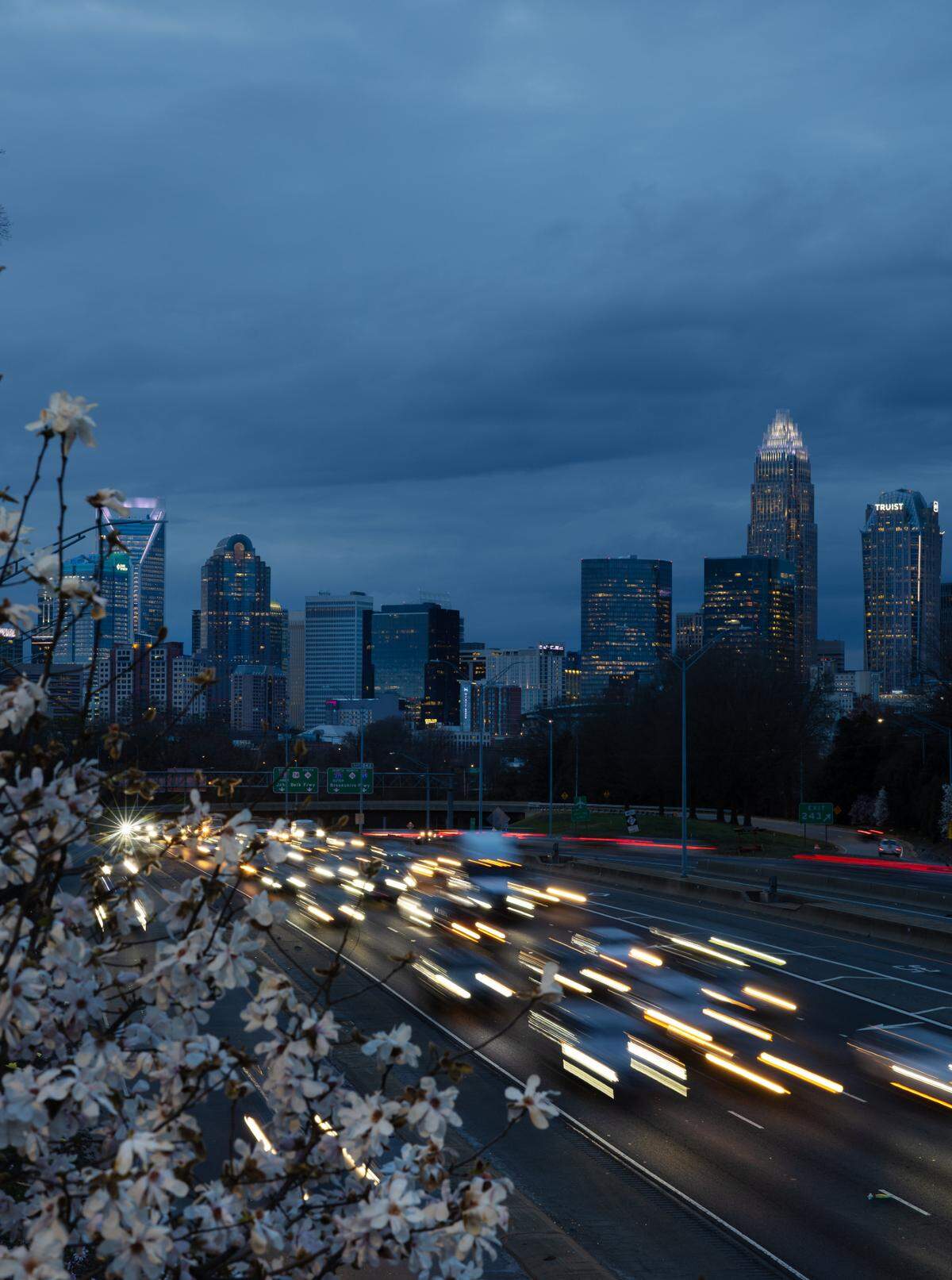
“At the beginning of the month, they have their paychecks, and they are a little happier and have a little more to give. These types of days are a little worse,” Sink said.
Sink is a man of the highway. He said he used to work with crews laying the asphalt down until a roller injured his foot. He was waiting on his disability check and trying to get some extra money for his wife, who had lung disease. He tries to make 80 dollars a day for her.
I told him I was walking to the South Carolina border. He replied, “On purpose?” and asked me if I had enough water to get up the road. I told him I did. There was a faint smile on his face. He didn’t ask for money.
I charged my phone in the lobby of the Courtyard Marriott by the airport. A flight attendant recognized the receptionist — they check in with each other every time the flight attendant passes through Charlotte.
By 7 p.m. I was more than halfway finished with the trek. The further down the road I went, the less expected the sights became.
I met a woman with a thick Cajun accent wearing a Santa hat at a bus stop. When I spoke to her, she advocated for understanding and peace among man. On the same road, a car full of high school students visiting for a basketball tournament parked in a suburb near Olde Whitehall after watching me walk. David Lozzi, a young basketball player from Winston-Salem, confessed that Charlotte is seen as a big city, and that part made his parents nervous about the trip.
Turning left onto Carowinds Blvd., it started getting dark, but I was close to the end. The sidewalk ran out, and I was rattled. I was walking in a ditch, and my mind ran diagonally. Uncut tree limbs ran me into the road at times. I chewed the air stubbornly as I walked.
It was an hour of pure hiking. Past the weaving trees, a gentle light lit up an intersection. Then there were billowing clouds, taller than any building Uptown. On the ground, there was a little Palmetto sign, marking the start of South Carolina. I had made it. My eyes stung with sweat, and I checked my depleted phone. It was 8:17.
I crossed the aluminum shrine with a sweat-caked face. I didn’t do the walk back — I ordered an Uber instead. My driver spoke Spanish. I wanted to explain to him why I looked so strange, sitting there in a soaked T-shirt and a baseball cap.
“Trabajo?” he asked.
“No, yo no trabajo.”
I laughed at myself a little as I sat there. I couldn’t tell him, or the people I met, that I lost that pool game on purpose.
I’ve heard someone say Charlotte feels like a doctor’s waiting room. It’s sanitized and people live with one foot in and one foot out. In 2000, the population of the Charlotte metro area was 768,000. Now, it’s over 2 million. Almost everyone I met along my eight-hour journey came from someplace else. I spoke with just one person who was actually born in Charlotte.
But what I learned is that, no matter where they’re from, most Charlotteans have something in common: everyone here is just trying to grow roots. The analysts in South End, like the man soliciting cars for money on Billy Graham Parkway, are here to be where the people are, to make their fortune, whatever that may be. Who can blame them for that? But it’s also hard to complain about how transient Charlotte is when you are an intern, dead tired, in an Uber.
Alex Nettles, a rising senior at Elon University, was an opinion intern at The Charlotte Observer this summer.
This story was originally published August 4, 2025 at 12:55 PM.