
Leaf season is back. Western NC’s tourism economy isn’t — yet | Opinion
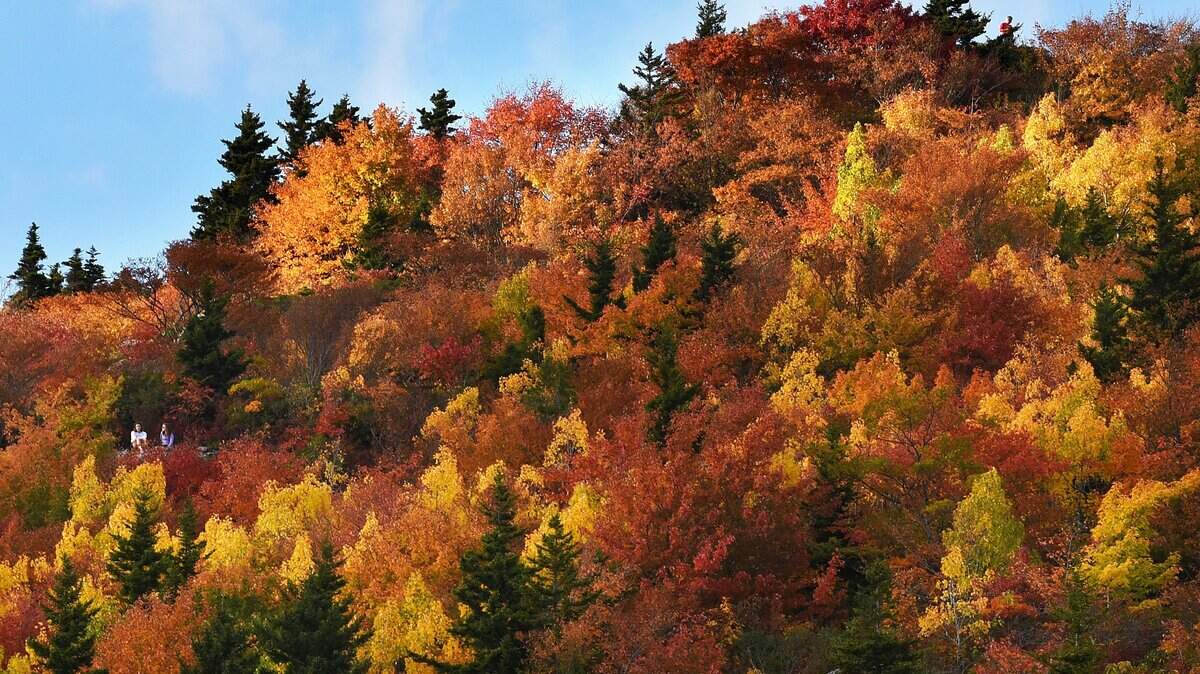
Already, the first reds and golds have started edging the ridgelines in western North Carolina. Soon enough, the maples, beeches, oaks and hickories will be in full splendor.
What we don’t know yet is whether the tourists will return with the same force.
As our state nears the one-year mark since Hurricane Helene, the mountain region is both changed and familiar. Bridges and back roads that were broken are patched and passable, though sometimes down to a single lane. Long stretches of the Blue Ridge Parkway are open again, even as crews keep working on the ugliest slide sites.
No one would pretend there’s nothing left to do, but the region is ready to welcome people back. This year, it’s particularly crucial that they do so.
“The loudest message is that western North Carolina is open and excited to have folks come back to visit us,” Christine Laucher of Mountain BizWorks told me this week. “To see the progress that we’ve made, and to support our small businesses.”

It may sound almost superficial to talk about the “tourist experience” while some families are still mourning and rebuilding, but it isn’t. Lives and livelihoods go hand-in-hand.
We learned during COVID there’s no such thing as a “non-essential” worker, because every job is essential to the person who works it — and to the web of work around it. A full inn keeps the linen truck rolling. A busy café keeps a bakery firing at 4 a.m. A guide’s calendar keeps a gear shop stocked and a mechanic busy.
New figures from Visit NC show roughly $380 million in spending vanished from mountain counties last year in the wake of the storm.
The actual numbers may be even worse. Laucher said a local study calculated about $1.4 billion in combined tourism losses across the region, on top of $3 billion in physical damage to small businesses.
A make-or-break season
Remarkably, most of the industry has weathered a year of uncertainty. But survival is far from guaranteed, and this fall is a make-or-break season. In a Mountain BizWorks survey, 93% of respondents say they’ve reopened, but 86% say they’re still earning below pre-Helene levels.
That strain shows up on Main Street. Just as neighbors helped neighbors dig out from the rubble, the business community rallied to keep the lights on.
In Buncombe County, a business-response work group has met every week since the storm, comparing notes and solving problems before they become closures. That web of quiet collaboration kept many owners afloat. It can’t carry another down autumn by itself. October cash flow is what pays the rent in February.
Do not mistake fresh paint for full recovery.
“It’s easy when you’re walking along a main street and everything looks repaired, to think that everything has fully recovered,” Laucher said. “But the reality is that some of our small businesses are pretty leveraged in their debt load.”
She told me about a beloved café run by an older couple who took on a new 30-year, $250,000 loan just to stay afloat. The payments are coming due.
Shifting rhythm
With peak color weeks away, the booking rhythm has changed. Instead of locking plans months ahead, people are treating trips more spur-of-the-moment. Spontaneity is understandable when detours and trimmed hours still pop up. It also turns staffing and ordering into a weekly gamble for owners trying to keep costs in line.
For those of us in Charlotte or Raleigh, the hesitation is familiar. My favorite place in the world is the Orchard at Altapass, right off the Parkway. I know they made it through the storm. I also know some Parkway segments are still closed or constrained. It would be easy to simply skip a trip this year.
You probably have your own places like that — an inn that remembers your kids’ names, a diner that knows your ridiculous order, a trail you walk to reset your soul.
Don’t guess from old headlines. It’s OK to call and check. Ask what’s open, how to get there, and when to come. Most days, the owner will pick up and talk you through the best route.
What we can do
There’s still a role for the state government while the long-haul rebuild of housing, roads and water systems continues. The General Assembly should consider a limited, forgivable small-business grant program to bridge this season into winter. These could be quick-turn awards administered locally by groups that already know the owners and their books, with clean guardrails.
If we say small business is the backbone of these towns, this is the shortest, smartest way to steady that spine.
Then there’s what the rest of us can do. Plan the trip instead of waiting for perfect certainty. Book the room instead of chasing a marginally cheaper rate tomorrow. Eat where the owner is at the register.
To his credit, Gov. Josh Stein has spent real energy telling that story. I disagree with him on plenty of policy, but on this he’s exactly right: Western North Carolina is open for business, and a fall visit is something concrete you can do to help.
The leaves will be gone in a month or two. The steadiness your visit gives — a fuller schedule, a confirmed order, one more paycheck that clears — can last all winter.
“All of the connective tissue is there,” Laucher told me. “What we need now is folks to come.”
Contributing columnist Andrew Dunn is the publisher of the Longleaf Politics newsletter, which offers thoughtful analysis of North Carolina politics and policy from a conservative perspective. He can be reached at andrew@longleafpol.com.