
As teachers march again, a question nags: Can NC ever catch up? | Opinion
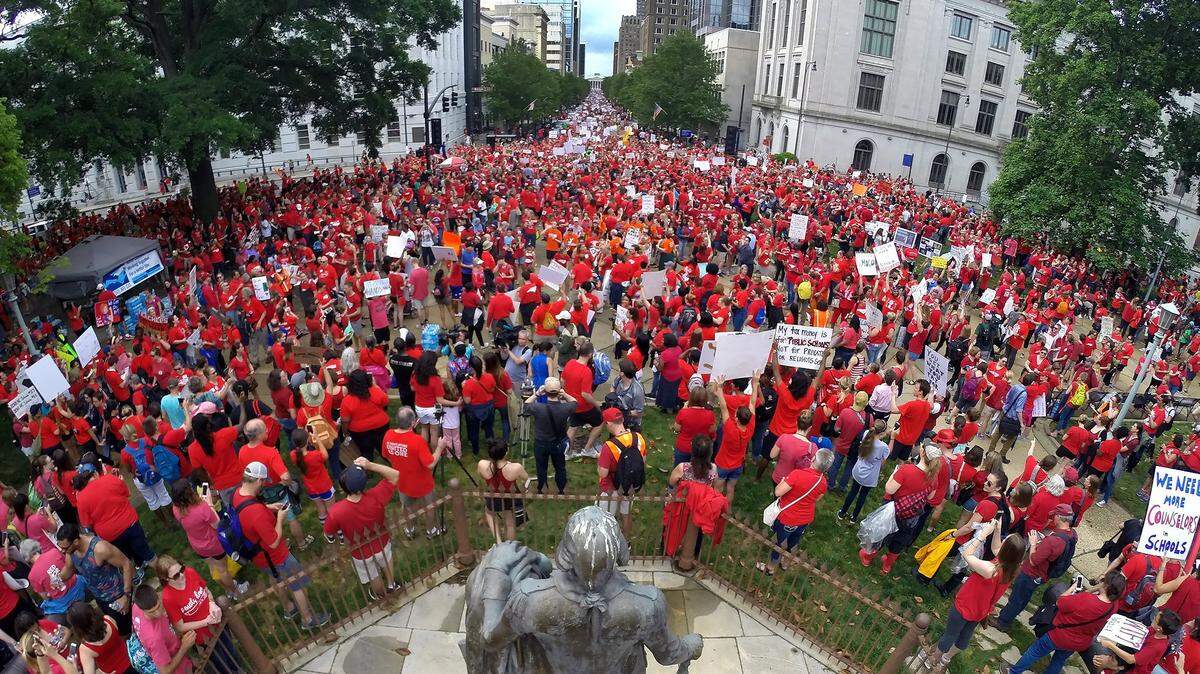
In 2018 when thousands of North Carolina teachers marched to the State Legislative Building to demand better pay and better schools it inspired hope.
When they marched again in 2019 it showed perseverance.
But their march on Friday seems only to express futility.
It’s now an iron rule that under a Republican-led legislature, public schools will not get the support they need. Even the chance to force more funding through the courts disappeared when the Republican-led state Supreme Court dismissed the long-running Leandro case in April.
After 15 years of Republican lawmakers putting tax cuts ahead of funding services, the damage to public education is so extensive that even a Democratic-led legislature would need years to repair it, let alone make improvements.
In the early 2000s, North Carolina’s average teacher salary rose to near the national average, but the Great Recession forced a salary freeze and a plunge in the national rankings. The state’s rank has bounced up and down since, but today it stands at 46th.
The legislature has approved small-percentage pay increases and boosted starting pay, but overall teachers have lost ground.
In 2009-10, North Carolina’s average teacher pay was $48,182, or more than $70,000 when adjusted for inflation. Today, North Carolina’s average teacher pay is $59,971, well behind inflation and $14,000 below the national average..
According to the advocacy group Public Schools First NC, the cost of bringing the state’s 90,481 teachers’ pay up to the national average would be more than $1 billion. That seems an impossible goal to reach, especially with the cuts in the personal income tax, the planned phasing out of the corporate income tax and the huge expense of the state providing vouchers to offset private school tuition.
Eric Davis, chair of the State Board of Education, thinks North Carolina has a lot of ground to make up, and it has to act now.
“I’m not sure if I’d say it’s impossible, but it’s certainly important that we get moving forward sooner rather than later,” he said. “That’s why we have to change our priorities as a state. We have the means. We just have to make that a priority and stay on it year after year.”
But the deficit affecting teachers isn’t only in dollars. There is also a lack of respect.
Republican lawmakers have treated the North Carolina Association of Educators as a political enemy. They cut a source of new teachers by ending the NC Teaching Fellows program in 2015 before restoring a version of it in 2017. GOP lawmakers have accused teachers of imposing liberal ideology and of hiding students’ changes in gender identity from parents. In 2021, then-Lt. Gov. Mark Robinson led a task force that sought tips on teachers indoctrinating students or distributing “inappropriate” materials.
Paltry pay and official disrespect have driven teachers out of the field and discouraged young people from entering it. Now North Carolina is so far behind on public schools that anything short of a massive push will not enable it to catch up.
With an executive order, Gov. Josh Stein established a Blue Ribbon Commission on Public Education. Its 30 members were jointly appointed by the governor, Senate President Pro Tempore Phil Berger, and the House Speaker Destin Hall. The commission could establish a path forward after so much backsliding on public education.
With teachers again on the march, it’s crucial that the commission and other state leaders get moving, too.
Associate opinion editor Ned Barnett can be reached at 919-404-7583, or nbarnett@newsobserver.com
This story was originally published May 1, 2026 at 5:00 AM with the headline "As teachers march again, a question nags: Can NC ever catch up? | Opinion."