What happened to working across the aisle, NC Democrats? | Opinion
The author is chair of the Mecklenburg County Republican Party:
Once upon a time, not long ago, working across the aisle was considered the mark of a good public servant. Voters expected their elected officials to disagree, yes, but also to govern. Compromise was not a betrayal of party, it was a mechanism by which a diverse republic functioned.
In 2026, that expectation has all but vanished.
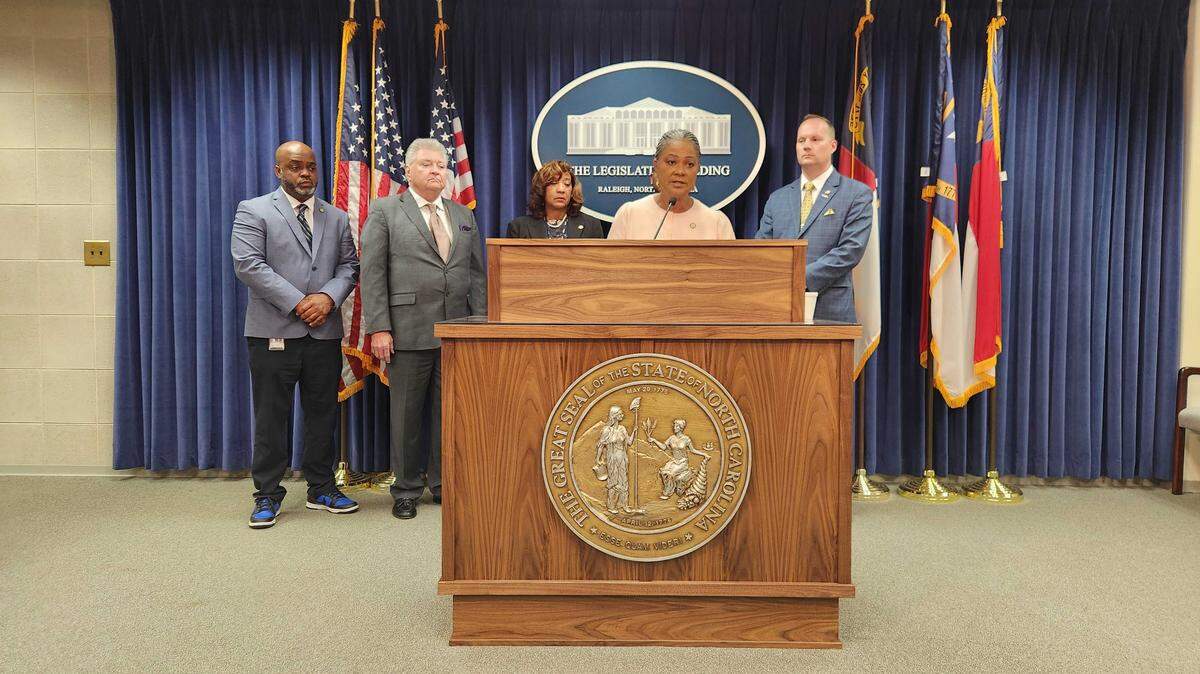
Today, bipartisanship is no longer rewarded, it is punished. Nowhere is that shift more evident than in Mecklenburg County, where two Democratic legislators, Carla Cunningham of House District 106 and Nasif Majeed of House District 99, became cautionary tales for anyone willing to collaborate across party lines.
Instead of being recognized for finding common ground, both were targeted by their own party with primary challenges, a clear warning to toe the party line or face consequences from party leadership, the dreaded planted primary opponent. Punishing bipartisanship in the General Assembly should be a future that all North Carolina voters should reject.
Kyle Kirby, Matthews
Secret sauce for CMS
CMS Board of Education - good move to schedule a Saturday session. The meeting shows concern about how to get the most out of the budget, which will be less due to decreases in enrollment.
The guardrails set as goals for the district are very good and come with challenges. Equity, mental health, and funding deserve to be at the top of the list for continued improvement in our district.
The “secret sauce” for reaching improvement in those areas really is not a secret. Parent and community involvement are essential, even critical, to move forward towards equity, providing mental health specialists in all schools, and achieving a sound budget for 2026-27.
Claude Underwood, Charlotte
Warmer weather and crops
The warming of the earth’s atmosphere is slowly changing the climate our food sources thrive in. More warmer weather? Sounds like it would be positive for agriculture. But it’s the opposite.
Soy, wheat, and corn — staple crops across the US and world — struggle when temperatures stay above 86°F for long. Livestock suffers in prolonged heat above 77°F, and neither crops nor animals show signs of adapting. As agriculture becomes unviable across vast regions, billions face hunger and will move towards places where food remains possible, welcome or not. Extreme heat has already contributed to conflict and refugee crises (remember Syria?).
Fortunately, we can avoid the worst outcomes by changing our CO2-spewing habits and preparing farms, farmers and societies for the disruption already baked into the future. But it will take governments willing to make policy and spend money on clean energy and mitigation. And for the U.S., that means a different administration.
Lynn Dransoff, Charlotte
Plastics
You’ve probably heard about how plastic is destroying our environment and how catastrophic its effects are. Taking action to reduce this problem is more important than simply talking about it. Thankfully, more people are becoming aware of how dangerous plastic is and are developing solutions to help our planet.
Plastic production contributes to greenhouse gases and climate change. Since plastic never fully decomposes, it breaks into microplastic pieces that can harm animals, humans, and plants. Our world is already heavily polluted with waste we cannot fully remove, yet we continue producing tons of plastic every day.
As a community, we must reduce plastic use and improve disposal methods. Recycling, reusing, products, and supporting laws that limit plastic bags can help reduce pollution. If we encourage people to use plastic wisely and reduce daily consumption, we can protect our environment before the consequences become worse.
Clara Oliveira, Charlotte
MLB in NC
As Major League Baseball considers expansion, the focus drifts to Nashville while ignoring the largest unserved baseball market in the United States. The Charlotte–Triad–Triangle corridor, combined with the South Carolina Upstate, forms a 17-million-person region with no MLB team and no dominant allegiance—a true opportunity to build, not shift, a fan base.
This is not a marginal market. It is a fast-growing, economically diverse powerhouse anchored by finance, life sciences, advanced manufacturing, and aviation. The game is already here—USA Baseball, elite college programs, and a deep minor league network. MLB would complete it.
If North Carolina is passed over, it won’t be due to lack of scale or strength. It will be because we failed to say what should be obvious.
We are ready. Now we need to act like it.
Mike Ciriello, Durham
Lowering the bar on teachers
North Carolina will not solve its teacher shortage by lowering the bar and calling it a solution.
Alternative pathways have a role, but they cannot replace fully prepared, licensed, and fairly paid educators. State data shows that in 2024–25, nearly one-third of new hires entered through residency routes, while just 27.23% came through traditional preparation. Schools also relied on 4,397 residency-licensed teachers, 4,205 temporary-licensed teachers, and 2,954 international teachers. Attrition rates were higher for these groups: 14.7% for residency, 24.14% for temporary, and 11.3% for international teachers.
That pattern is clear. Short-term staffing fixes are not a long-term solution. Relying on emergency licenses and international recruitment may fill vacancies, but it does not build a stable, experienced workforce.
The real solution is investing in the profession: competitive pay, strong preparation programs, and meaningful support for teachers so they choose to stay.
Patrick Doiel, Charlotte