
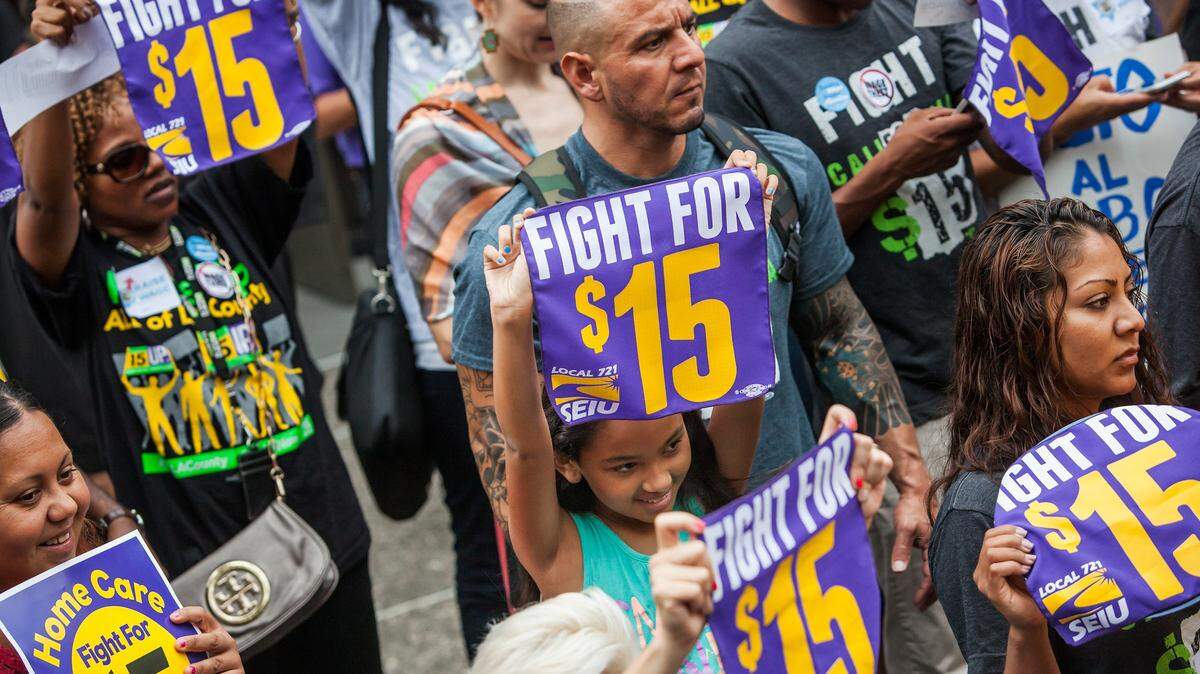
If a $15 minimum wage is good for state workers, it's good for everyone
From an editorial in the Winston-Salem Journal Sunday:
Many employees across state government will get a nice boost to their paychecks beginning this week, as the state budget kicks into a new fiscal year. Their hourly wage will be elevated to $15, with the N.C. Highway Patrol getting a little more.
Estimates are that this wage change will affect some 8,000 employees, or about 12 percent of the state’s workforce. North Carolina is the first state to reach $15 an hour.
Adjusting the pay scale for government employees to a livable wage is an appropriate and noble act. But why have legislators consistently opposed this for the workforce in general? What’s good for the goose isn’t good for the gander?
North Carolina matches the federal minimum of $7.25 an hour, one of 17 states at that level. According to the U.S. Bureau of Labor Statistics there were, as of Jan. 1, about 52,000 North Carolinians who made less than that, largely because of the scale allowed for restaurant servers who earn tips.
And apparently that’s the way legislators believe the system should remain — that free-market decisions should manifest the wage structure.
“The state of North Carolina is the employer, and we are voluntarily raising the salaries,” state Sen. Joyce Krawiec, R-Forsyth, told the Journal’s Richard Craver. “Private employers have the option of doing the same.”
So now the legislature has passed a law that will allow the state to have a favorable position in competing for employees in a very tight labor market. There are statutes that prevent the state from competing with private industry.
“I would just say that what we are trying to do is manage the resources of the state of North Carolina in a prudent manner," Senate President Pro Tem Phil Berger told WRAL last month. "Sometimes what that means is you need to pay your people more. Sometimes it just makes sense.”
We agree. Raising the minimum wage makes sense for all workers in North Carolina.
Legislative secrecy
From an editorial in the The Fayetteville Observer on Tuesday:
This year, at least, the General Assembly’s short session lived up to its name. Lawmakers convened on May 16 and went home on June 29 – just six weeks and two days in session. That shouldn’t be difficult if lawmakers stick to the original purpose of the short session: To make corrections in the state budget passed the previous year and to address any urgent business that may have arisen and can’t wait until next year’s long session.
But legislators were far more productive than that. They passed a slew of legislation and also came up with six proposed amendments to the state constitution that will appear on the November ballot.
How was this remarkable productivity possible? Simple. Legislative leaders used their signature technique: Develop the proposals in secret, allow little or no debate, then railroad them into law with the power of Republicans’ veto-proof majority.
The disturbing lack of transparency means we won’t know the impact of some of this legislation for months to come. In fact, legislative leaders tentatively scheduled a late November session so they can figure out how they'll implement any of the six constitutional amendments that pass.
There’s not a single one of the six that couldn’t be accomplished just as well – or better – by simple statute. Enshrining those items in the constitution takes away the flexibility that a government needs in order to keep up with changing times.
Not real protection
From an editorial in the Wilson Times on Wednesday:
State fishing license requirements are suspended today in honor of the Fourth of July. If voters pass a constitutional amendment establishing the right to hunt and fish, could anglers enjoy the same freedom 365 days a year?
In short, probably not.
The text of Senate Bill 677, which places an amendment to the North Carolina Constitution on ballots this November, starts out with a ringing endorsement of individual liberty.
"The right of the people to hunt, fish and harvest wildlife is a valued part of the State's heritage and shall be forever preserved for the public good," the proposed amendment states. "The people have a right, including the right to use traditional methods, to hunt, fish and harvest wildlife..."
So far, so good. But the amendment continues:
"...subject only to laws enacted by the General Assembly and rules adopted pursuant to authority granted by the General Assembly to (i) promote wildlife conservation and management and (ii) preserve the future of hunting and fishing."
Tar Heels, then, would have the right to hunt and fish — as long as the General Assembly and N.C. Wildlife Resources Commission say it's OK.
We've noted Fishing Freedom Day's sad irony in the past. The one-day reprieve from licensure requirements is meant as a symbolic nod to American freedom, but it only serves to remind us how regulated, subjugated and micromanaged we are the other 364 days of the year.
This story was originally published July 5, 2018 at 12:59 PM.