
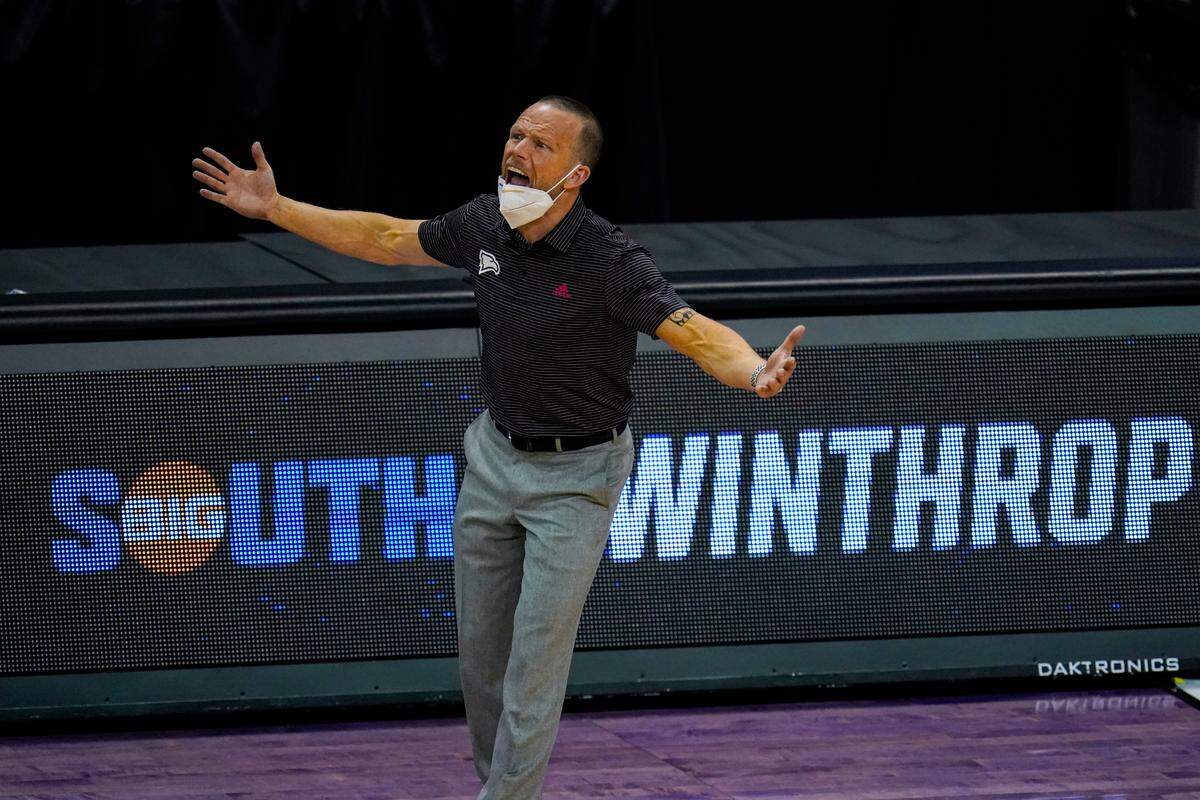
Pat Kelsey is gone. Understanding the Winthrop job and who the next coach needs to be
Year after year, offseason after offseason, Winthrop athletic director Ken Halpin heard a similar refrain: Pat Kelsey is leaving. He’s not staying in Rock Hill another year.
“I’ve been told that every year,” Halpin told The Herald on Thursday night. “I’ve absolutely been told that every year. And it lasted five seasons. He had four before me and five after. And, you know, that’s always been there.”
In the span of a few hours Thursday, that line — Pat Kelsey is leaving — proved true and obsolete all at once.
After nine seasons at Winthrop, Kelsey is the new head coach of the College of Charleston. He takes with him to the Lowcountry 186 wins, three NCAA tournament bids and an energy that, according to his late and adored mentor, Skip Prosser, “makes coffee nervous.”
In his wake, Kelsey leaves behind a series of unanswered questions. Among them: What kind of situation will Winthrop’s new coach be stepping into? And who does Winthrop’s next basketball coach need to be?
Here’s a close look at the state of Winthrop basketball — present, past and future — now that its familiar and fiery coach is gone.
Winthrop’s present: A transfer portal dilemma
With Kelsey’s exit, Winthrop is at risk of losing some key pieces to the transfer portal.
Why? For one, the transfer portal is reconstructing programs across the country, even the so-considered “stable” schools that have been led by the same, successful coaches for decades. This is in part because players are emboldened by their extra year of athletic eligibility. It’s also because of the increased likelihood that these players will be able to play at their next destination without having to sit out a year.
As of Thursday night, 894 names were listed in the NCAA Division I basketball transfer portal, according to Verbal Commits. That’s about double the number of names that were listed in the portal in March 2020.
Winthrop has plenty of desirable players. The Eagles, who went 23-2 this past season and earned a 12 seed in the NCAA tournament, were far and away the best team in the Big South Conference. They were more talented than their peers with their Big South Player of the Year, Chandler Vaudrin, their University of Tennessee transfer, DJ Burns, and their nine other players averaging more than 10 minutes of playing time a game.
That excess of talent, now no longer bound by the head coach that recruited them, furnishes a challenge for Kelsey’s successor.
Early signs indicate that a transfer problem may come to fruition: Winthrop reserve guard Adonis Arms — who two years ago transferred to Winthrop from Division II Northwest Nazarene University in Milwaukee, and was among the Eagles’ most talented offensive players this year — reportedly entered the transfer portal Thursday night after Kelsey was announced as C of C coach.
In addition to Arms, on Friday, Winthrop sharpshooter Josh Corbin also entered the transfer portal. And Vaudrin reportedly told ESPN that he was declaring for the NBA draft.
There could be other departures, too: What about Burns, the Rock Hill native who said he came back home to play in part because he thought those Winthrop coaches could help deliver him his NBA dreams? Or Toneari Lane, the three-star prospect who chose Winthrop over Butler and spent most of 2020-21 in a walking boot, but will expect some shine in his sophomore season?
Winthrop’s past: Kelsey’s successor could learn from him
Kelsey’s departure could launch a head coaching career. Given Winthrop’s hiring history, it probably will.
Since becoming a Division I program, all but one of Winthrop men’s basketball coaches have been first-time D1 head coaches. That includes Steve Vacendack, who became Winthrop’s coach after serving as Duke’s associate athletics director (1986-1992); Dan Kenney (1992-98); Gregg Marshall, who’d go down as the winningest coach in Winthrop history and third-most in Big South history (1998-2007); and Pat Kelsey (2012-21).
Randy Peele (2008-12) coached at UNC-Greensboro for four years prior to Winthrop. He was fired from the Rock Hill school after compiling three losing records in five seasons.
Bringing in someone new to the head coaching role can clearly have its advantages. But there are a few things Kelsey did that his successor might want to replicate:
▪ Kelsey was Winthrop’s national advocate. This was Kelsey’s ultimate balancing act. The Cincinnati native often found himself having to be both the program’s biggest proponent — vying for Top 25 attention in the loud, crowded, national conversation — while also not allowing his team to grow complacent.
This is an important role at a place like Winthrop, which has a notable basketball history but is still in a one-bid Big South Conference, where attention arrives with caution.
▪ Kelsey was Winthrop’s salesman. Kelsey — inspired by his car salesman father and by his coaching mentor Prosser (who Kelsey once called “the best marketer in the history of college basketball”) — was the ultimate salesman. In his farewell statement to the city of Rock Hill and Winthrop he released via Twitter on Thursday night, Kelsey said, “You tolerated my goofy antics when promoting games, including distracting your lunch at Thompson or DIGS with an impromptu pep rally. I worked hard to do my part and earn my keep. I wasn’t perfect but I gave you every ounce of what I had.”
This, too, is vital at Winthrop, where filling the 6,100-capacity Winthrop Coliseum to half-full requires considerable work — much more work than merely fielding a fun-to-watch team and winning games. It’s so vital that it was part of Kelsey’s contract that was updated Dec. 2020: Kelsey could earn a $1 bonus for each men’s basketball game ticket sold above 11,151 tickets for the season. (For reference, in a normal 15-home-games-a-year season, that 11,151 “baseline” averages to just over 743 tickets a game.)
▪ Kelsey was a resourceful recruiter. Kelsey wasn’t afraid of recruiting small guards — note 5-foot-7 Keon Johnson, who graduated as the leading scorer in Winthrop history — nor did he shy away from recruiting positionless big men and Division II transfers.
Most coaches say they know that recruiting at the margins is important. Kelsey and his staff actually did it.
Winthrop’s future: A few candidates worth discussing for Winthrop job
This is Halpin’s first men’s basketball coaching hire as Winthrop’s athletic director, and he told The Herald on Thursday that he’s “never going to speak about how we manage our process.”
But given the history of Winthrop’s hires and the situation that Winthrop’s next coach will be inheriting, here are a few candidates who might be worth discussing.
▪ Mark Prosser: Prosser wouldn’t be a new head coach, but his ties to Winthrop and Kelsey are strong. He’s the coach at Western Carolina, hired in 2018, and was a former associate head coach at Winthrop under Kelsey. He’s also the son of the aforementioned Skip Prosser, who Kelsey coached under and played for and considered a mentor. Bringing Prosser back to Rock Hill might prove to be a difficult task, though: He appears to be turning the WCU program around — the team went 19-12 in 2019-20, its first winning season since 2013-14 — and the SoCon is widely considered a more formidable mid-major conference than the Big South.
▪ BJ McKie: McKie appears to check a lot of boxes: The Wake Forest assistant began his coaching career at Charleston Southern in 2011 — and thus knows the Big South landscape — and has coached under Steve Forbes (one of the best mid-major coaches this decade) for three years. He’s also one of the most decorated players in University of South Carolina basketball history, and hiring him could compel positive statewide attention to Winthrop.
▪ Marty McGillan: McGillan, now an assistant at Longwood, has an assistant coaching record that has spanned 30 years and has witnessed seven conference championships and eight NCAA tournaments. He was also once an assistant at Winthrop in two separate stints — 2007-11 and 2012-17.
▪ Someone on Kelsey’s staff at Winthrop: Kelsey, who never was one to shy away from hyperbole, regularly said his assistants made up the “best coaching staff in the country.” They appeared to work well together, too, so there’s a chance that Kelsey arrives in Charleston with his full coaching staff from Winthrop intact. But if Halpin wants to keep the program in familiar hands, he has a wealth of people to choose from — whether that be Dave Davis (former head coach at Newberry and Pfeiffer Hall of Famer), Justin Gray (former Wake Forest star), Brian Kloman (team’s “defensive coordinator”), Zack Freesman (Director of Basketball Operations) or another assistant.
Clarification: All but one of Winthrop men’s basketball coaches in its D1 history have been first-time D1 head coaches. This article has been updated to clarify this point.
This story was originally published March 26, 2021 at 10:27 AM.
.jpeg)