An NC teen and her boats are set to make Olympic history, with some help from her dad
Evy Leibfarth hasn’t settled on where she wants to put it yet, but she has decided this:
“I want to get a cherry blossom tattoo,” she says, and seeing as that’s the unofficial national flower of Japan, this makes sense.
There are just a couple of pieces of business she needs to take care of before getting inked, though.
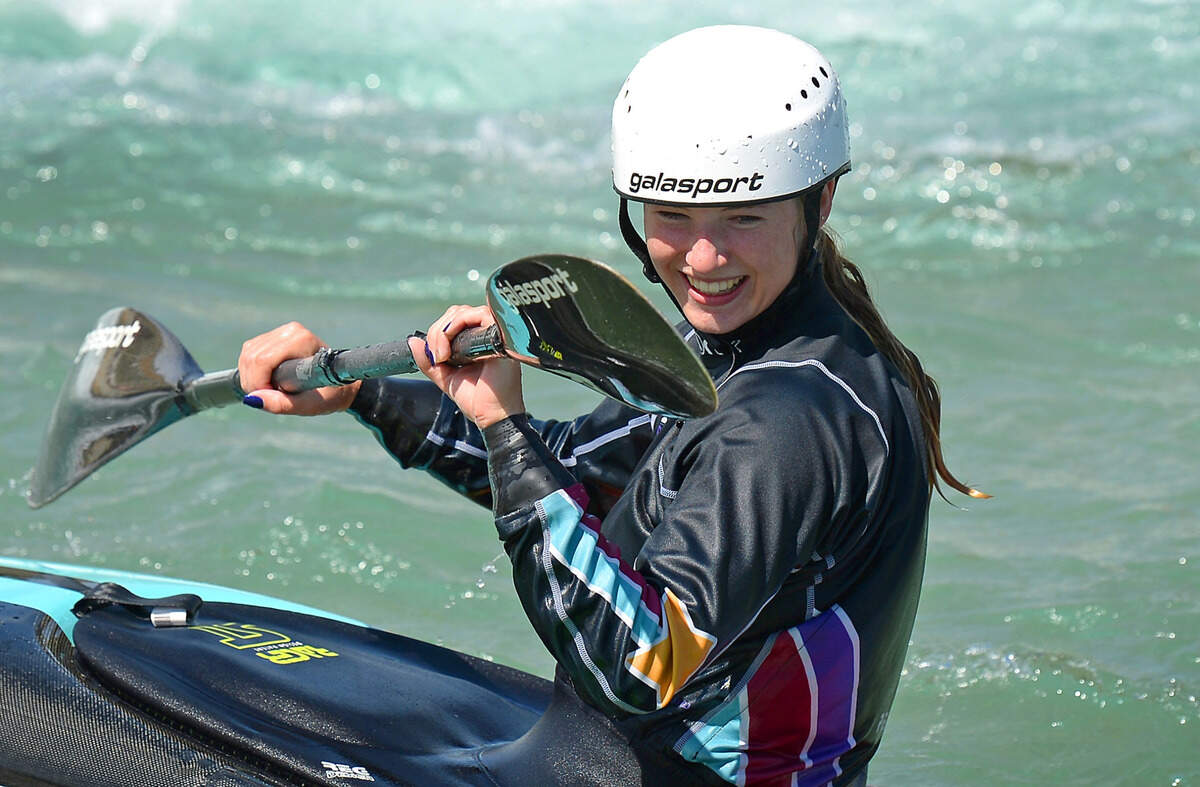
First, she’ll need to fulfill her childhood dream of competing in the Summer Games this July in Tokyo, where the stars have aligned for the Bryson City native to make history as the first American woman to race in a canoe at the Olympics after punching her ticket in Charlotte last month.
Then she’ll need to wait another six months. Because she won’t be old enough to legally get that cherry blossom tattoo to commemorate her experience till her next birthday.
Leibfarth — whose family has been living since March in an Airbnb near Mountain Island Lake to be close to the training facility at the U.S. National Whitewater Center — turned 17 in January, and this summer will double-dip as a history maker by becoming the youngest athlete ever to represent the U.S. in canoe slalom at the Games. The sport of canoe slalom encompasses medal events in both kayaks and canoes.
Still, as many (if not most) Tokyo 2020 athletes would probably tell you, these Olympics are shaping up to be somewhat bittersweet due to COVID.
It’s possible that Japanese spectators will be allowed into venues. It’s also possible that fans will be barred from the stands completely. And either way, it’s definite that international fans are a no-go.
“Through all this, I kind of had the feeling that I wouldn’t be allowed to go, so when they announced it in March ... it wasn’t like a shocker to me,” says Evy’s mom, Jean Folger, of the decision to prohibit overseas spectators from entering Japan for the Olympic Games.
“I’m sad,” Folger continues. But she knows there’s a silver lining, too. A significant one.
Lee Leibfarth — who is Folger’s husband and Evy’s dad, and who once dreamed of paddling a boat of his own in the Olympics — will get to go with Evy to Japan.
How? The answer is simple: He’s her coach.
There’s whitewater in her blood
It’s not a surprise that Evy Leibfarth (her first name rhymes with “heavy,” by the way) ended up on the water.
Lee Leibfarth and Jean Folger met, in fact, at a party near Bryson City back in the ’90s, when he was working as a raft guide on the Chattooga River for Nantahala Outdoor Center and she was working as a raft guide on the Ocoee River for Wildwater. They also both were kayak instructors.
The biggest difference between them was that Lee had a competitive fire burning within him.
He spent the better part of the ’90s racing competitively in K1 (shorthand for a kayak built for a single individual) and continued racing into the next decade, including at the Olympic team trials in South Bend, Ind., in April 2004, when Evy was just an infant. He also served time before Evy was born as a coach for the U.S. junior national slalom team.
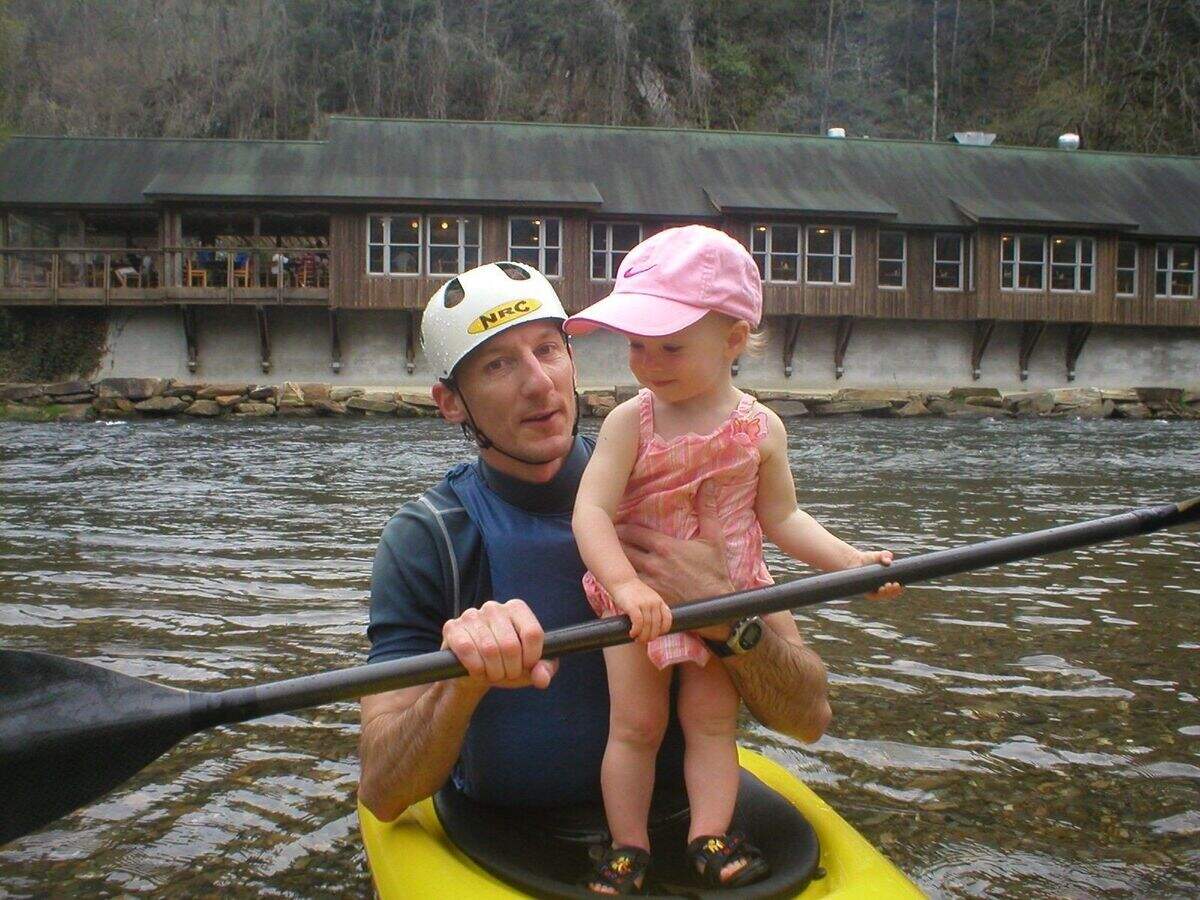
Given all of this, it’s also no surprise to learn that Lee first started taking Evy out in a kayak when she was just a toddler, with her in his lap and a smile plastered on her face. Neither is it a surprise to learn that by the time she was 6 or 7 years old she already had her own kayak — a pink one, so small it fit in the front seat of the family car — or that shortly thereafter she won her age group in the very first race she paddled it in, at the Whitewater Center.
What is surprising is that her first Olympic dreams encompassed two entirely different sports.
The gym vs. the river
While she was beginning to show promise in a kayak, she also could often be found practicing back handsprings and handstands at New Vision Training Center in Franklin.
She remembers the first time it really hit her that paddling provided a path to the Olympics at age 8, when the Nantahala Outdoor Center hosted an “Olympic Day” in June 2012 in the run-up to the London Games; during the event, Olympians shared their experiences, signed autographs and answered questions.
She also remembers watching Team USA’s “Fierce Five” gymnasts roll to a team gold medal in London a month and a half later, and ”I completely dreamed of going to the Olympics in gymnastics,” Evy says. “Gabby Douglas was my big hero.”
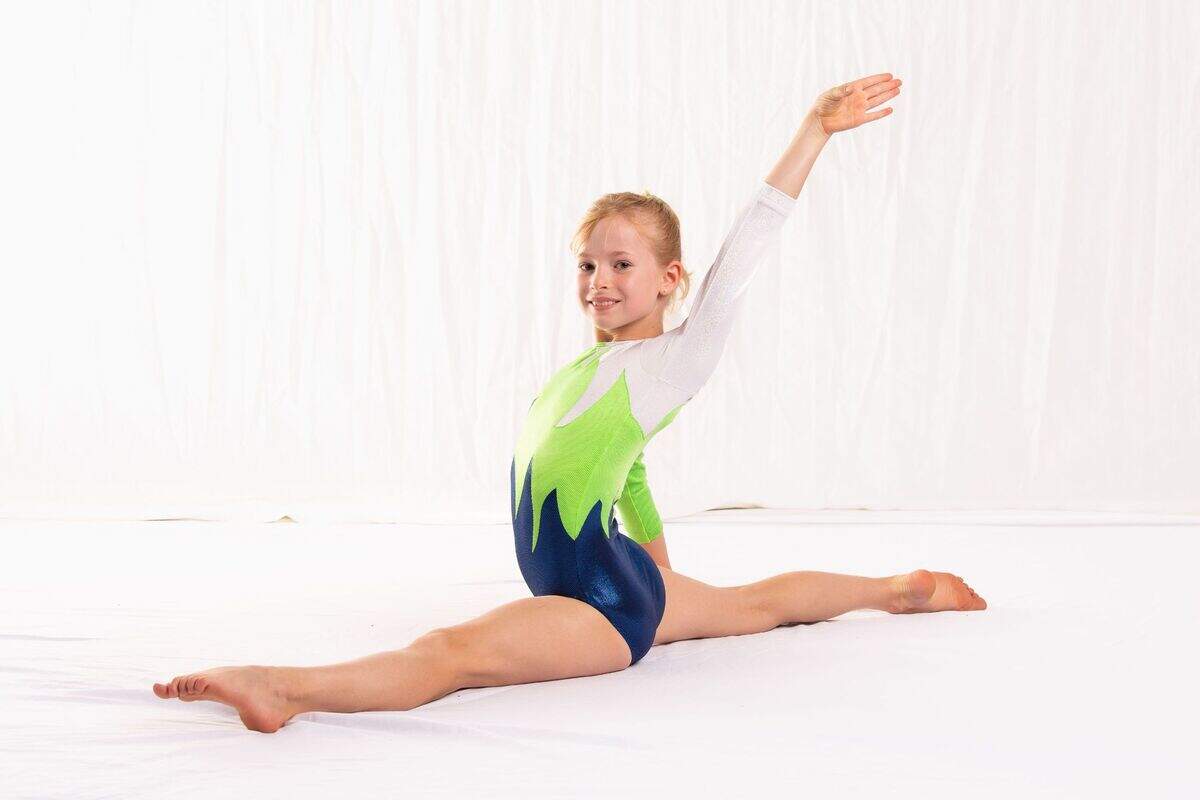
But over the next three years, gymnastics gradually became more of a social outlet for Evy, while at the same time she began dominating practically every kayak race she entered, with her father having started to formally coach her.
At age 11, she decided to hang up her leotard for good to focus on paddling.
Not long after her 12th birthday, she became the youngest athlete, female or male, to enter the U.S. team trials, and finished sixth in the women’s K1 event. That summer, she traveled to Europe, where she swept all five races against some of the best girls under 14 in the world at European Canoe Association Junior World Cup Series in Slovenia, Austria and Germany.
By the time she was 14, Evy was the No. 1-ranked female paddler in the country. Not just the best among girls her age, but the best among all women.
Finding her way to Tokyo
As it turns out, it’s not that easy to secure a spot in the Olympics as a slalom canoeist.
The system used to determine which countries can send athletes for this event involves an arcane methodology and convoluted processes that would take too long to explain here.
But basically, there are two types of boats that can get you there: K1, aka single kayak, and C1, which is shorthand for a canoe built for a single individual. Both K1 and C1 races see paddlers negotiating a series of up- and downstream gates and generally last less than two minutes. The most distinct difference between K1 and C1 is that K1 uses kayaks made for sitting and powered by a paddle with a double blade, while C1 uses canoes designed for kneeling and steered using a paddle with one blade.
Evy does both K1 and C1.
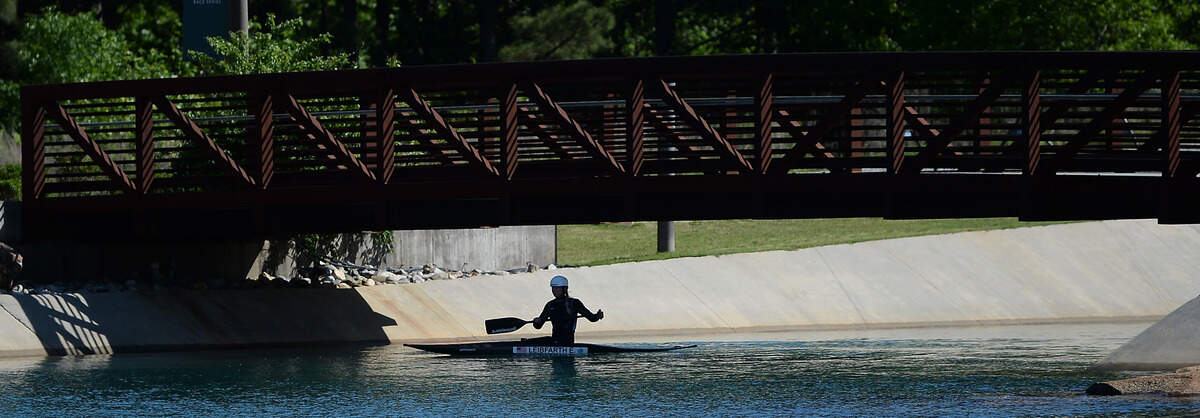
When it comes to Olympic slalom canoe, not every country gets to send athletes. The U.S. had to earn its way into Tokyo 2020, and it did so thanks to Evy’s performance at the International Canoe Federation Slalom Canoe World Championships in La Seu d’Urgell, Spain, in September 2019. She was the youngest athlete ever — and first American woman — to qualify the U.S. for a spot in slalom canoe at an Olympics.
She still, however, needed to punch her ticket as an individual, at the U.S. Olympic team trials.
Originally, those were set for spring 2020 in Oklahoma City. Evy was a heavy favorite on the women’s side. Then COVID hit, and the dominoes quickly started falling.
“I think everyone saw a postponement coming,” Evy says. “It wasn’t unexpected. But, I mean, 2020 is the year that I’d been planning on for eight years. Since 2012. And when it feels like you’ve spent so much of your life preparing for a certain year, and then that happens, I had a lot of emotions. I definitely did kind of feel robbed. I was 16. It was supposed to be like the best summer of my life.”
Sad tears first, then happy ones
“There was a day of tears,” adds her father, Lee.
He and his wife helped to put things in perspective for her, though.
“It’s hard on everybody,” her mom, Jean Folger, told her. “Every single athlete is struggling through this. You have to keep in mind that there are lots of families who are struggling worse, and for far sadder reasons.”
And ultimately, it all worked out for the better.
For one, Lee says, “when Evy started her competitive career at age 15, and was racing in 2019, some of the other athletes were physically stronger than she was. ... So (during COVID) we got a bunch of weight equipment and built a home gym. We were able to do more aerobic training, we were able to focus on more technique. So as much as possible, I was trying to frame it as a really good opportunity for Evy to have an extra year of preparation for the Games that she wouldn’t have normally had.”
On top of that, it was announced that the trials would be moving to the U.S. National Whitewater Center, giving Evy a bit of a home-field advantage.
Finally, last month — a year later than planned but also a year stronger and more seasoned — Evy took one of the final steps toward realizing her Olympic dreams when she crossed the finish line as the top overall woman in K1 at the trials in Charlotte.
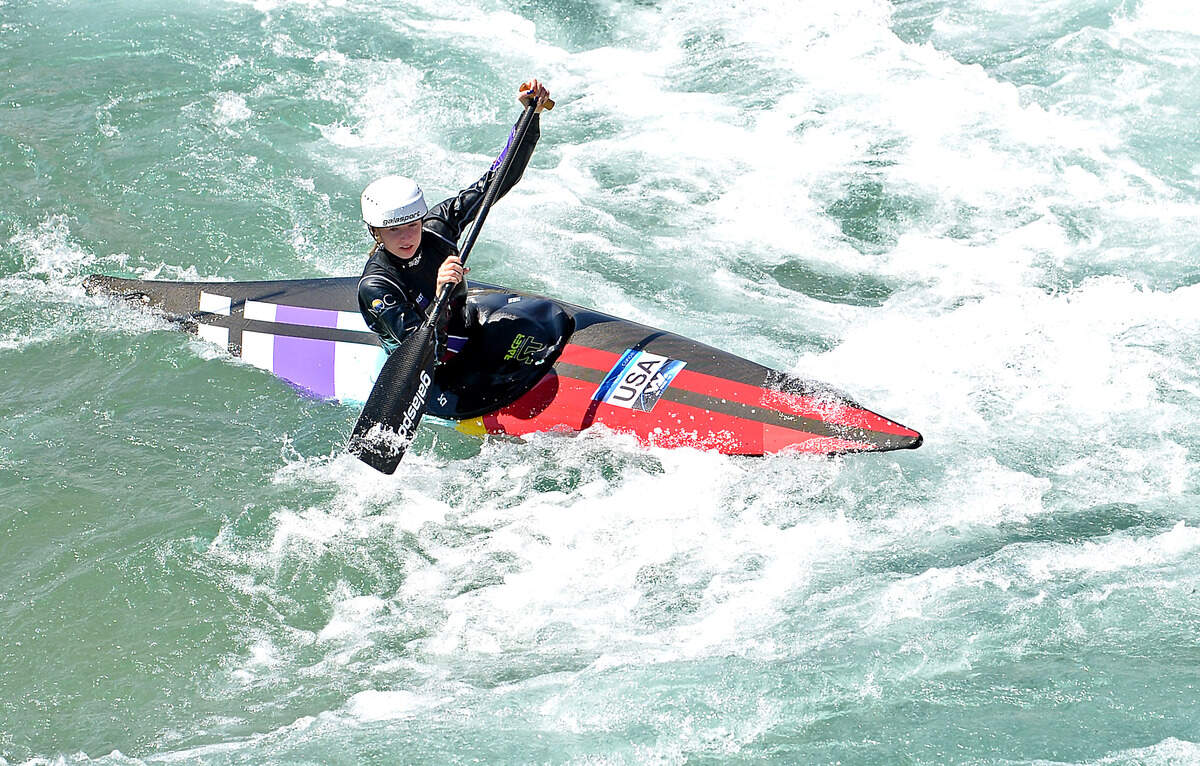
“I just started crying,” Evy says. “And I remember I paddled down around a little bit to where my dad was standing.”
“There was a moment of panic there,” Lee says, “because usually when Evy has a good run she’ll come across and it’ll be on her face and she’ll be pretty hyped. And she came across and she was completely in tears.
“I was like, ‘Oh my gosh, did you get hurt? What happened?’ She’s like, ‘No, I’m just happy!’”
‘So crazy that it’s actually happening’
It’s a beautiful late-April morning and Evy is standing at the edge of the parking lot at the U.S. National Whitewater Center, on top of a hill overlooking the world’s largest man-made, recirculating whitewater river. A few minutes earlier, she was on that river, doing a workout that saw her switching between her kayak and her canoe and running the course alongside athletes she used to idolize.
She’s beaming brightly, and she’s wearing a snow-white Team USA jacket adorned with the Olympic rings that her father jokes she hasn’t taken off since the day she qualified at the trials.
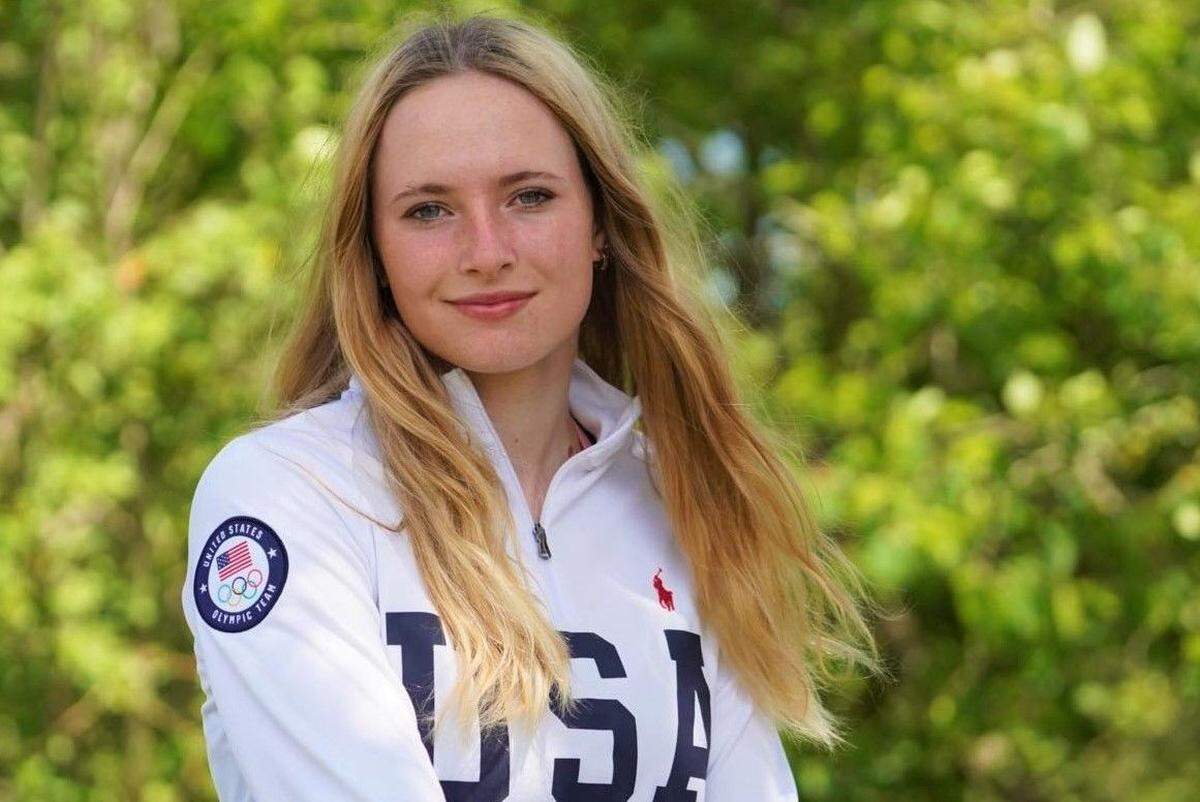
“I’m definitely still getting used to saying that I’m an Olympic athlete,” says Evy, who also will become a Davidson College student in January 2022, after the Games and her competitive season are behind her. “Every time I say it, I kind of do a double-take, just ’cause it’s so crazy that it’s actually happening now.”
Due to yet another quirk in those arcane and convoluted rules, she will race at the Games in both the women’s K1 — which has been a part of the Olympics since 1972 — and the women’s C1, which is making its Olympic debut. She’ll be the only female athlete representing the U.S. in C1 and K1. (Not just the only female athlete doing both, by the way, but the only woman in her sport at the Games, period.)
It will, of course, be different than the Olympics that her predecessors have been to.
Since the world is still trying to get a handle on the pandemic, international athletes are allowed to arrive only five days before they compete, and they must leave the country two days after their events end. Based on the current schedule, this means Evy will be there for the opening ceremonies but not the closing ceremonies.
And then there’s the whole issue of family and friends not being able to come over and line the course at Kasai Canoe Slalom Centre to cheer her on.
Although that’s one COVID restriction from which the Leibfarths have a special exemption: Essentially, because the canoe slalom contingent is so small, Lee Leibfarth has the OK to attend the Games with Evy, having taken on the role of Olympic team coach kind of by default.
“It’s fantastic,” Lee says. “I mean, to be able to be an Olympic coach — and to be able to coach Evy at her first Olympics — is amazing. That’s definitely a pinnacle in my paddling career as well.”
Father knows best?
Evy says her goal isn’t focused on bringing home a medal this summer.
“I want to have a race that I’m happy with,” she says. “I want to paddle well, I want to feel confident in my racing. Whatever happens, happens.”
Lee Leibfarth nods in agreement. But when the conversation returns to tattoos, her coach — actually, in this context it’s probably more appropriate to refer to him as her father — her father starts shaking his head vigorously.
“Oh yeah,” Evy says, laughing, when asked if she’ll get the cherry blossom after she turns 18 next year no matter what the result is in Tokyo.
“Hey, hey, hey, hey, hey! Wait on that one. Hang on,” Lee interjects. He’s trying his best to feign outrage, but winds up laughing, too. “We haven’t decided that yet, come on.”
“Yes, we have,” Evy replies softly, flashing a mischievous smile.
As for where she’ll have it put? “Probably like on my wrist or something, but I haven’t decided the placement yet,” she says.
“No face, no neck!” Dad says.
“Yeah, we’ve agreed: No face, no neck,” Evy says, laughing again. “The rest is fair game.”
This story was originally published May 5, 2021 at 6:00 AM.