What’s made Wake Forest great is a strategy not only based on talent. These guys are old.
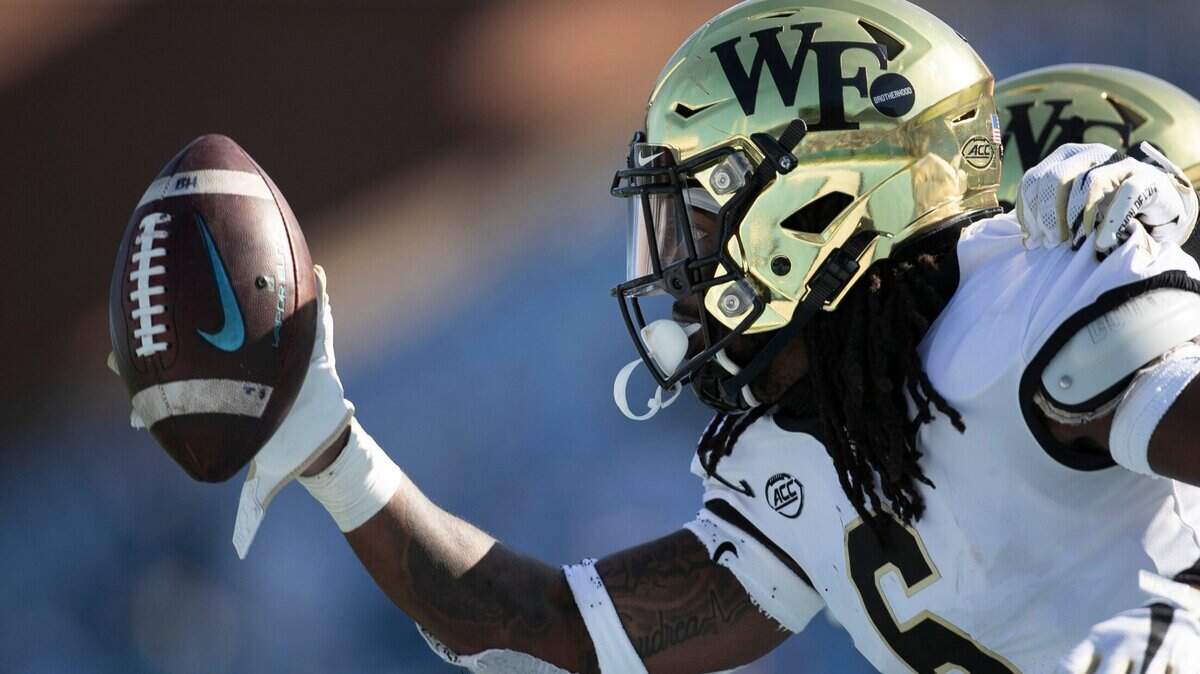
Sometimes, just for fun, the youngest among Miles Fox’s teammates at Wake Forest will ask him when he entered college for the first time. They know the answer because this is a question Fox receives often, but even if it momentarily escaped them it wouldn’t take long to do the math.
But still. There’s something about hearing it.
And so they’ll ask Fox the question, again, about when he first went to college.
“And I’ll say 2015,” he said with a laugh by phone earlier this week.
“And they usually reply, ‘Oh. I was in middle school.’ ”
“It’s just fun,” Fox said. He’s a senior defensive lineman at Wake Forest — or is it a senior senior defensive lineman? Or, perhaps, a senior senior senior defensive lineman? Either way. Some college football players spend three seasons in school before leaving, often to enter the NFL Draft. For Fox, this is his fourth year of being a college senior, in one form or another.
Yes, he acknowledged, after earning an undergraduate degree, and then a Master’s — he has indeed grown a bit tired of class. But not so tired of football. Fox’s collegiate journey brings to mind the memorable scene from the 1990s comedy Tommy Boy, in which the lead character, played by Chris Farley, tells his sarcastic friend that, “You know, a lot of people go to college for seven years.”
“I know,” says the snide David Spade character. “They’re called doctors.”
Fox, in his seventh year of college, is indeed an anomaly among his peers but is less of one these days, in this still-strange era of pandemic college football. About a year ago, when most Division I schools forged ahead through virus-related postponements and cancelations and games played in empty stadiums, the NCAA decided to give athletes an extra year of eligibility.
All of a sudden, seniors — fourth-year seniors, fifth-year; even sixth-year seniors, like Fox — were not faced with the specter of an end. They could live out the plot of many a frat-boy comedy film and extend their college days just a little bit longer, if they chose. Fox and eight of his Wake Forest teammates whose eligibility would have otherwise expired decided to come back.
It’s one of the primary reasons why the Demon Deacons are undefeated and nationally ranked entering the weekend. It’s also one of the primary reasons why, as the calendar turns to October, there’s a reasonable, defensible argument to be made that Wake Forest has emerged as the favorite to win the ACC’s Atlantic Division.
About a month ago, such an assertion would have sounded laughable. But that was before Clemson returned to Earth, and before four one-sided Wake victories, two against ACC opponents (Florida State and Virginia) by three touchdowns apiece. Dave Clawson, in his eighth season as Wake Forest’s head coach, has built his program on a foundation of experience; he often tells incoming freshmen to be prepared to sit out their first season for the sake of long-term development.
Yet even for Clawson, who especially values the contributions of older players, this particular Wake Forest roster offers a bounty of riches. The Demon Deacons returned 20 players who started a season ago, and several of them would’ve been gone by now if not for that extra year of eligibility the NCAA allowed because of the pandemic. Few programs anywhere, in the ACC or nationally, have benefited from contributions from so-called “super seniors” more than Wake Forest.
“You have seven really good players, who are good leaders, and mature and committed that are on your football team you otherwise wouldn’t have,” Clawson said earlier this week, referencing the seven super seniors who returned and remain healthy enough to compete. “And if you add two or three players like that, it helps your football team, and we’ve added seven.”
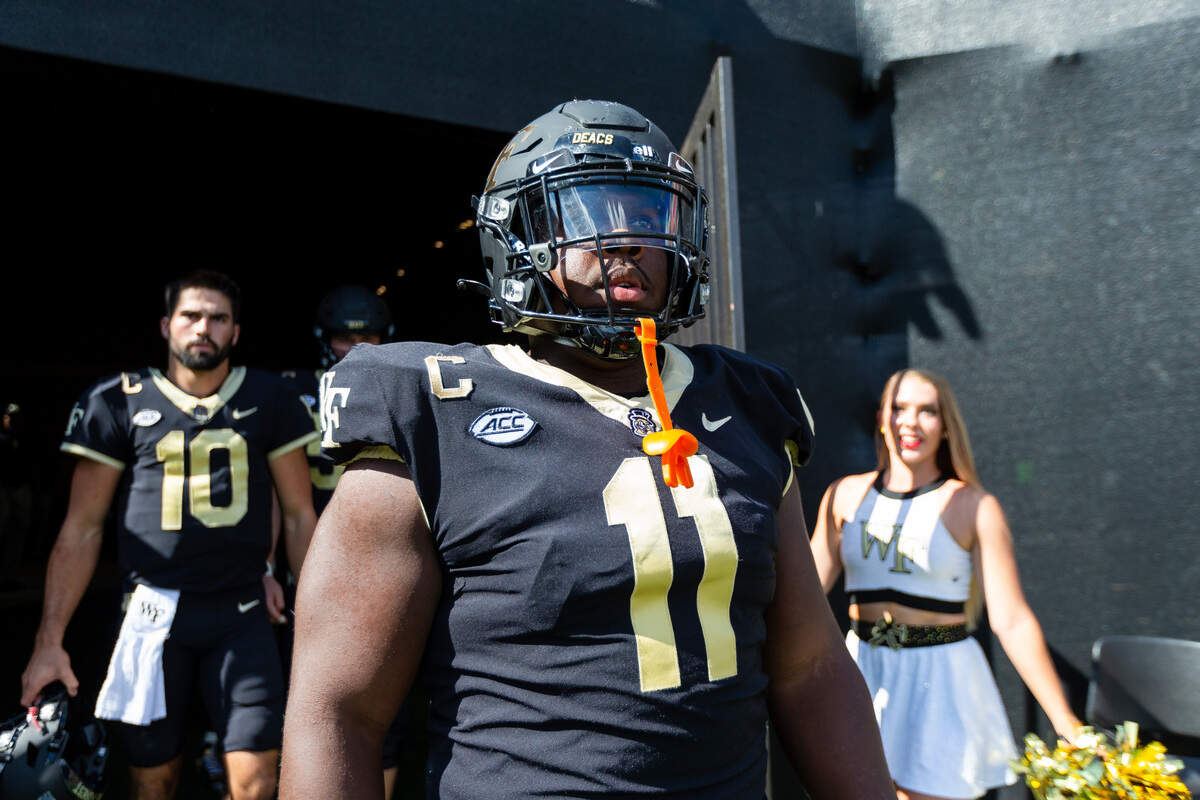
There’s Fox, who was an All-ACC defensive lineman last year, but also Sulaiman Kamara, another defensive lineman and Luke Masterson, a linebacker; Ja’Sir Taylor, a defensive back; and Traveon Redd, another defensive back.
“All those guys are starters,” Clawson said. “So that’s close to half your defense that you don’t have to replace, and that’s allowed us to have depth. And that’s always been our challenge here. So it helps a lot.
“We’re not the only team that has a bunch of super seniors back, but certainly at Wake Forest, the way we try to redshirt our (freshmen), to have seven additional players that are good players, good people and good leaders, helps us tremendously.”
Clawson referenced the challenge of building depth, which has almost always eluded Wake Forest during college football’s modern era, however one might define it. The inherent limitations make Wake a particularly unenviable and challenging job: It’s the smallest university, by enrollment, among any in a Power Five conference. Among those schools, it plays in the smallest home stadium.
In the past 50 years, the Demon Deacons have finished a season with a winning record 16 times; only seven of those times have they won more than seven games. And yet, in spite of the meager historical record, and in spite of the small-school limitations, Wake has won an ACC championship (in 2006) far more recently than any of its in-state rivals.
In a lot of ways, Jim Grobe, Clawson’s predecessor, provided the blueprint: Recruit prospects who fit the school, and the program, and who are content to stick around for a while, bide their time and develop. It is not necessarily a philosophy that will generate headlines or social media buzz on signing day. Yet when it works at its best, it has proven effective at winning games.
“You’re there for so long, you’ve been through good, bad, ugly, droughts — everything,” Taylor, the fifth-year defensive back, said of the benefit of time. “You’ve experienced a lot of things, and the only way to be able to handle those things better is by going through them, so a lot of young guys (on other teams), they come in, have good success their first year and they rarely face adversity.
“And we’re out there and we’re an older team and we know not to get down.”
Taylor, 23, was the rare Wake Forest freshman who didn’t redshirt when he arrived. He almost sounded wistful when he talked about it this past week, as if he’d missed out on something.
Now he is among the Demon Deacons’ six captains, four of whom are players who are on their second (or third) senior seasons. Fox, who in 2019 arrived at Wake Forest as a graduate transfer from Old Dominion, is part of that group and so is Masterson, who arrived at Wake in 2016 and is now working toward his third degree — a one-year Master’s program in Sustainability.
Fox, Masterson and Taylor all spoke, in their own way, of coming back because of “the belief that this year could be special,” as Masterson put it. In different ways, they all epitomize the long-game approach Clawson has employed during his tenure — one that appears to have allowed Wake to transform from Atlantic Division pest into a viable contender.
Among major conference teams, the Demon Deacons offer one of the more compelling arguments for the value of player development, and against the notion that championships — or even September games — are won solely on signing day.
Take, for instance, Wake’s 35-14 victory against Florida State on Sept. 18. In the past five recruiting cycles, the Seminoles’ incoming classes ranked no worse than 22nd nationally, according to 247Sports.com. The Demon Deacons’ best class during that span, meanwhile, ranked no higher than 59th. And yet on the field the supposed less-talented team, by a wide margin, had no trouble.
“That’s something that we talk about,” Masterson said. “I know for myself and for other people that are playing teams like Florida State, that’s definitely used as motivation. Just because that is how our program is perceived. We are perceived as a team with not as much talent as a team like Florida State in terms of coming out of high school, (recruiting) stars and stuff like that.
“So one, that’s definitely motivation going into games for us. And then in terms of coach Clawson’s program, he’s done a great job creating a plan for everybody. And if you follow that plan coming in as a freshman ... that’s how we get good here.”
Masterson has gone from something of a recruiting afterthought — he chose Wake over Coastal Carolina, Appalachian State and a long list of FCS schools, including several from the Ivy League — to become a key component of a defense that has allowed 14.3 points per game. Only Clemson and N.C. State have been stingier through the first month of the season.
Fox, meanwhile, played out his high school career in relative anonymity in the suburbs northeast of Atlanta. By the time he’d generated enough attention to warrant an offer from a major conference school (Iowa offered him a scholarship after his senior season at Collins Hill High, in Suwanee, Georgia) Collins had committed to Old Dominion.
Read the official school website bios of a lot of ACC players, and the section detailing the high school years will often include a long list of accolades: Star-ranking this and top 150 that and All-American the other. Fox was first-team all-county and all-region, at least, but spent more time hearing about what he wasn’t instead of what he was.
“I didn’t have the luxury of being a five star,” he said with a laugh.
“That’s one thing that’s always kind of been a chip on my shoulder,” Fox, who’s 6-foot-1, said. “Just the big schools like N.C. State, the Tennessees always telling me that if I was I was two inches taller, they’d offer me a scholarship. That’s something I’ve always held close to me, and I’ve always wanted to prove everybody wrong. And prove, I don’t care how short I am — that I can play.”
Was it fair to say that Wake Forest had a team full of those kinds of guys, ones motivated by the thought that they weren’t enough?
“Definitely,” Fox said. “We have a whole bunch of guys who flew under the radar and who have chips on their shoulders.”
Now they’re older, and if anything those memories became part of why they came back. Fox believed he could improve his professional prospects with another year of proving people wrong. Taylor wanted to do the same. Masterson envisions a career in finance and athlete wealth management and likely wouldn’t have had too much trouble finding work, but he wasn’t ready to leave. Not after the Demon Deacons finished with a losing record a season ago, or after the pandemic made it the weirdest and most difficult season in memory.
Wake, though, has been here before. This is the fourth time under Clawson that it has won its first four games. The others, in 2016, ‘17 and ‘19, the Demon Deacons stumbled through the final two months of the season. They believe now it’s different. Their leaders, for one thing, are even older than they were then. They’ve been through more. They came back just for the opportunity ahead of them, to keep their college days going a little bit longer.
This story was originally published October 1, 2021 at 11:23 AM.