4 key ways the organizers of Charlotte’s marathon will run things differently in 2021
Ask Tim Rhodes what change runners will most notice at Saturday’s Novant Health Charlotte Marathon, and he might come back with a smart-aleck remark.
“We took out all the hills this year,” deadpans Rhodes, the race director for the marathon. “So it’s pancake-flat.”
For the record, he is joking. The event’s famously rolling course still has plenty of rolls to it. But in all seriousness, several big changes are afoot for the 2021 edition of Charlotte’s sole marathon, which hasn’t happened in person since 2019 after being canceled and only offered virtually last year due to the pandemic.
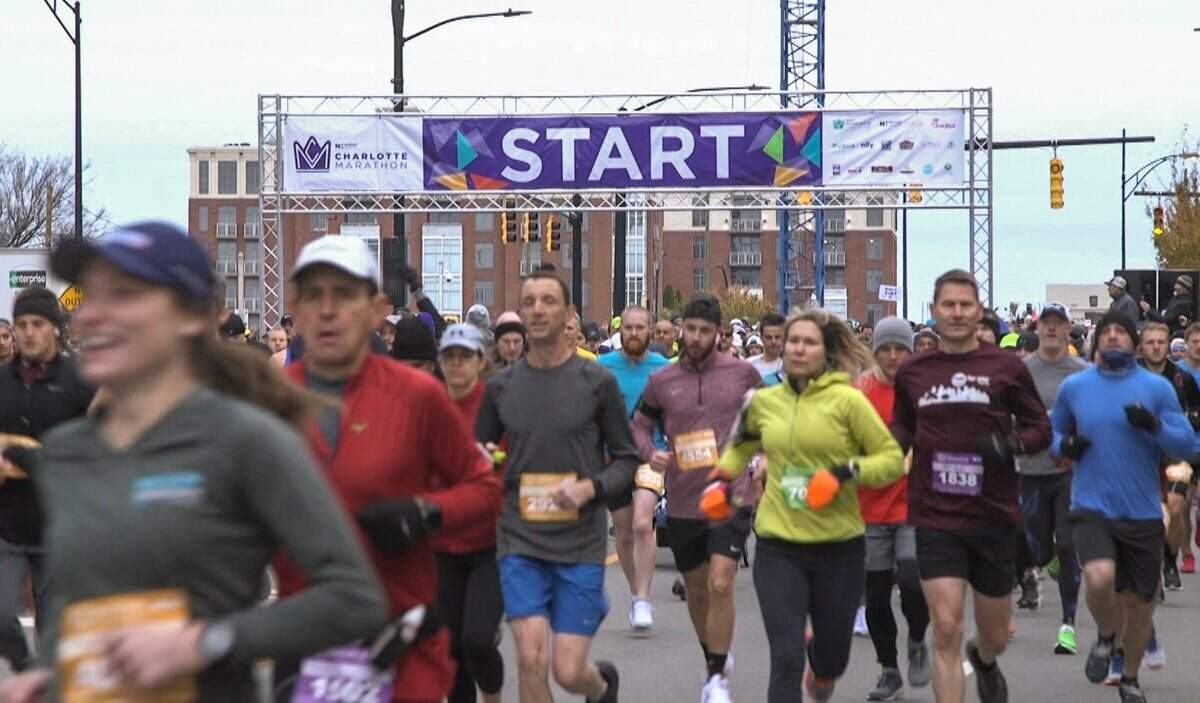
Here are the most significant of those changes, and the reasoning behind them.
1. Major course alterations
The first half of the 26.2-mile marathon route — aka the half marathon, for those only going 13.1 miles — now crosses busy Providence Road, but no longer spends any time on it. Instead, runners will be on residential-neighborhood streets from mile 4 till roughly mile 5.5, when they reconnect with the old course on Queens Road East near Myers Park Baptist Church.
Bigger changes await full marathoners in the second half.
Says Rhodes: “When you get to Mile 12.x — whatever x is, where the half and the full split — two of you are turning left for the half finish, and one of you is gonna turn right for the marathon. That means if you’re running a group of three, now all of a sudden you’re alone. And the second half of that marathon can be really lonely, and that’s when you need people the most.”
So now, starting at right about Mile 15, on North Davidson Street, the second half of the course will eventually double back on itself in multiple places. That includes about a mile and a half in both directions on North Davidson and about a mile in both directions on The Plaza. The out-and-back section concludes around Mile 23.
“I think the cool thing is you get to high-five and — well, post-pandemic you’ll be able to,” Rhodes says, chuckling, “but, you know, you can see people and wave and cheer ’em on and say ‘way to go,’ and you’re just not isolated like you would be running by yourself. (At times) gonna be somebody coming back at you — so I think that adds some fun to it.”
There’s another benefit to the change, though.
“The (police) manpower it took was just incredible,” Rhodes says of the old course, noting that it could take 400-plus officers for the marathon. And with local law enforcement agencies short on staffing, “it’s been a struggle to get every post filled. So we thought, well, let’s try to figure out a way to not use as much manpower.”
This all, of course, begs an obvious question: Do the new sections of the course add hills, or take them away?
“I think it runs a little faster,” the race director says. “But I mean, I’ve said this before: They call it uptown for a reason, and we finish uptown. That means you have to go up to finish. So no matter where you run in Charlotte, if you want to get back uptown, you’re going to go uphill.”
2. A hipper, lower-stress expo
Rhodes says the credit for the idea for moving the marathon’s health and wellness expo from the Charlotte Convention Center in uptown to NoDa Brewing Company in the NoDa neighborhood goes to Alaina Williams, who was hired last winter as the event’s first “experience director.”
Williams came to Charlotte with weighty credentials.
Her previous jobs included overseeing the expo at the San Francisco Marathon; coordinating hospitality and experiential events for the New York City Marathon; and directing food and beverage, catering, and concessions for events at Lincoln Center in New York.
“She looked at the surveys and stuff like that,” Rhodes says, “and one of the things that people complain about the most was the expo. It’s like, Man, I gotta drive uptown and traffic’s a mess, and then I gotta park in the NASCAR Hall of Fame and then walk all the way around to the Convention Center and then downstairs, and then all the way back out — and all I did was get my packet and I gotta pay $5 to park, and then I gotta wait in that stupid parking garage line and that was a mess.
“It was a hassle. So she said, ‘Let’s try to make it fun and more interesting.’ ... At first I was real skeptical. Then when I mentioned it to people, I’d be like (sharply inhales), ‘Yeahhh, we’re gonna do it at NoDa’ — and you kind of wince like they’re gonna reach out and slug you. But everybody’s been like, ‘Oh, great idea! Love that!’”
Just one pro tip: Don’t get too tempted by that beer selection while picking up your packet. You’ve got a marathon to run the next morning.
3. The impact of Covid
We’ll get the two most frequently-asked questions out of the way first.
Are race officials requiring proof of vaccination to participate? No. But if you’ve not been vaccinated, Rhodes says, “we ask that you wear a mask at all times unless you’re between the start and finish line” — meaning, unless you’re actively running the race.
That partly answers the second question, which is, What are the rules regarding the wearing of masks? The rest of the answer is:
The marathon will observe the current local mask mandates. As such, anyone entering NoDa Brewing for packet pickup/the expo will be required to wear a mask; the same holds true if you’re riding the shuttle that will transport attendees to and from the 36th LYNX light rail station.
Runners are not being required to wear masks at the start line, but it’s being recommended (and again, if you’re unvaccinated, it’s being requested). Otherwise, if you’re vaccinated and you’re outside, Rhodes says, “use common sense and don’t get in people’s face.”
The rest of the event’s Covid health and safety protocols are pretty standard for races these days.
The ones most worth noting, as they will be the changes runners notice the most, are:
- At the finish line, a volunteer wearing a mask and gloves will hand you a medal. In the past, volunteers would have leaned in to place them around the finishers’ necks. “That just requires us to get a little too close,” Rhodes says. “By just handing over a medal, that gives me a little bit more of an arm’s length to keep my distance for both of our safety.”
- Post-race food bags will be pre-packaged and, again, handed out by volunteers wearing masks and gloves. “It just reduces all the touchpoints,” Rhodes says, “and people sticking their sweaty hands in a box to get stuff.”
- There will be a QR code on the front of each runner’s bib. Upon finishing, participants can scan the code with their phones to call up the race results page.
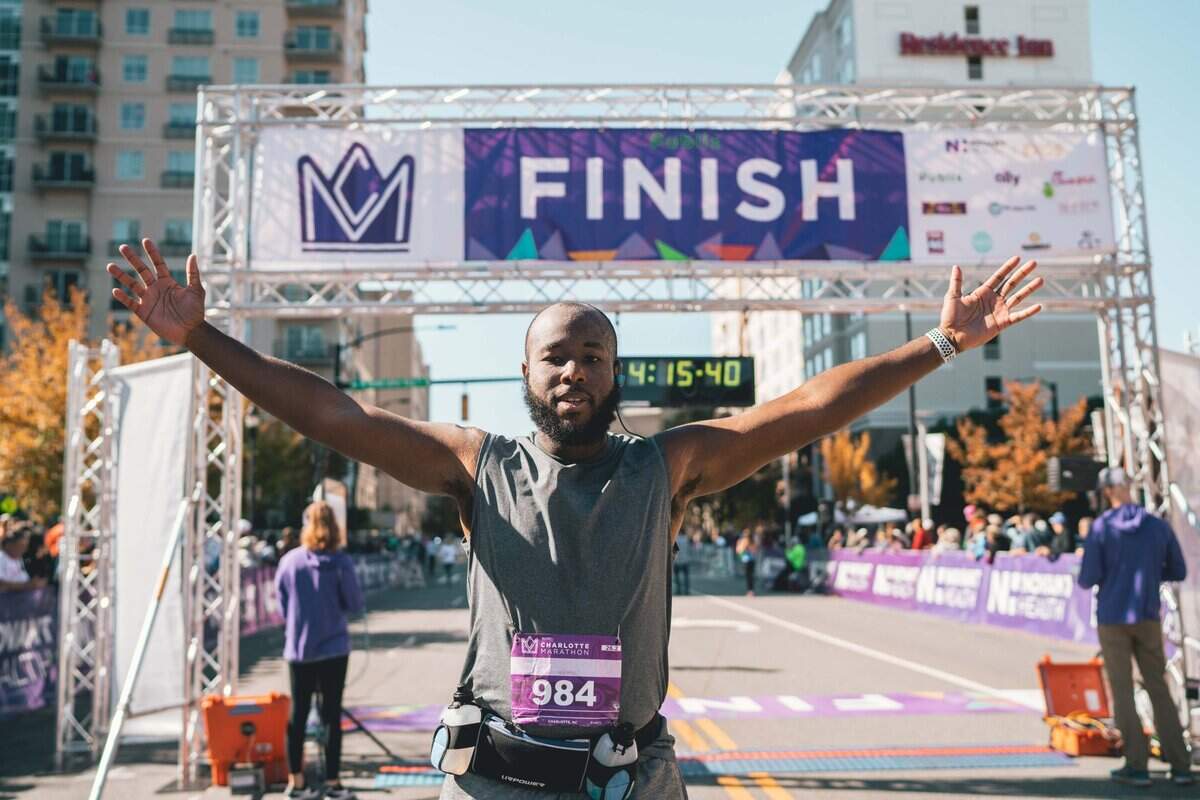
As for how the pandemic has affected registration numbers, Rhodes will only say that “they’re gonna be down a little bit. And we planned to be. We hit almost 6,000 in 2019 (across all of the event’s races, including the full, the half, the 5K and the relay). ... It’s not drastic. I mean, people won’t show up and say, ‘Gosh, this is a ghost town.’ It’ll be a pretty crowded event. But we are down slightly.”
4. A race for all running stores
For several years, Rhodes balanced being the marathon’s race director with his ownership of Charlotte’s Run For Your Life running store. And it wasn’t ideal.
Why? Because although the company he ran that owned the race was a separate business entity, many didn’t see it that way.
“They thought it was Run For Your Life’s marathon, and it wasn’t,” Rhodes says. “For good or for bad, it had that reputation. It was good for the store maybe, but ... if (the event) screwed something up, you didn’t want them blaming the store for it.”
On top of that, “I think some people were like — and I don’t mean this in a mean way — but some people rightly were kind of like, ‘Yeah, isn’t that a conflict of interest that you give Run For Your Life pole position?’ The store got the best expo space and logo inclusion and everything else. I mean, if I was another running store owner I would have gotten frustrated.”
“We’ve always tried to make it inclusive,” he adds. “But I think it was hard.”
For reasons that go beyond these issues — and that predate the pandemic — Rhodes sold his stake in his Run For Your Life running stores effective Dec. 31, 2020.
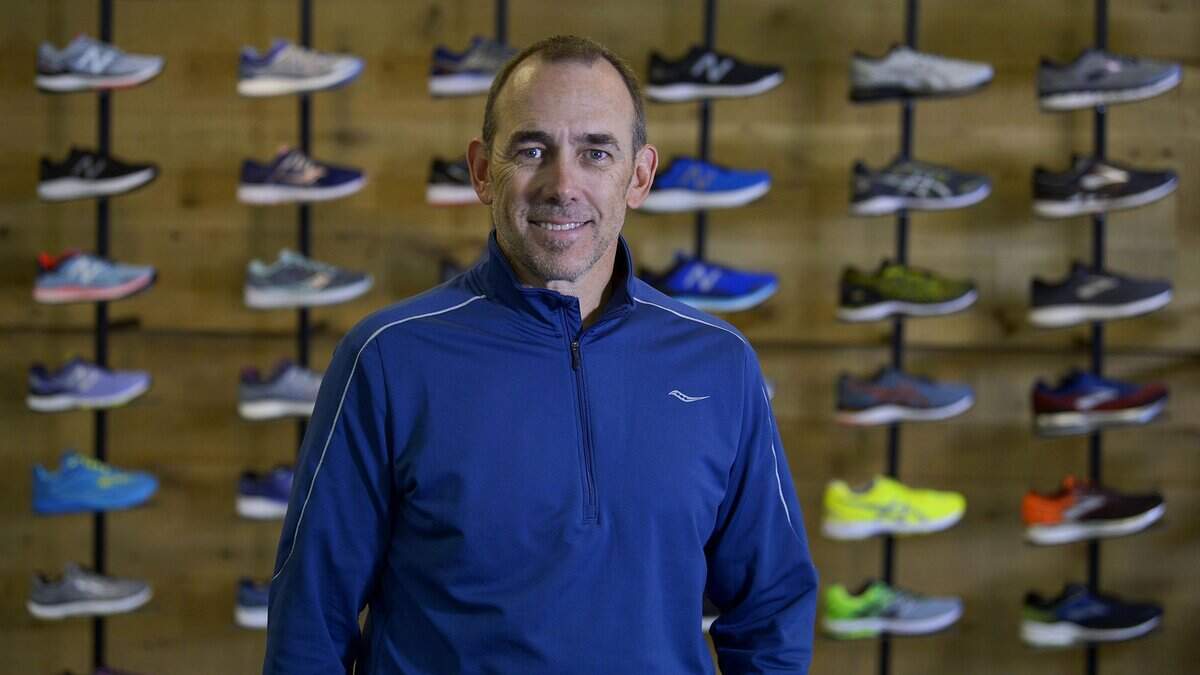
As a result, this year’s expo will be perhaps the most inclusive ever when it comes to local running stores, with Charlotte Running Company, The Ultra Running Company, Fleet Feet, and Omega Sports all expected to be on site.
“We want everybody to feel like this is Charlotte’s race. I mean, that’s part of the reason we re-branded, too,” Rhodes says, nodding to the decision to change the name from the Thunder Road Marathon to the Charlotte Marathon a few years ago. “Because it was Charlotte’s marathon. We want it to be Charlotte’s.”
One final quick postscript: If you see Rhodes on Saturday, wish him happy birthday.
On race day, he turns 60 years old.
This story was originally published November 11, 2021 at 6:00 AM with the headline "4 key ways the organizers of Charlotte’s marathon will run things differently in 2021."