
Why Jackie Robinson Day is personal for UNC baseball pitcher Boston Flannery
AI-generated summary reviewed by our newsroom.
- Boston now wears No. 42 as a junior after Jake Knapp previously had it.
- Rachel Robinson wrote to the Flannerys after meeting Boston’s grandfather.
- After limited early work, Boston logged 16.2 innings through mid‑April of this season.
Laura Flannery believes in coincidences. Her husband, Keith, does not.
So when their only son, Boston, was born in May 2004 — months before the Red Sox snapped an 86-year championship drought — Laura couldn’t help but draw conclusions, even if Keith laughed.
“My people from Massachusetts were like, ‘Oh my God, Boston broke the curse,’” she said with a chuckle. “Meaning my son.”
“If you talk to her,” Keith added, “It was divine intervention from God.”
About a decade later, Boston joined his first travel team, the New City Generals. Keith’s running theory is that 9-year-old Boston was more interested in the uniforms than the baseball. For Laura, it was a sign of what was to come. Because something, seemingly, pulled Boston to the “NC” letters on the ball cap and, above all, the team’s colors of Carolina Blue and navy.
And the number 42, which he wears now as a junior pitcher for the No. 3 ranked Tar Heels.
Boston said he was inspired after watching Chadwick Boseman’s portrayal of Jackie Robinson in the 2013 film “42,” which was released just before his ninth birthday.
“Since a young age, I had kind of known who Jackie Robinson was,” said Boston. “I didn’t truly understand, until I got older, exactly what he meant to the game of baseball. And what he had done, his sacrifices, to be able to just even play.”
On April 15, or Jackie Robinson Day, every uniform across Major League Baseball carries the same number — 42 — in a league-wide tribute to the man who broke baseball’s color barrier in 1947 and changed the sport forever. For many of today’s young players, they learn about Jackie Robinson’s legacy in school or perhaps at museums.
But Boston always felt a closer connection to Robinson, even though it’s been over five decades since his death. For Boston, it all traces back to when he was 10 — when his family received a letter from Jackie Robinson’s widow, Rachel.
The letter
You can chalk it up to luck or good timing — the kind of serendipity Laura tends to believe in more than her husband — but right around the time Boston began playing for the New City Generals, his grandfather crossed paths with Rachel Robinson.
David Flannery, Keith’s father and a longtime New York City detective, had picked up some side work to make extra money for the holidays when the encounter happened.
“He bumped into Mrs. Robinson… and he went on and on about what a nice woman she was,” Keith said. “He couldn’t believe that she took the time to talk to him.”
And then David did what any proud grandparent would do.
“Of course, as soon as he got the chance to talk to Mrs. Robinson, he talked about, ‘Boston, my grandson, he wears 42,’” Keith said. “And she was paying attention and she was engaged.”
David later wrote to Rachel. She wrote back.
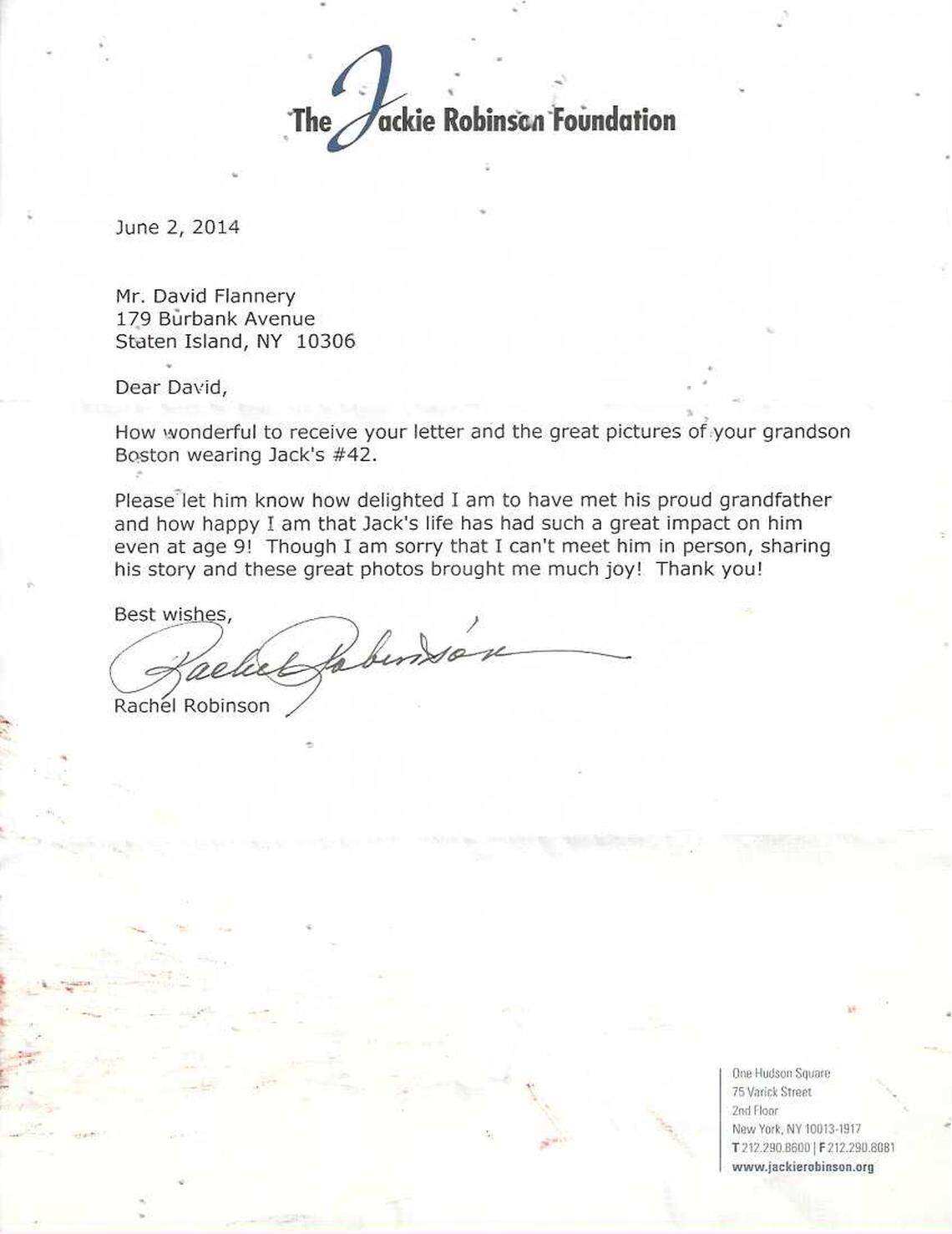
The letter is now framed in the Flannery’s New York home. Boston estimates his mom has remodeled the kitchen “maybe 100 times,” but the letter has never left its spot.
Boston calls it “one of the coolest things” he’s ever received — even if he didn’t fully grasp the significance as a child.
“I’m 21 now, and I’ve seen everything that’s going on in the world,” Boston said. “It has a completely different meaning. My mom is Black and my dad is white… I’ve been constantly learning and experiencing every single thing.”
Boston still remembers his mother’s stories of being followed in stores — how she was watched with suspicion as if she might steal something. He later saw the difference in how his parents were treated during traffic stops.
Growing up as a biracial kid in a predominantly white area outside New York City was a lesson in itself — in identity and what it meant to stand out.
“We always wanted him to be proud of his heritage, his identity,” Keith said.
“When he played for the Generals, when he pitched, he had his hair in cornrows,” Laura added.
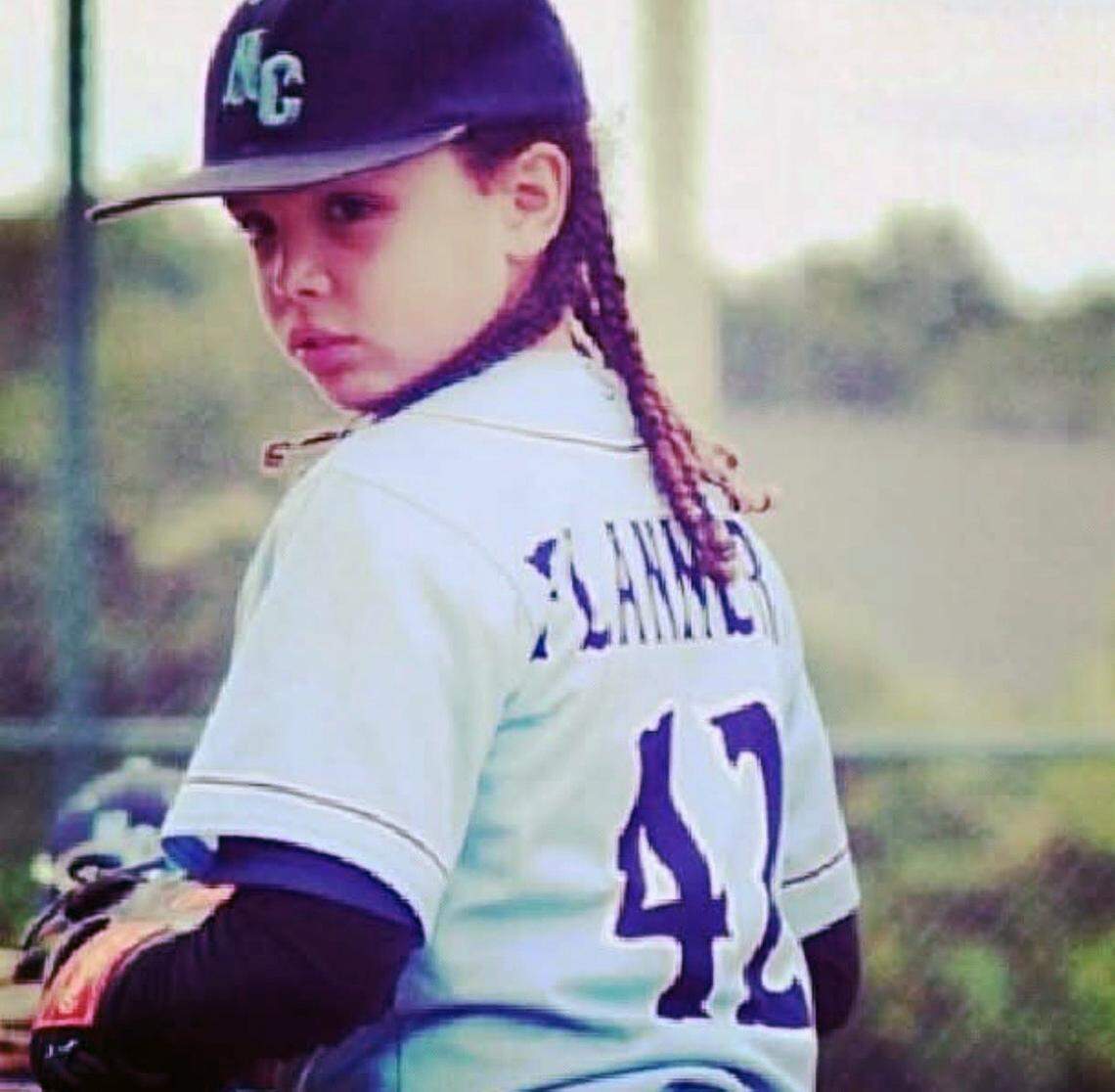
That image of a young Boston, with the braids and No. 42 jersey, is what Laura believes caught Rachel’s attention when she crossed paths with Boston’s grandfather back in 2014.
“I think that she understood the importance of young kids who identify with number, and identify with the player, and what that means to them,” Laura said. “It’s more than just a number. It’s honoring someone who went through difficult times to just be a part of something that they rightfully should have been a part of… so I feel like Mrs. Robinson identifies with young people who appreciate and honor what her husband went through, to make way for the rest of us.”
‘One of the greatest experiences ever’
In many ways, Boston is the kind of player baseball has been losing.
Black participation in the MLB peaked in 1981, but in the decades since, the sport has grappled with a shrinking pipeline of Black players.
At the Division I level, Black players only made up 4% of rosters (outside of HBCUs) in 2025, per NCAA’s demographics database.
The reasons are layered: cost, access, and the dominance of travel-ball circuits that often funnel prospects through expensive showcase systems and national tournaments. The result is a suburban game increasingly shaped by who can afford to be seen.
It’s a gap the MLB and USA Baseball have tried to address through initiatives like the DREAM Series and Breakthrough Series — structured pipelines meant to widen access and develop underrepresented talent.
Boston passed through, and was shaped, by those spaces.
“Some of the best times I’ve ever had playing baseball in my life…those were my favorite events,” Boston said. “It was truly one of the greatest experiences ever. It’s taking all of the best prospects that you can find across the country and it was just beautiful in the fact that we could all be in one spot and truly learn.”
The Breakthrough Series is hosted at the Jackie Robinson Training Complex, in Vero Beach, Florida, which made the experience even more meaningful to Boston.
“Everywhere you look, there’s a quote from him,” Boston said. “There’s 42s everywhere. It was really, really awesome.”
The three-day camp, which Boston attended in 2023, included daily meetings centered on Robinson’s life and legacy. The message was simple: do things “the Robinson way.” Carry yourself like a professional, on and off the field, and don’t let negativity reach you.
Boston said he’s relied on those lessons during his time in Chapel Hill.
“You get on the mound and you start hearing things that the fans are saying, some of the teams are saying… but I’m up there and I’m focusing on one thing, and that’s each making each pitch that I can,” Boston said. “So I can’t let somebody saying something negative to me affect me, because I have a job, and I’m out there to do my job.”
‘You’ve got to trust your stuff’
When Boston arrived at UNC in the fall of 2023, No. 42 was already taken.
“The National Pitcher of the Year wore it,” he said.
As in Jake Knapp, the unanimous All-American and ACC Pitcher of the Year. Knapp’s connection to the number was, admittedly, less poetic.
“They just gave it to me,” Knapp said. “There’s no history with me in that number.”
But Boston never asked for it. In his own words, he “didn’t deserve it.”
“I was extremely immature, especially for my age, because I was one of the oldest guys coming in,” Boston said, reflecting on his freshman year. “I was coming in expecting all these things to happen, just doing the same thing that I had been doing in high school.”
Boston had always relied on his arm. As a top-10 prospect out of New York, he boasted an upper-90s velocity and a heavy fastball — the kind that overwhelmed high school hitters and built plenty of buzz.
But in the ACC, that wasn’t enough.
“If it’s down the middle, with no other breaking stuff, it’s going to get hit in this league,” Boston said. “It’s a completely different game.”
Knapp saw the same thing.
“In high school, you can overpower guys,” he said. “But here, they’re going to catch up to a fastball. It’s about how you set up counts and where you attack.”
Velocity might get you noticed, but at the college level, it doesn’t necessarily get you outs. Boston, like many young arms, arrived knowing how to throw — not pitch.
He learned the difference the hard way.
Competing for a spot in UNC’s star-studded pitching rotation, Boston logged just 5.1 innings across six appearances as a freshman, then saw the mound only once as a sophomore — a one-inning outing in February 2025 — as he worked to translate his raw arm talent into a more complete, reliable pitching approach
“The first two years... I was always changing my delivery,” Boston said. “I was always changing what I was doing in the weight room.”
North Carolina pitching coach Bryant Gaines implored Boston to be patient. He pushed him to diversify his arsenal.
“He had the trust in me,” Boston said. “I just didn’t have it.”
Part of it was execution. Part of it was belief.
“And you’ve got to trust your stuff,” Knapp said. “I think that’s where he got in trouble at times — giving hitters too much respect.”
The biggest adjustment Boston had to make didn’t come on the mound. In his own words, he had to grow up.
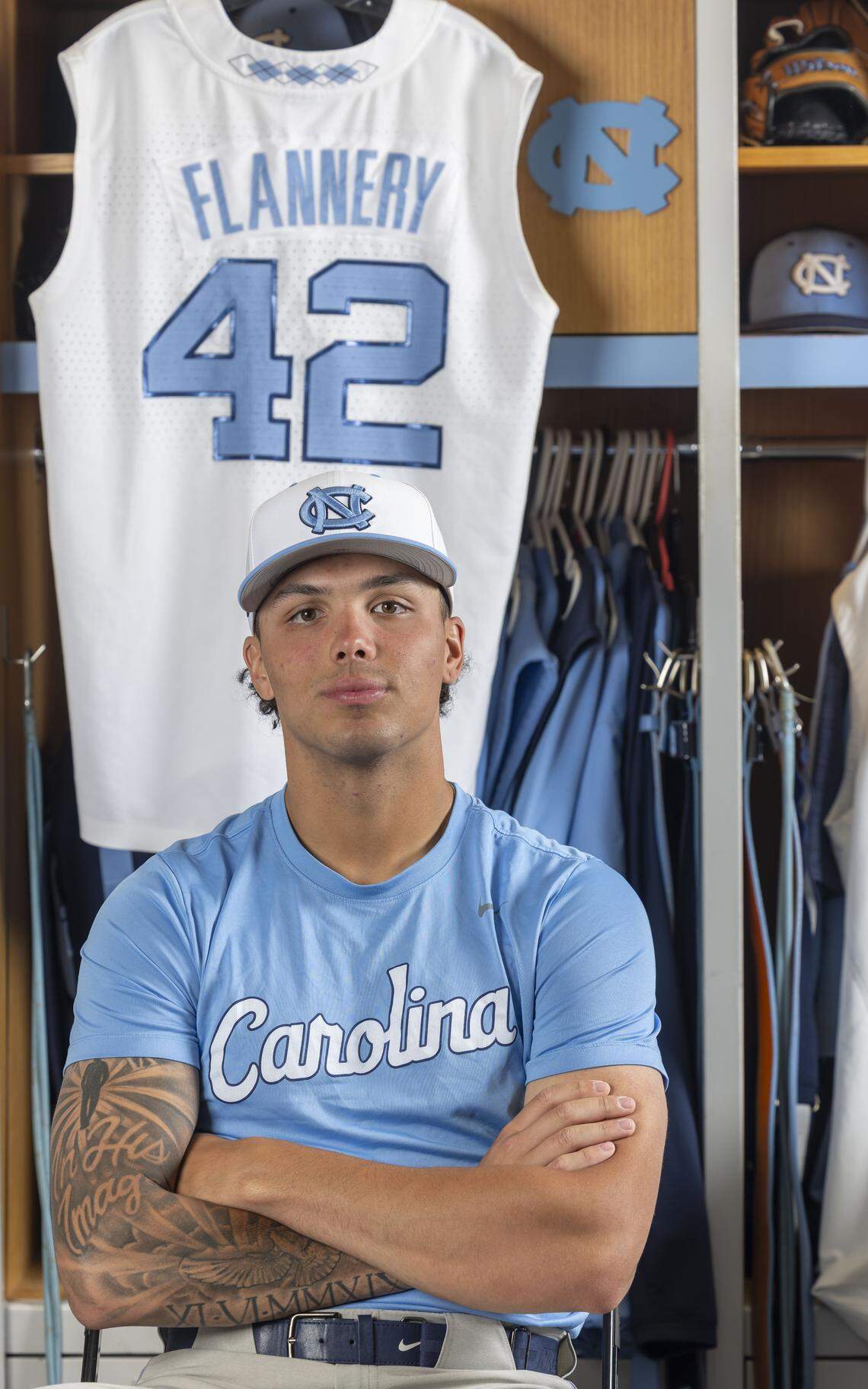
“The most important thing for me is how much Boston has just matured as a person,” UNC coach Scott Forbes said Tuesday. “I love him like a son. He’s a great teammate. He’s all in at North Carolina... he’s just matured tremendously. And he’s a big reason that these younger guys are getting better, too.”
“Because now, for him, it’s just all about the team and the team winning,” Forbes continued. “And that’s why he’s had more success.”
Earning the number
After pitching less than seven total innings in his first two seasons, Boston has logged 16.2 innings through mid-April of this season. Forbes has labeled Boston, now a junior, as an “X-factor” this season for a Tar Heels team poised to make a run to Omaha.
He’s shown flashes of what he can do all year. His March 24 start against South Carolina was a perfect example.
And the most meaningful sequence of the game — and, perhaps, his college career — began with him hitting a batter with a pitch in the second inning.
Boston gave up a single on the next at-bat, prompting Gaines to visit him on the mound. But the pitching coach wasn’t subbing Boston out. He just wanted to ask a question.
What do you feel more comfortable with? Your cutter or slider?
Boston chose the cutter and the two settled on a strategy: induce soft contact, turn two, escape the inning.
In Boston’s first two seasons at UNC, this is the exact kind of moment that might have unraveled him. He had to trust his teammates’ defense instead of pushing for a strikeout. He couldn’t let one mistake spiral into another. He couldn’t second-guess the pitch in his hand.
But Boston had been preparing for this moment. He had honed his mechanics in the offseason with a regimented catch play routine. He’d put deliberate emphasis on positive self talk — something he’d written off as frivolous in the past. And he had put full faith in his coaches, like Gaines, and completely scrapped his four-seamer. He spent the summer before his junior year honing a smaller array of consistent, repeatable pitches through reps in the Coastal Plain League.
And so Boston was ready when, following Gaines’ mound visit in that South Carolina game, he nearly hit the following Gamecocks batter. He took a deep breath and reset. On the next pitch, South Carolina’s Tyler Bak grounded into a double play. Boston’s cutter was on target, on time and UNC got out of the inning.
Boston went on to pitch three innings in what he considers the best outing of his college career. He later told his dad he’d never seen Gaines so happy.
“He goes, ‘He actually hugged me and said this is the best I’ve seen you pitch,’” Keith recalled. “I know Boston appreciated that… that was a big moment for him.”
It was big because Boston had worked for that moment — to be able to throw that pitch, wearing that jersey.
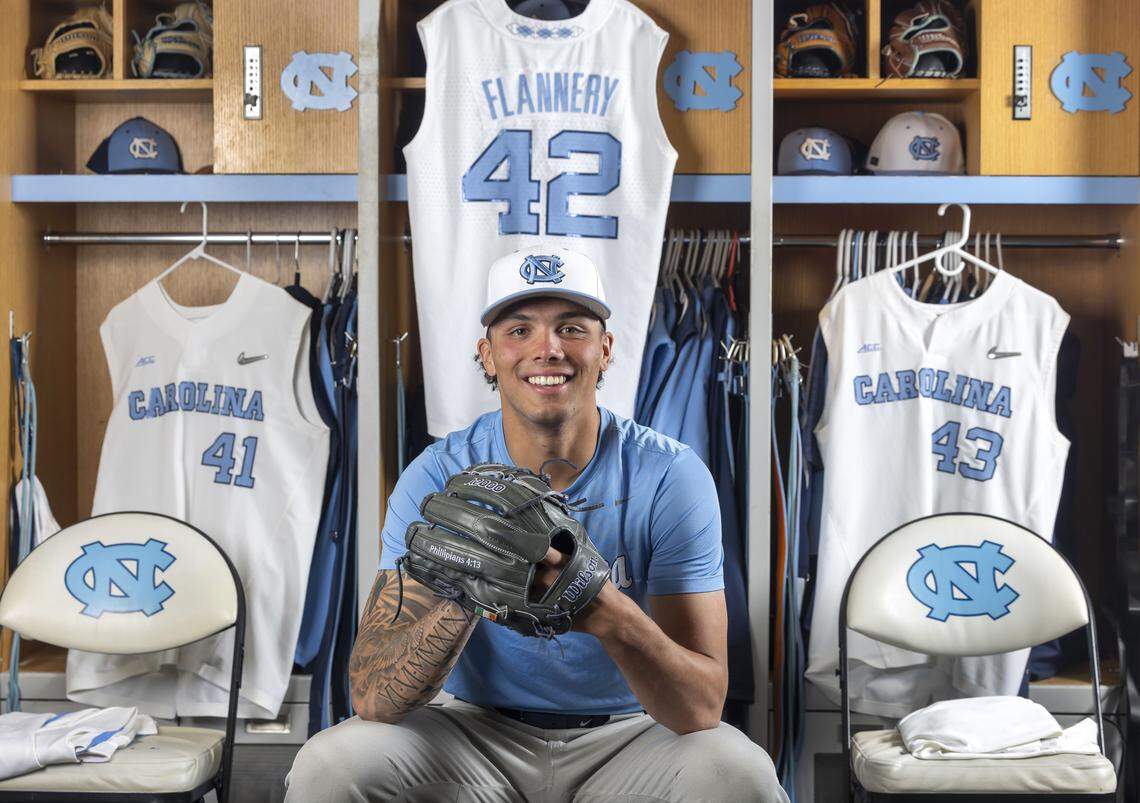
“I was able to really earn the number,” Boston said. “As a person, I had really changed. As a teammate and as a person off the field, I think I’m getting in the right direction.”
This story was originally published April 15, 2026 at 10:00 AM with the headline "Why Jackie Robinson Day is personal for UNC baseball pitcher Boston Flannery."