Charlotte FC’s new kit honors a past champion in Carolina Lightnin’
An unknown 16-year-old boy changed the trajectory of Charlotte’s professional soccer scene while sitting around with his dad in their Hickory home.
Mike Finegan decided to join over 6,900 other contestants entering The Charlotte Observer’s 1980 “name the team” contest, a competition designed to brand the American Soccer League’s newest franchise located in the Queen City.
Finegan and his dad wanted to submit something that related to the city and the state. He landed on an answer.
Lightnin’. Yes, with the apostrophe and in the southern dialect.
“(Owner) Mr. Bob Benson liked the Lightnin’,” director of operations Ed Young said. “Thought it had a lot of pizzazz.”
Finegan said it represented quickness, speed and dazzling scoring ability. He knew the team would strike like lightning. Oh, and it’s the nickname for White Lightnin’, a popular moonshine in the South that in Finegan’s words can “knock you for a loop.”
He won. Finegan was the only Lightnin’ entry. For his efforts, he received eight season tickets for a cash equivalent of $800, a $100 gift certificate from Charlotte’s Soccer Shop, eight $25 gift certificates to the Lightnin’s 1981 soccer camps or a cash equivalent of $200, an official ASL ball and a soccer-season subscription to The Charlotte Observer.
And over 45 years later, Finegan is still reaping the award. He’s the nomenclator of a team that’s been forgotten about by most, except by those in the club and the ones who watched them. The Carolina Lightnin’ had a vision to transform Charlotte with the help of soccer.
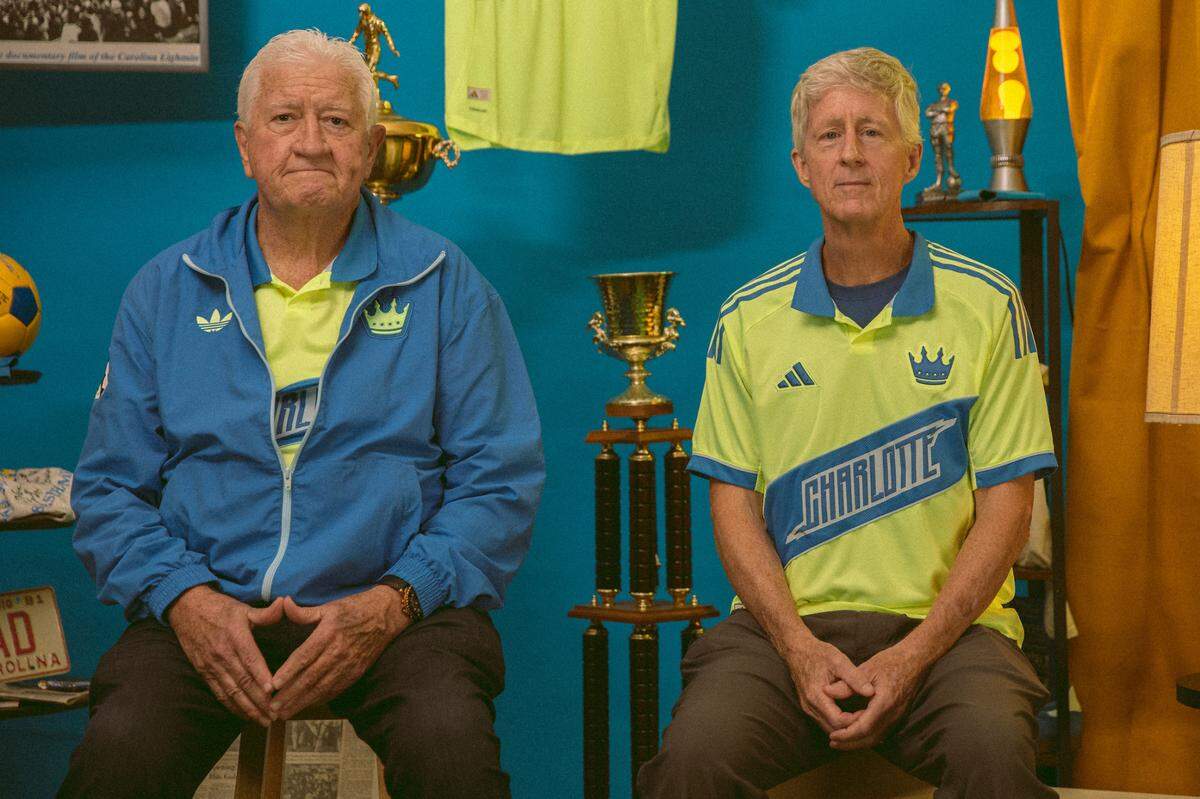
Charlotte FC jersey paying tribute to Lightnin’
On Wednesday, Charlotte FC is honoring the squad that laid the foundation for its origin in 2021. The Crown is one of 10 MLS teams selected by Adidas to feature a third archive-inspired uniform for the rest of the season. Although the Lightnin’ only survived three seasons before the American Soccer League folded, the team’s 1981 championship remains historic.
But before there was a region-wide contest and Finegan, there was Ed Young and Bob Benson.
Developers decided they wanted Charlotte to become a world-class city in the late 1970s. Top banks were developing in the Queen City. Transportation and business hubs were starting to come along, too. But Charlotte was still behind places like Greensboro, Raleigh and Columbia. The city needed to progress, and it needed to make a name for itself quickly.
So, developers turned to sports. They realized every major city had a professional team. To create their own, a sports action council under the Chamber of Commerce was founded.
Every sport had a representative, and Young represented soccer, a sport with growing youth participation and limited professional mobility. That’s where Young met Benson, the basketball representative, who became interested in the less popular sport because his son played soccer.
“Mr. Benson was all-in on soccer just because it was something with his kid, right?” Young said. “And so he became very interested, attracted to soccer. (He) thought that he could pursue a soccer franchise.”
In March 1979, Young helped book Memorial Stadium’s first major soccer game, a match between the Minnesota Kicks and the Atlanta Chiefs. The contest caught the attention of representatives from the American Soccer League, who decided they wanted to pursue a franchise in Charlotte. The ASL contacted Benson.
“Bob Benson was an amazing man, creative entrepreneur, dynamic, forward thinker, risk taker,” Young said. “Everything you need to buy a franchise and bring it into being.”
Benson, along with the help of ASL representative Rich Melvin, began putting together a team. Young was the first employee of Carolina Professional Soccer, before the club was branded. His official job title was “director of operations, etc. and everything else.”
Young and Benson navigated the numerous steps that come with building a program. There were several exhibition games, naming the squad and then forming it.
Rodney Marsh, a former professional soccer player, was named the coach. The Lightnin’ held open tryouts, bringing all different characters to Charlotte from around the country.
“We had people that were excellent collegiate players,” said John McGillicuddy, the ticket manager and operations assistant. “But also players that had never played soccer. It was that kind of open tryout.”
Still, they formed a team from the cast.
The staff organized a place for the team to live together in an apartment complex. What started as an oddball squad blossomed into friendships on and off the field.
“Rodney refers to them as the dirty dozen, even though they’re more than a dozen,” McGillicuddy said. “But what he meant by that was they were all hard-nosed, rough and tumble players, but they had a lot of skill as well. And it was them against the world.”
Memories of Lightnin’s ‘magical’ era
Soon, the historic 1981 season began, featuring stories that have become ingrained in the memories of Young and McGillicuddy. Unforgettable ones that are almost too good to be true.
There’s the impact of Marsh, who was the face and voice of the team. There’s forward Tony Suarez, who drove the team bus before turning into a starter and star. Forward Mal Roche won two, back-to-back championships with the University of San Francisco. He was the rookie of the year and their leading scorer. According to McGillicuddy, he made every penalty kick he attempted. Sometimes one or two a game.
Then, there are the car giveaways. And the one time the Lightnin’ gifted an airplane to the fan who threw a paper version closest to the vehicle’s propeller.
Oh, and it’s hard to forget about The Beach Boys’ performance 10 minutes after a match in the center of the field. The stage looked like an ocean.
Over 20,000 fans showed up to the Lightnin’s championship game. There were so many people Young had to delay the game. He had to two-way radio the airplane dropping in parachuters so they wouldn’t come too early.
“All those kinds of little things you remember, they’re good memories to have,” Young said.
There’s even a phrase imprinted on the inside collar of the kit Charlotte FC will wear. It reads, “I’ve been struck.”
One time, a thunderstorm came through Memorial Stadium. In those days, they didn’t send fans out of the stadium. Lightning struck the field during the storm, and the lights went out. When they came back on, goalkeeper Scott Manning was lying on the turf.
He was OK. The game continued. After the match, a reporter asked Manning what happened.
“I thought I was struck by lightning,” Manning said.
The quote was printed in the newspaper and it turned into a big deal. Benson turned the phrase “I was struck” into bumper stickers. The phrase stuck. And almost half a century later, Charlotte FC is wearing it.
It’s all a part of the legacy the Lightnin’ left, and what Charlotte FC is trying to honor. Although the Lightnin’ only played three seasons, its impact altered the course of professional sports in Charlotte. The Lightnin’ gave direction to George Shinn, the founder and original owner of the Charlotte Hornets, and Panthers founder Jerry Richardson.
If Charlotte could love soccer in the 1980s, it could love anything. And now that love is stitched into a kit.
“(The Lightnin’ is) magical,” Young said. “Something magical about it. Something special about it for the city of Charlotte, for the Carolinas. They accomplished something with the Carolina Lightnin’ that they hadn’t been able to accomplish before.”
This story was originally published July 16, 2025 at 11:00 AM.