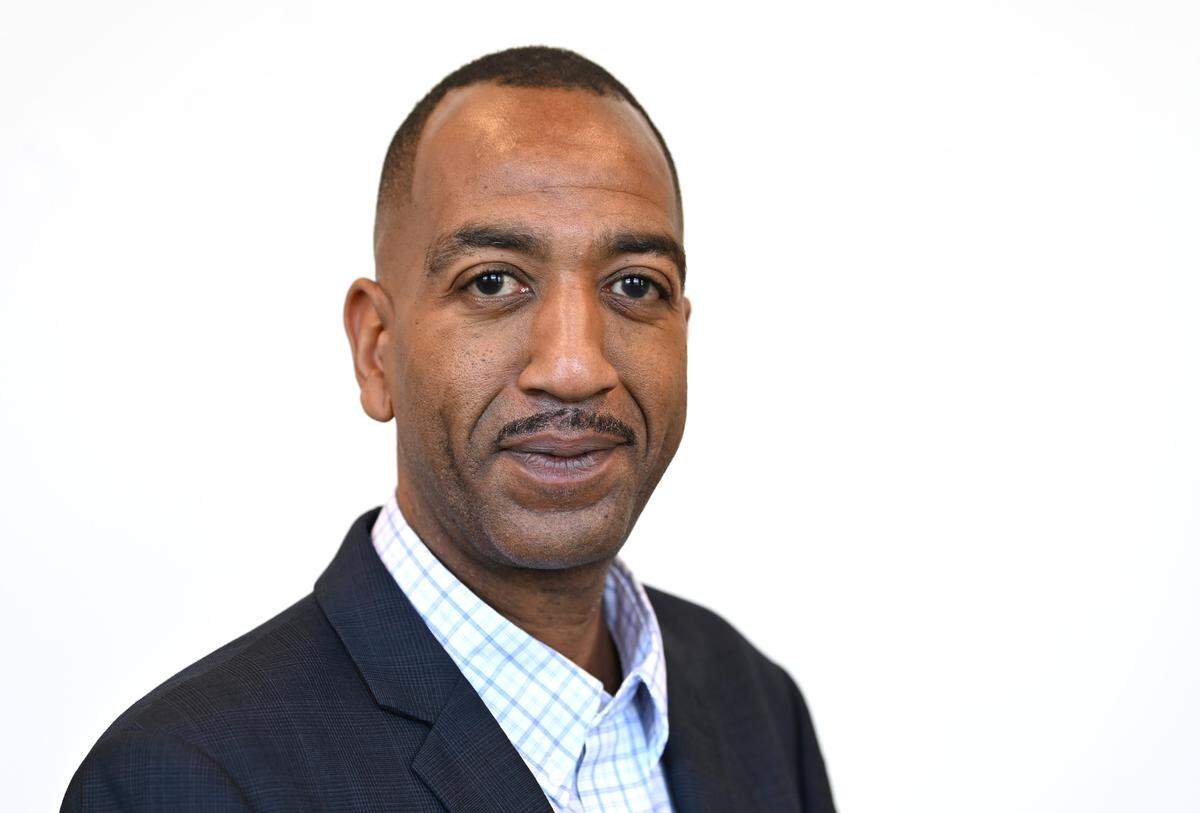
How James Jordan’s military roots, family shape his leadership with Charlotte Hornets
Staring at a computer screen in an office tucked into a corner of Spectrum Center’s executive offices, one of the Charlotte Hornets’ longest-tenured employees is hard at work as usual.
A somewhat muffled and repetitive electronic chime dings through the walls as James Jordan combs through important business details, unfazed by the repetitive jingle from patrons scanning mobile tickets entering the building.
Jordan, hours before shifting into a new senior adviser role with the organization, meticulously finishes up the latest of his seemingly nonstop tasks, readying himself for the rest of the chores he has staring him in the face on a game night. Duties range from greeting fans to spending time courtside at the end of the team’s bench, observing the likes of star point guard LaMelo Ball and coach Charles Lee up close.
All while being personable.
“With the COO title, you are doing a little bit of everything,” Jordan told The Observer during a brief break. “So I’ve never really got caught up on the title. I got caught on, ‘What do the people in the organization need me to do to be successful?’ Whatever it is, it doesn’t make a difference.
“You’ll see me outside talking to the customers that come into the building. I’ll be monitoring how fast it is, how slow it is. And then when I get ready to finally sit on the bench, I’m checking the numbers to see whether people are still coming in or not. Those are things that you just do in making sure that the business runs well.”
For the 67-year-old Jordan, the eldest of five siblings and big brother to Hornets minority owner Michael Jordan, that laundry list of chores is all in a day’s work and he shrugs at the number of things on his plate daily. It’s simply his makeup, a foundation established thanks to a military career spanning more than three decades.
He’s a veteran and wears that dedication to service proudly, often pointing to it being the blueprint to his core values.
“I think some of it is the way I grew up,” said Jordan, who hails from Wilmington. “I grew up in the country and I worked in probably every little field possible. And when I was in high school, I joined ROTC. And ROTC taught me about discipline, being on time, how you dress, how you focus, how you work as a team. I graduated on the sixth of June in 1975, and on the ninth of June I joined the Army.”
That’s where things truly took off for Jordan. He knew he had found his purpose: Being a leader, someone who could stay strong and calm even during the most difficult moments.
He thrives in that kind of environment.
“When you are in a squad, the senior person is to the right and everybody is to the left,” Jordan said. “You always are the one accountable for the people to the left. So when I grew up, it was never about me, it was always about the people to the left of me. It was about them. Leaders, you are supposed to be protective, you are supposed to tough it out, you are supposed to be focused.”
He added: “To lead, you don’t have to be an expert but you’ve got to be able to get the right answer. And how do you do it? Communication. I communicate with everybody. It doesn’t make a difference what their job is, what they look like. I ask them, ‘How are you doing, how’s it going? How’s your job, are you happy? How’s your family doing?’ Because that’s what it’s all about.
“You can pretend to do it or you can do it consistently. That’s me.”
Others can easily detect the military fingerprints all over Jordan’s approach.
“Two tremendous benefits of James’ military experience that I’ve seen personally and I’ve seen have an impact on our organization is, one, his caring for the staff and team,” Hornets chief marketing officer Seth Bennett said. “I think that’s the same way in the military. You care for your troops. You care for them and you make sure that they’re seen after.
“The other thing is just the discipline of structure. Having processes in place and understanding that is the backbone of success. He brought that culture here. And I think it’s been good for not just those of us who’ve been in business, but young professionals who are just getting their career going, that they come and see that there’s a method to everything you do. Whether the mission is successful or not is one thing, but it’s the fact that you have a plan.”
Long military journey
Jordan held several positions in the armed forces, including posts with the 327th Airborne in Fort Bragg, North Carolina, from 1993-2002. There, he was responsible for planning, coordinating and directing activities of all personnel. He was also part of the 18th Airborne Corps Task Force from 2002-2006, supporting combat operations in Iraq and Afghanistan, and served as the senior manager of a special task force that reached over 3,600 soldiers and contractors spanning both countries at times.
Following 31 years of service with the Army, Jordan retired from active duty in September 2006. That concluded a career during which he garnered honors as an outstanding soldier, leader and manager, collecting medals and numerous awards.
He began working for Charlotte’s NBA franchise in 2013 when Michael Jordan brought him on board, and he was an adviser to the chairman’s support team for three years. He’s held countless positions over the past decade-plus, with a seven-month term as interim president in 2023-24 being among the most recent titles.
He presided over the Charlotte Hornets Foundation for the last few years, too.
“Adaptability — it’s also a military trait,” Bennett said. “Adapt and overcome. See efficiency under adverse conditions.”
It’s why Jordan always has a certain perspective on things, a distinguishing characteristic that comes out in every conversation. Chalk it up also as a result of being raised in rural eastern North Carolina and having a father in James Jordan Sr. who instilled in his children to never settle and have their own persona.
That stuck with James Jordan.
“When I was in the military, Michael was just becoming who he was,” Jordan said. “And he got famous and I stayed in the military still, because I was all about being myself. And I always used that then and I use it now to my kids and myself, ‘You were given your last name. You earn your first name.’ If they always just call you, ‘Jordan, Jordan, Jordan’ and they don’t call you by your first name, then they’ll think about the Jordan family and not think about you individually.
“And so my mindset has always been, when people remember me, I want them to remember me by my first name, not by my last name. And that’s the same way I look at it.”
Even with a younger brother who’s a global brand and icon.
“Michael blew up, he did very well and I’m 100% proud of everything he’s done,” Jordan said. “My old man told us, ‘You don’t want to be second, you always want to be first.’ And that’s the mentality we all grew up with as a family. And he just did it at a higher level.”
Joining forces with Michael to help run the franchise just added another layer to Jordan’s desire to lead. While they weren’t able to sustain a winning on-court product during Michael’s tenure as majority owner, James Jordan points to other areas that have flourished before he fades off into the Carolina sunset.
“At the end you have to evaluate whether you are successful or not, and a lot of times it depends,” Jordan said. “We were always taught you’ve got to go 110% all the time and when you reach that point and you don’t get there, it is what it is. And the same way we did everything we could to try to put a winning team on the floor and tried to do it.
“But what we decided, what I always told the team that worked for me internally — because I didn’t control what necessarily happened on the floor — is we still can win.”
In other ways.
“We may not win between the lines, but let’s win outside the lines,” he said. “Winning outside the lines, that means business, means (our corporate communications director) is doing his job well, making sure that the brand is out there, making sure everything about (it) is good, making sure with the community we were out there doing all types of things, customer service … To me, those are wins.
“You may not have your record reflect that you had a good team between the lines, but outside the lines, we’ve done very well and the business overall did pretty well at the end. Michael sold it. I think he did pretty well at the end. And as a result we didn’t necessarily win everything we wanted to on the court.
“But when you wrap it up in a global perspective, from a business (sense), ‘Did you run a good business and at the end, was your business rewarded because of the way you ran your business?’ And I can say yes to that.”
This story was originally published November 11, 2024 at 5:00 AM.