Call him Flick or basketball legend. Alex English’s roots and heart are in Columbia
Editor’s note: This story is part of The State’s series “SC Sports: Where are the stars now?“
Alex English could be anywhere now.
He could be in Denver, the place where he became one of the NBA’s greatest scorers of all time. He could be in Toronto, the longest stop in his five-city coaching career. He could be in China, a country he visits often as part of his role as an NBA ambassador. He could be in Hollywood, continuing a passion for acting that’s led him to the silver screen on more than a few occasions.
But Alex English, wearing a light blue polo and dark jeans, is in a greenhouse on his property and telling visitors to taste what he’s growing.
“Take a leaf off and chew it,” he says, “any leaf. They put it in salads now, they’re putting it in everything.”
It’s an unseasonably warm Thursday afternoon in January and English is supposed to play golf. His playing partners rescheduled, however, and here he is around a different kind of green. Four rows of hemp plants sit under specific lighting for growth. It’ll eventually be harvested and extracted for CBD oil in association with English’s new company, GreenSmart Botanicals.
“It’s a beautiful plant,” English says, “and it’s got great medicinal value. I don’t know if you study hemp, but there’s what they call terpenes in the plant. And its 101 different terpenes are used for epilepsy spray, for dementia, for cancer, for so many things.”
The greenhouse, shaped like a miniature dome, is English’s new arena. He’s filling guests’ notebooks with facts and figures about a new venture and a couple things stick out: At 6-foot-7, English can still be the center of attention. At 66, English is still thriving on the grounds that know him best.
Where is English now? In about the same place he was back then, and he’ll stay there.
He’s home.
In the Beginning
University of South Carolina-produced game notes sat on a coffee table inside Alex English’s home office. The room is part work space, part museum for the Naismith Basketball Hall of Famer who occasionally drops into Colonial Life Arena and analyzes games for the SEC Network.
English is USC’s most accomplished player and there are reminders everywhere. Trophies, NBA All-Star Game coffee mugs, framed photos with Ralph Sampson, Kareem Abdul-Jabbar and Julius Erving. But, in a reflection of his life, the room has balance. For seemingly every inch of basketball nostalgia, there’s a book or some form of art.
Ask English, a published poet, for his favorite piece of decor and he’ll be stumped.
“Man, I don’t even know,” he said as eyes wondered the four walls. “There’s something from Brazil. There’s something from Greece. There’s all that from China. These are trophies and stuff. It’s hard. Lots of memories.”
As he has for 30 years, English lives on these 50 acres in Blythewood, a 20-minute drive from his roots in downtown Columbia. He grew up in a home on the corner of Barnwell and Gervais streets, living as one of 13 — siblings and cousins included — under one roof. His grandmother was in charge while his parents, aunts and uncles worked in New York “to help support family back in the South.”
Imagery of those times — when a two-meal day was never guaranteed — comes in a painting that hangs over the mantle. There’s a boy in a white T-shirt and blue jeans. His arms are extended — wrists bent — well above his head as a basketball floats toward a peach basket. The backboard is made of wood. Scripted at the bottom are are the painting’s artist — the late Ernie Barnes — and title — “In the Beginning.”
“I got a chance to meet Ernie Barnes before he passed,” English said. “He captured basketball, the moment, the feel of what it was like growing up.
“Because I remember what it was like growing up in Columbia. We did pretty much what you see on that picture up there. We got a piece of plywood and we had to find a rim. So we would take an old tire rim — if we couldn’t find a basketball rim — we’d nail it on that backboard and we’d get us a pole and we’d nail that to it.
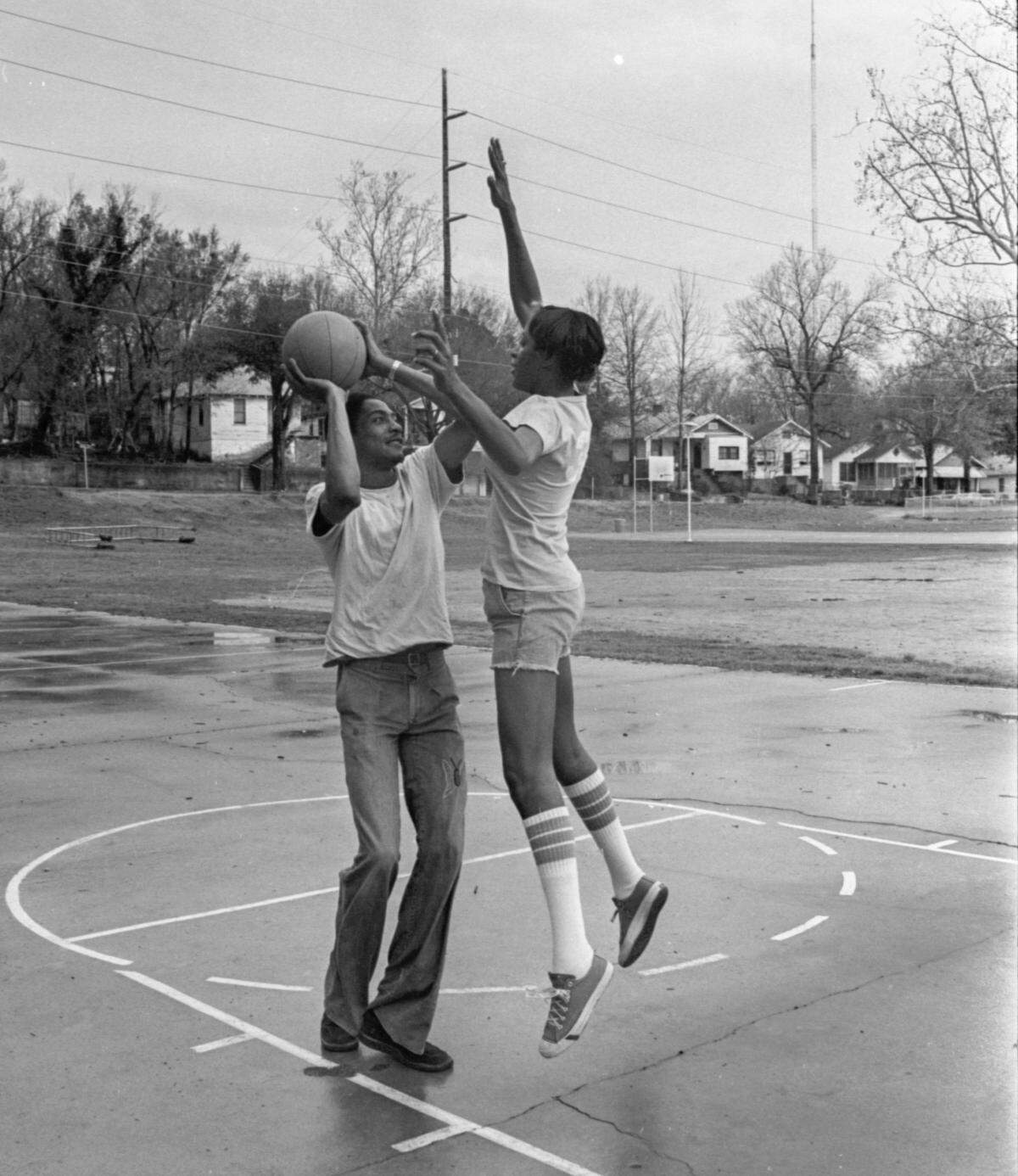
“And then we’d dig a hole and we’d put it in the ground. And just so it wouldn’t rock, we’d put brick rocks around it so it would stay stationary. Then, we’d put in the dirt. And we did this in the backyard, and it was slanted. So a lot of times, when you shot the ball, if you missed the shot, it would roll down the hill and you had to go down and get it. So you had to learn to shoot the ball without missing.”
The neighborhood kids gave English the nickname “Flick,” a fitting title for someone who hit more than 50 percent of his shots at the NBA level. But every story gets twisted with time and this is one of them.
While English was developing a smooth stoke in Columbia parks, his rapid growth was causing unfortunate attention.
“I was long and lanky and I was kind of awkward,” English said. “And one of the guys was saying I was afflicted. Kids can be brutal sometimes. And then he shortened it and he just called me Flick. And it stuck with me a while.”
Name’s origin aside, “Flick” still echoes in certain sections of his hometown.
“Even to this day, folks that are 50, 60, 70 year old, they still refer to him as Flick as opposed to Alex English,” said Carey Rich, who came up through inner-city Columbia in the 1980s and played point guard at South Carolina. “And that was the street cred that came along with being a really good basketball player.”
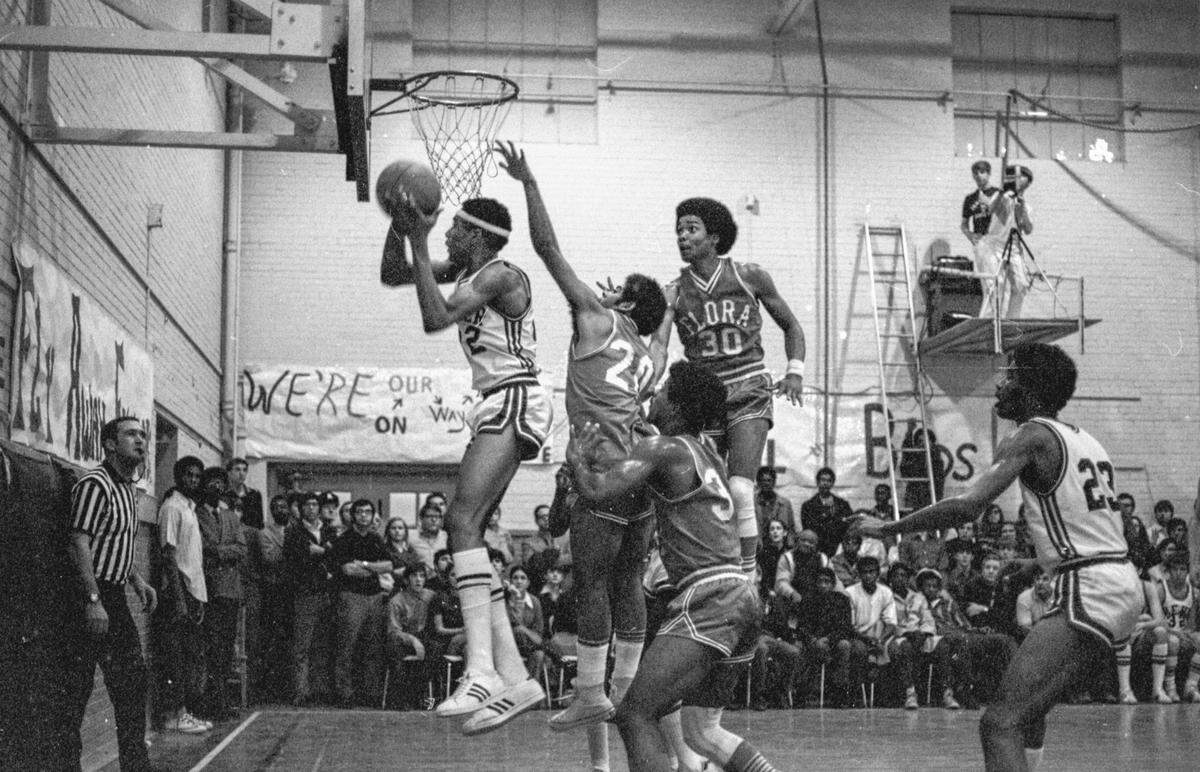
English was the best player in South Carolina by the time he was a senior at Dreher High School. He said he “can’t count the colleges that recruited him,” but some finalists remain clear: Oklahoma, Maryland, Minnesota, Clemson and USC.
A visit to Oklahoma meant seeing the Sooners play football against O.J. Simpson and Southern Cal. English liked Maryland as a “great opportunity” under then-coach Lefty Driesell. The Minnesota program was attractive because of then-coach Bill Musselman, but the weather was too cold. And Clemson, led by Tates Locke, was seriously considered, “but I would not betray my hometown,” English said.
He was a Gamecock.
Paying it forward
South Carolina’s courting of English included a trip to Peddler Steakhouse in Five Points.
The kid who grew up on beans, rice and grits — with fried chicken and cornbread as the special Sunday meal — never had a steak until Frank McGuire invited him to dinner.
“It was just great,” English said. “And the Columbia community, the alumni, was very welcoming. But it was mainly Frank McGuire. He was a very classy man.”
McGuire, Carolina’s legendary coach from 1964-80, long stacked rosters with New York talent. But in the early 1970s, McGuire’s staff made a local star a priority. Donnie Walsh, an assistant at the time, knew little about English’s humble beginnings.
“Alex wouldn’t have mentioned it,” Walsh said. “He was such a good guy in every way to be around. He just was. He was only thankful for everything.”
There was a pay-it-forward nature to English’s commitment to South Carolina. If he could succeed there, it could finally put a spotlight on his neighborhood and beyond.
“It was known that the University of South Carolina did not have and hadn’t recruited a lot of African-American players,” English said. “And I knew that they were a lot of great basketball players in Columbia because I played against them during the summer time. So I wanted to go and be a part of that era, that situation, and making it so that other African-American players could feel comfortable going there.
“Because the word was you go there and they might have seen Casey Manning, my teammate and roommate, and saw that he didn’t get a chance to play much. And they said, ‘Oh you’re going to go and you’re not going to get an opportunity to play and dada, dada, dada.’ I had a lot of confidence in myself in my ability, but I also wanted other African-American players feel comfortable coming there.”
Most pioneers end up in a shallow grave along some path off the main drag. That’s the saying, coined by Carl Sanburg, Manning uses to describe the impact of his time with the Gamecocks. The first African-American to play basketball for USC made it to his senior year, long enough to be English’s freshman roommate.
Manning’s path — one he stayed on as a black man in the South in the early 1970s — had its challenges “and that meant I had to ignore some things,” Manning said. “We’re 17-, 18-, 19-year-old kids. But I had to remember I’m not always going to be 17, 18, 19. I’m going to be 30, I’m going to be 50, 60. So I had to have a vision of the future, a sense of history.”
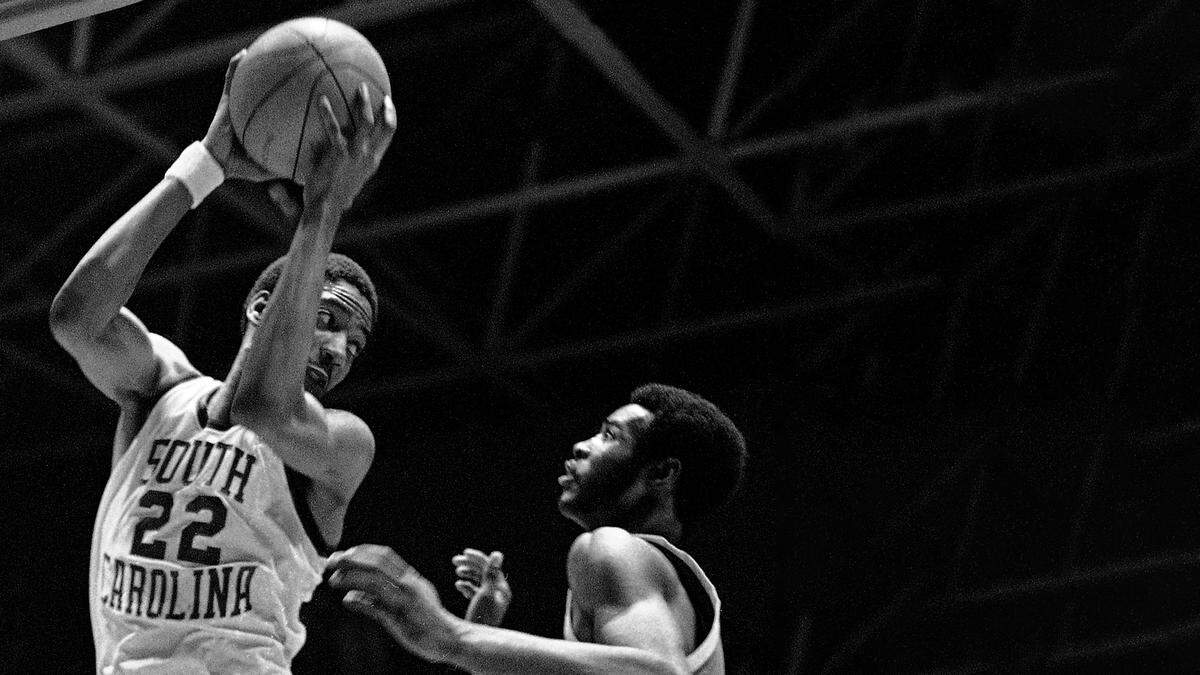
On a wall outside his office in the Richland County Judicial Center, Manning — now a circuit court judge — has framed a black-and-white photo from his playing days. There’s Manning, No. 44, and English, No. 22, sitting next to one another while McGuire shouts instruction during a timeout.
“I knew the significance of being a pioneer,” Manning said. “Why did I stay at USC? For someone like Alex to come along.”
When English finished his Carolina career, he was the school’s all-time leader in points and field goals, but also starts and minutes played.
Manning delivered the greatest assist in USC history.
“He laid the groundwork for me,” English said. “When I came around, I was the best player in the state and got an opportunity because the groundwork had been laid. I guess people were more accepting. I didn’t get as much pushback.”
After English, Nate Davis (Eau Claire) came in USC’s next recruiting class. Golie Augustus (Keenan) came a year later. All three were drafted into the NBA.
“From the Columbia area, I think I was the first player on scholarship,” English said. “There were other players who had tried out and made the team, but didn’t get a chance to play. So it was important for me to see my fellow Columbians come and be a part of the history-making, too, because I knew what they could do. I played against them all the time in the park and I knew the great talent.”
Azaleas and dogwoods
English’s skill set was different. As current South Carolina coach Frank Martin tells it, English “would get 40 and not even break a sweat on you.” It was a signature, effortless style that eventually found steady work in Denver.
The Milwaukee Bucks drafted him, the Indiana Pacers traded him, but the Nuggets kept English for 11 seasons. He made the All-Star Game in eight of them and led the NBA in scoring in one of them.
English was a rock star on a perennial Western Conference contender.
“When I was in school,” said Jade-Li English, the oldest of Alex and his wife Vanessa’s five children, “people were like, ‘Oh my God, that’s Alex English’s daughter!’ We’d go to dinner or the grocery store or whatever and we’d be mobbed.”
Denver, English said, was a “great city” and a place he considered settling in upon retirement, but it lacked a few crucial touches of home. He found himself traveling east shortly after early playoff exits.
“If it was over before school was,” he said, “I would just leave the kids there with their their mom and I would come home to Columbia.
“I just wanted to get a taste of my springs, my Columbia springs — the azaleas and the dogwoods.”
These were quick trips. Longer stays included the entire English clan. Dad drove the Suburban cross-country so his kids could experience summers as he once did.
“It was kind of like living two lives — Denver and then Columbia,” Jade-Li said. “Columbia, it was a little different because it was like every one knew him personally. Everyone called him Flick. Of course, people would approach him in the streets and what not. Like, ‘Flick, remember when we did this?’ It was like he knew everybody here.”
English always tried expanding that base in his hometown. A budding legend by the 1980s, he’d host camps and often used Columbia’s best high school players as counselors.
“We didn’t make a whole lot of money, but it wasn’t about the money,” said Rich, a state champion point guard for C.A. Johnson. “He gave us free shoes and we got the opportunity to hang with and be part of an NBA player for an entire week.
“That was a big thing to us. He made us understand the importance of giving back to the young kids that are following in our footsteps.”
Rich in October founded Captain’s Hope, a non-profit organization that plans events and provides for Columbia’s youth.
“He put us in situations early on to make sure that young kids following us had a good example to follow,” Rich said of English. “He was the guy that did that.”
Legacy secured
English played his last NBA game in 1991. He’s since retired to a life of variety.
He was an assistant coach for the Atlanta Hawks (2002-03), Philadelphia 76ers (2003-04), Toronto Raptors (2004-11) and Sacramento Kings (2012-13). Already an experienced actor from roles in Amazing Grace and Chuck (1987) and Midnight Caller (1989), English appeared in Eddie in 1996 as an opposing coach against Whoopi Goldberg’s New York Knicks. He owned Wendy’s franchises for 16 years, and he was heavily involved with the National Basketball Players Association.
The list continues to grow. Travels to NBA academies in China, Europe and South America as a game ambassador. Owner and operator of a European Wax Center. Hands in the CBD business. SEC Network analyst.
Sitting on a couch in the den of his Blythewood home, he revealed progress toward his latest project. English has linked with Family Promise of the Midlands in an effort to help Columbia’s homeless. He noted Columbia native and NBC News anchor Craig Melvin’s work with the organization on a national level and added, “maybe I can follow in his footsteps.”
A “proud Columbian” looking out for his city’s future.
English’s No. 22 has long been retired by USC. Friday, Dreher High School did the same. It’s a legacy secured in a place he’s never wanted to leave.
“It’s always good to be able to come back and dig your feet in the sand,” Flick said, “and feel your roots.”
This story was originally published January 30, 2020 at 5:00 AM with the headline "Call him Flick or basketball legend. Alex English’s roots and heart are in Columbia."