The next branch of the Dean Smith coaching tree extends to high school level and beyond
Legendary basketball coach Dean Smith took two teams to the Final Four in the late 1990s before he retired in ‘97.
Smith, who coached for 36 years at North Carolina, has a coaching tree that includes a who’s who of basketball hall of famers, many of whom coached in the NBA (Larry Brown, George Karl) or experienced success at the collegiate level (Roy Williams).
Another branch of the Smith coaching tree has suddenly started to sprout, mainly from the 1994-95 Final Four team.
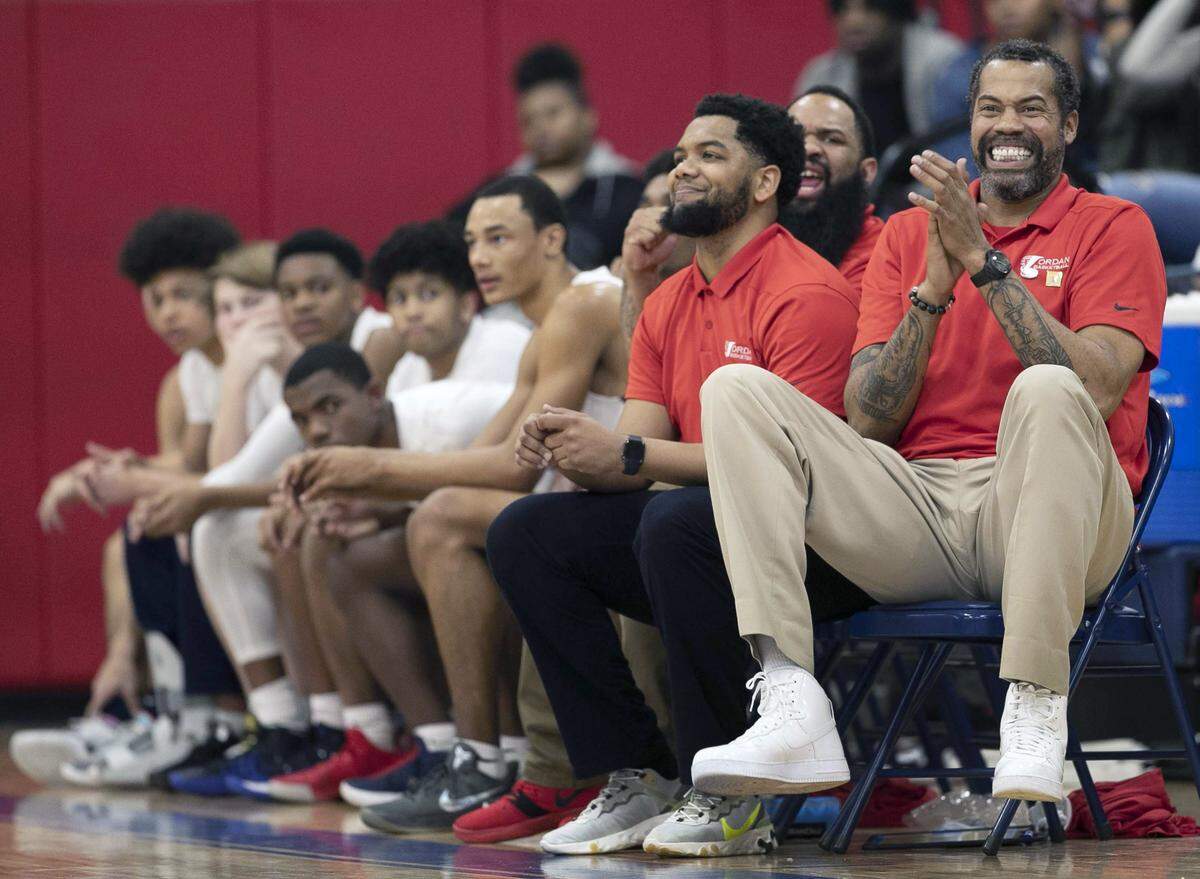
The four leading scorers from that squad — Jerry Stackhouse, Rasheed Wallace, Donald Williams and Jeff McInnis — are all coaches. Three of them are high school coaches in North Carolina, including Wallace and Williams, who are coaching in the Triangle. Wallace is in his first season as the varsity boys coach at C.E. Jordan, while Williams is in his third year as the girls basketball coach at Wakefield High School.
McInnis coaches Combine Academy in Lincolnton and Stackhouse is in his first year as the head coach at Vanderbilt University.
Others on that team have also ventured into coaching, but the stars aligned so that this is the first season the leading scorers are all on the sidelines.
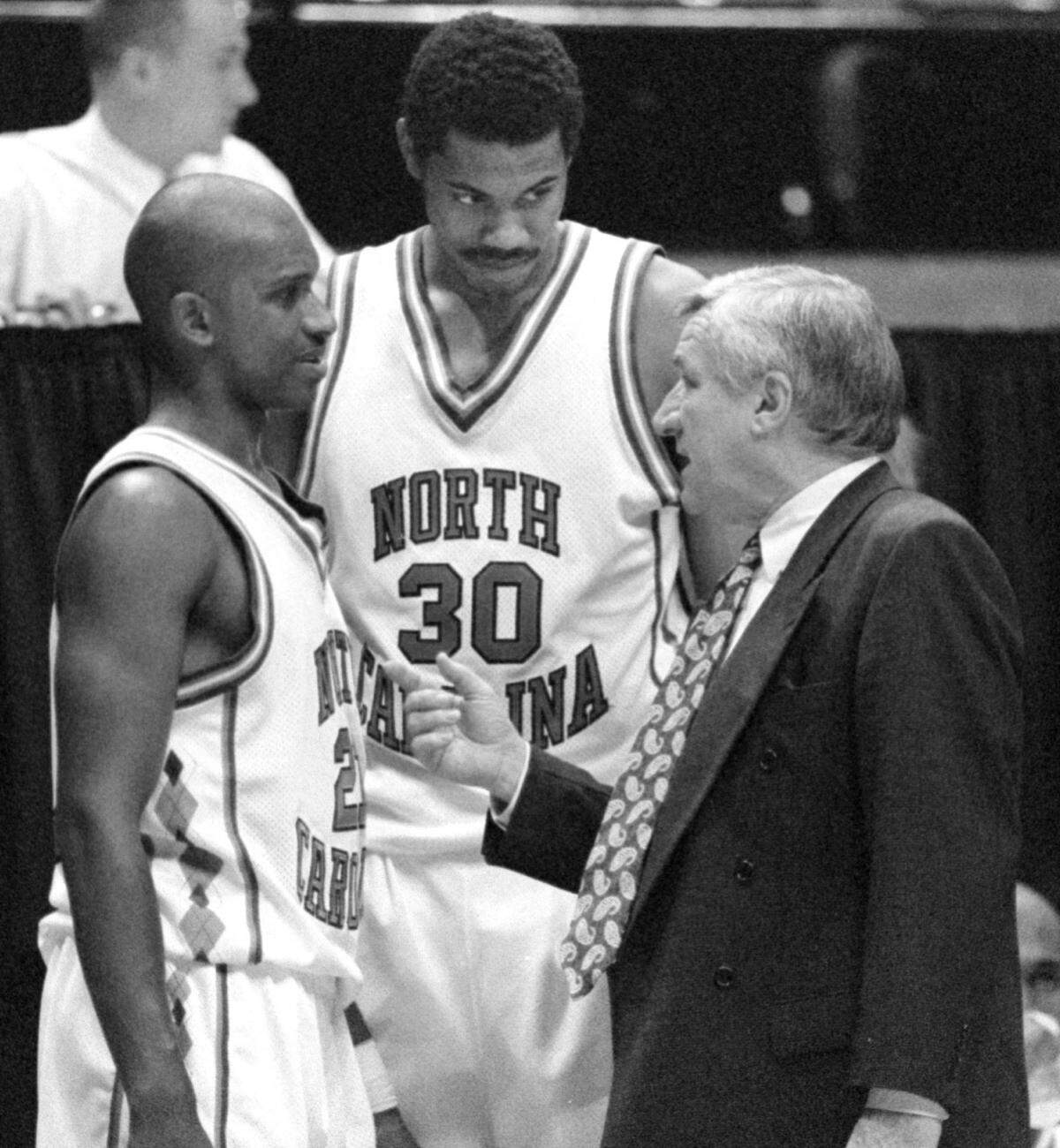
During the 1994-95 season, the Tar Heels went 28-6 overall and 12-4 in the ACC, finishing second in the league. Behind super sophomores Stackhouse, Wallace and McInnis and a senior in Williams, UNC made it to the national semifinals where it fell to Arkansas.
Back then, when they were one of the best programs in college basketball with two future lottery picks (Stackhouse and Wallace), a coaching future was the furthest thing from the players’ minds.
“To be honest I didn’t think any of us were going to be coaches on any level,” Wallace recently told the N&O. “I just didn’t see it then.”
In a quick survey, the former players were recently asked who they had least expected to be a head coach one day, and Wallace was the unanimous choice. He even named himself when presented with the question. During his sophomore season at UNC, Wallace was the second-leading scorer, averaging just under 17 points per game. The Philadelphia native was a second-team AP All-American in 1995 and was the fourth overall pick in the NBA Draft that summer, selected by the Washington Bullets.
Throughout his long NBA career, in which he won a championship with the Detroit Piston, Wallace was known for his intensity on the court and his battles with officials. He holds the NBA record for most technical fouls and ejections in a season.
“You have to have patience (to coach),” Williams said. “They probably didn’t think Rasheed had patience.”
But all of his UNC peers agreed that Wallace probably has the best basketball mind out of the bunch. The intensity and outbursts might have overshadowed that basketball I.Q. Those who were around him in the gym for years know he has an eye for details like no other, and that he’s a great teacher — which made coaching second nature.
When Stackhouse briefly coached in the G-League, Wallace occasionally came to practice and worked with the post players. That’s when he saw firsthand how much his former teammate had to share.
“He had so many jewels and so many nuggets of information, especially for big guys,” Stackhouse told the N&O. “Just watching him teach was really eye opening for me, just thinking this guy should be on somebody’s bench or eventually having his own (team) and I am glad that came about for him.”
WANTING TO SEE A BETTER GAME
The coaching bug hits everyone at a different time. Some players know it’s in their future from day one. In the case of Stackhouse, Wallace and McInnis, long NBA careers put that on hold. Even when they hung up the sneakers for good, it wasn’t an automatic next step.
Stackhouse remembers the exact moment he was bitten. His son was in the seventh grade and Stackhouse went to watch one of his AAU practices in Atlanta. According to Stackhouse they were just rolling the ball out and playing.
He compared it to playing pick up basketball in a formal setting.
“They were all over the place,” Stackhouse said. “I decided it was time for those guys to start really learning the game. I started coaching them and formed my own AAU program and that’s when I got the bug, when I started to see those kids get better.”
Wanting to see a better basketball is also what motivated Wallace.
“I got tired of seeing nasty basketball in the NBA and college,” Wallace said. “Guys just depend on one facet of their game; oh I can jump, that’s all I’m going to do, I’m not working on anything else because I can jump or dunk. Or if I can shoot a three I’m not working on my defense. To me, this game now in college and in the NBA, it’s me ball, not we ball.”
Wallace’s Jordan team is currently 10-10, two more wins than 2018-19 with three games remaining in the regular season. With Wallace on the bench, the Falcons are trending in the right direction — the basketball mind that Stackhouse and Williams talked about being put to good use.
“He has a lot to offer and a lot of people don’t know that part about Rasheed,” Williams said. “That guy loves kids, he’s going to do it his way, but he loves kids and wants to give back to the community.”
Wallace was a fixture behind the Wakefield bench at times the last few seasons, supporting Williams, the 1993 Final Four Most Outstanding Player. Williams shows way more intensity on the bench than he did during his playing days at UNC.
Williams has won 65 games in three seasons and is on pace for his third consecutive 20-win season. When asked what made him get into coaching, the Garner native talked about not wanting to waste the knowledge passed onto him by Smith.
“I think through his system and his style, he really taught us how to teach the game,” Williams said. “We learned so much. I feel like I learned so much basketball from that man it’ll be a sin for me to not pass this knowledge on to these kids.”
When they arrived in Chapel Hill from various parts of the country, the players might not have known as much about basketball as they thought. Smith opened their eyes to a level of basketball that would not only help them thrive at UNC, but beyond. Wallace and Stackhouse were multi-time NBA All-Stars; McInnis played in the NBA for seven years and Williams had a long career playing professionally overseas.
Stackhouse attributes that to Smith seeking out a particular type of player when he went out recruiting. Not just a player who could run fast and jump high, but one who could think the game.
“Coach Smith, when he was recruiting he went out and got certain guys that obviously had talent,” Stackhouse said. “But were able to grasp what he was able to teach as well. Not everybody is made to go to Carolina and I think we fit the bill of the kid that they wanted to bring in.”
LEARNING FROM THE GREATEST
While at Carolina, playing and making a run at a national title was the only thing the group thought about. They wanted to win games, then go to the next level, attempt to win more games and make a living while doing it.
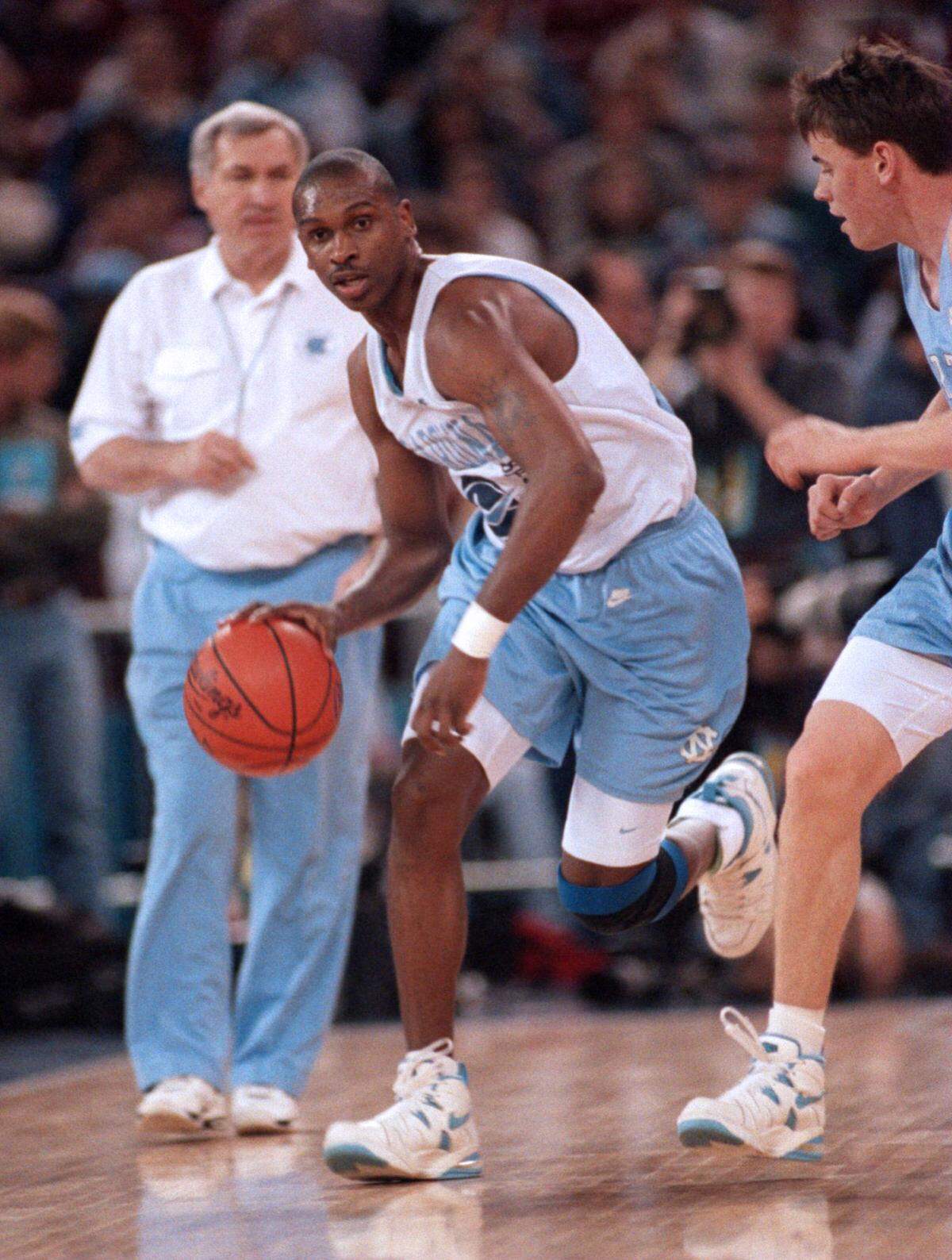
During their tenure in Chapel Hill they were learning from one of the best, who was setting them up for their next act, even if they didn’t realize it at the moment. Stackhouse said learning under Smith was something they took for granted during their college days. Once he got to the NBA, that’s when Stackhouse realized just how much he soaked up during his two years at UNC. He found himself grasping concepts faster than some of his teammates because of the learning process he had under Smith and his coaching staff.
When asked who was the coach on the floor during their playing days, the natural answer were the guards like Williams, McInnis and Shammod Williams, who has also done some coaching since leaving UNC.
But none of the players could point to one guy on the 1994-95 roster and say ‘I knew he would be a coach one day.’
Stackhouse remembers being a rookie and how veterans on the Philadelphia 76ers were threatened by the presence of the No. 3 overall pick. He vowed to never be that way and always helped the younger players on his teams. He points to that moment for him gravitating towards younger players, becoming more of the teacher, less of the student as he got older.
They all have lessons they’ve taken from Smith, the biggest one for Stackhouse is to have poise on the sideline. Wallace and Williams execute their Xs and Os to the T, and Williams pointed out that McInnis shows an amazing ability to connect with his players.
It’s the reason why not only the starters made the transition to become coaches, but even the role players like Donte Calabria and reserves such as Ed Geth have had coaching careers.
“Damn near everyone on the team became a coach,” Wallace said. “It’s like we are all a rendition of Coach Smith.”
This story was originally published February 7, 2020 at 11:27 AM with the headline "The next branch of the Dean Smith coaching tree extends to high school level and beyond."