SEC weighing new football schedule options. What they mean for South Carolina
Four days of beachfront discussions weren’t enough to resolve the Southeastern Conference’s plans for future football schedules.
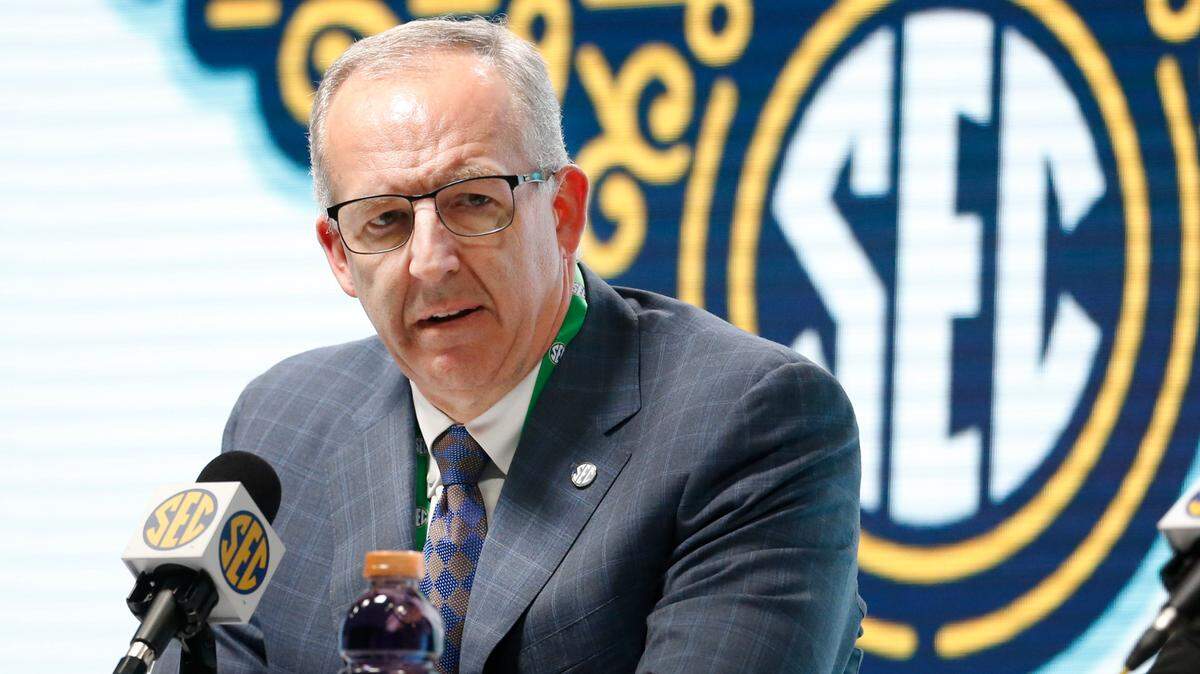
SEC commissioner Greg Sankey told reporters Friday that administrators couldn’t come to a resolution on potential changes to the league’s scheduling structure during the conference’s spring meetings this week.
“We’re going to work on answering some questions, seeking some clarity on some matters over the summer,” Sankey said. “Looking toward late summer to mid-fall for outcomes.”
So where does that leave things, particularly for South Carolina? Let’s backtrack for a second.
The SEC is considering changes largely due to the impending additions of Texas and Oklahoma that, for the time being, are slated for 2025. The prevailing thought is the league will eliminate its current division structure to allow for a more flexibility in rotating matchups.
Sankey confirmed Friday that options are essentially down to two models — an eight-game conference slate that would include one permanent opponent and seven rotating matchups; and a nine-game conference schedule comprised of three permanent opponents and six rotating contests.
“If we’re going to play nine conference games and we’re going to end up playing probably five minimum top-15 teams in the country — and I’m talking about all of us, not just our team — how is that going to compare to other conferences?” Alabama head coach Nick Saban, a longtime proponent of playing more conference games, said on Tuesday. “We could have a great team and lose two games in our conference, and somebody else gets the playoffs because they went undefeated, but they didn’t have the same opportunity to play as many good teams.”
South Carolina, at least on paper, will be likely proponents of the eight-game model given, among other reasons, its annual matchup with Clemson.
The nine-game format would stipulate South Carolina add an SEC contest to a yearly ledger that already includes its in-state clash and, for the foreseeable future, a second Power Five nonconference game on the books. As it stands, South Carolina has matchups with North Carolina, N.C. State, Miami, Virginia Tech on its schedule over the next 10 years.
A nine-game SEC schedule in the short term would leave room for three other games in which USC would play Clemson, one of the aforementioned Power Five teams already under contract and a third opponent — presumably an FCS team.
Short of lawyers navigating USC out of those existing Power Five opponent deals, however, that makes the path to bowl eligibility year to year a far stiffer task.
Sankey also noted the league’s timeline for a change is needed, at least in part, due to continued research and analysis as far as what schools already have scheduled in the future.
“This is the best conference in all of America,” South Carolina head coach Shane Beamer this week said in response to a question about scheduling. “And you’ve got some of the most decorated college football coaches in the country sitting in that room. So to be able to sit in there and listen and learn is great. Hearing new ideas — future of the conference, future of college football, future of college athletics — I mean, there’s a lot to have a lot to discuss in there.”
This isn’t to say the eight-game model is a perfect scenario.
That one permanent opponent clause would likely lead to the elimination of secondary rivalry games like Auburn-Georgia, Alabama-Tennessee and, for better or worse, South Carolina-Florida.
The nine-game, three rotating permanent opponent formula, by contrast, would give more flexibility to schools like Alabama, LSU and Tennessee, whose rivalries reside in the conference, compared with those like South Carolina (Clemson), Georgia (Georgia Tech) and Kentucky (Louisville) with non-SEC Power Five games scheduled annually.
“It does,” Sankey said as to whether out-of-league rivalry games have factored into the scheduling discussions. “We’ve done a good job of honoring those.
“You have to remember that, over time, if you go back and look, Kentucky-Louisville was an early season game. It’s now a late season game. We used to have some rivalry games played the week before Thanksgiving — I mean in-conference rivalries. We’ve adapted over time and that’s part of the care that’s being given to how we determine the outcome.”
Sankey cautioned reporters during his opening address on Tuesday the league hoped to have a resolution on the scheduling conundrum sooner than later, but it didn’t have to happen this week. He added Friday he feels poised to make a decision, but the league’s members remain split.
The additions of Texas and Oklahoma — which Sankey said have been involved in the scheduling discussions — give the league impetus to determine its scheduling future. So, too, does the uncertainty regarding the College Football Playoff, whose current contract will expire in 2025.
That said, the it’ll take another few months before the scheduling picture becomes clearer.
SEC scheduling format changes approved
Though what happens in football has not been resolved, new scheduling formats have been approved for men’s basketball, women’s basketball, soccer, men’s tennis, women’s tennis and softball as the league prepares to add Texas and Oklahoma for the 2025-26 sports seasons. The information below is according to an SEC statement released Friday.
Men’s basketball
Regular season: Each season a team will play two permanent opponents home and away, one rotating opponent home and away, plus the 12 remaining teams in single contests either home or away, for a total of 18 conference games.
SEC tournament: All 16 teams will compete in a single-elimination format, consistent with the current format but with two additional games. The top four seeded teams will continue to receive a bye through the first two rounds of the tournament.
Women’s basketball
Regular season: Each season a team will play one rotating opponent home and away, plus the 14 remaining teams in single contests either home or away, for a total of 16 conference games.
SEC tournament: All 16 teams will compete in a single-elimination format, consistent with the current format but with two additional games. The top four seeded teams will continue to receive a bye through the first two rounds of the tournament.
Soccer
Regular season: Soccer will continue to compete in a two-division format. Each season a team will play seven divisional opponents plus three cross-divisional opponents on a rotating basis, for a total of 10 conference games.
SEC championship: 12 teams will compete in a single-elimination format, with the top four seeded teams receiving a first-round bye.
Men’s and women’s tennis
Regular season: Each team will play a single round robin against all other teams in the conference, consistent with the current format.
SEC championships: All teams will compete in a single elimination format with the top four seeded teams receiving a bye through the first two rounds of the tournament.
Softball
Regular season: Each season a team will play a three-game series against eight rotating opponents, for a total of 24 conference games.
SEC tournament: All teams will compete in a single-elimination format, consistent with the current format but with two additional games.
This story was originally published June 3, 2022 at 2:48 PM with the headline "SEC weighing new football schedule options. What they mean for South Carolina."