Talking Season is upon us: Five key discussion points entering ACC football media days
The real, actual start of the college football season doesn’t begin for another five weeks or so but, no matter — Talking Season can be almost as entertaining. Depending on the topic and who’s doing the talking, it might even be more entertaining.
And now we’ve reached peak Talking Season, also known as conference football media days.
The Big 12 held its version last week outside of Dallas, where its incoming commissioner, Brett Yormark, spent a lot of time discussing branding and how “to position our brand a little younger, hipper, cooler.” The SEC’s media days, meanwhile, began Monday in Birmingham, Alabama, where commissioner Greg Sankey, perhaps the most powerful figure in college athletics, gave a 3,000-word state-of-the conference address in which he said “there’s no sense of urgency in our league” to expand after the Big Ten recently plundered the Pac-12 for USC and UCLA.
“No panic and reaction to others’ decisions,” Sankey said. “We know who we are.”
Yes, the SEC has good reason to be confident these days. Same with the Big Ten.
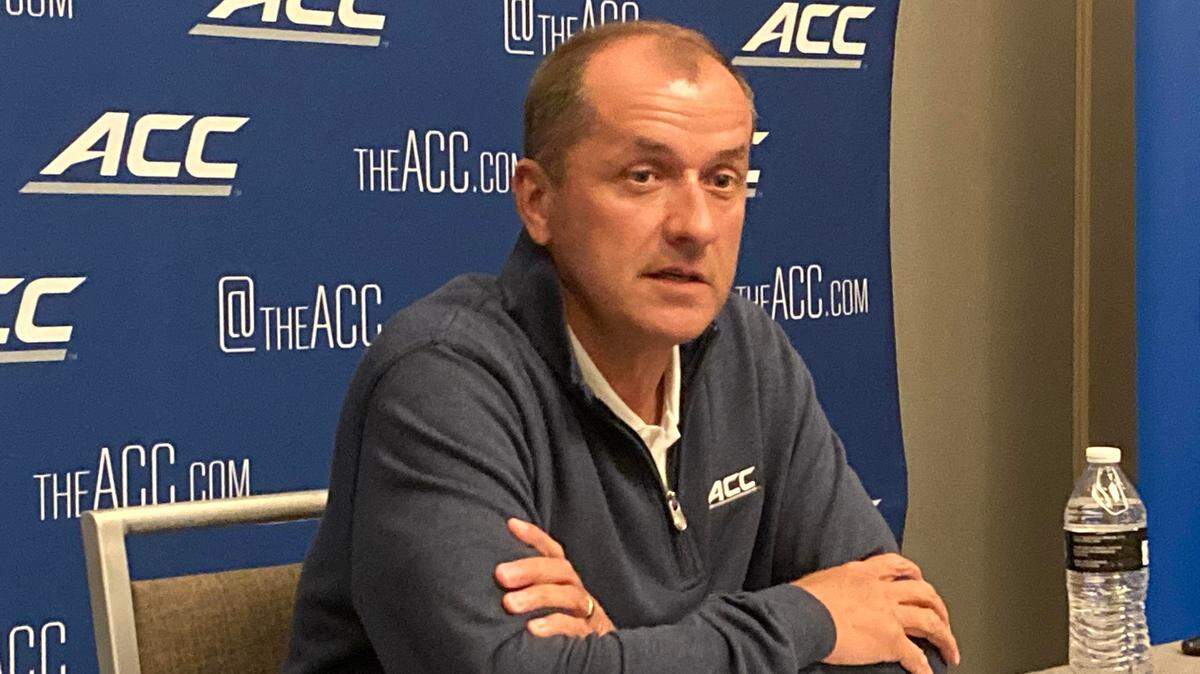
The ACC? These are vulnerable times for the conference, which is hosting its annual football media days in Charlotte this week. Day one is Wednesday, starring Jim Phillips, in his second year as commissioner, and coaches and players from the Atlantic Division. The Coastal Division takes its turn on Thursday. And remember, the 2022 season will be the ACC’s last with a divisional format.
That’s likely to come up a time or two over the next two days, though there’s a good chance the focus in Charlotte will be most directed toward all things off the field. Name, image and likeness (NIL), the transfer portal, the state of the conference overall, amid another massive upheaval in college athletics. Prepare to hear a good amount about all of that, and more.
To get yourself ready for the talking, allow for some reading. Here is a primer, of sorts, about the most important things everyone will be discussing during the ACC’s media days:
Realignment! Expansion! Chaos!
Last summer, it was the SEC moving to add Texas and Oklahoma from the Big 12. This summer, it’s the Big Ten poaching the Pac-12 for USC and UCLA. Both developments were bombshells, but the Big Ten news, especially, inspired a chain reaction of panic and anxiety that continues to reverberate. In an instant, it all became very clear where major college athletics seems to be heading: toward a two superconference model, with those schools on the outside looking in facing a considerable financial disadvantage.
The plight of the ACC has been well-documented, here and elsewhere. The facts are plain enough: The conference generates hundreds of millions of dollars less than the Big Ten and the SEC. The revenue gap will only grow wider. The ACC is locked into an unfavorable contract with ESPN through 2036, but also a grant of rights agreement that is holding the league together.
Phillips, in his own version of the ACC’s state of the union, will be expected to bring calm amid all the turmoil. Undoubtedly, certain ACC schools have to be exploring their options these days, even if the grant of rights is impossible to maneuver around. The conference has a perception problem — namely that its failure is inevitable and that some schools will leave as soon as they can.
And so how does Phillips combat this? There’s only so much to be done about the TV money — no one should expect ESPN to all of a sudden start giving away cash to make the ACC feel better — but Phillips has to address the elephant in the room and guide the league through turbulence.
The ACC’s ‘BRAND’
College athletics is an industry of copycats, where ideas are passed around so much it can be difficult to remember where they originated. Big things like expansion and realignment go round and round, conferences trying to keep up or outdo each other. Small things like uniform reveals on social media are imitated and adopted from one school to the next.
Yormark, the Big 12 Commissioner-to-be, talked about the need for that conference to enhance its “brand” last week at Big 12 media days. So, the odds that Phillips talks branding have to be greater than 50 percent, no? It’s easy to poke fun at the corporate-speak, and Yormark’s mission to make his league more hip, but it is true that the ACC’s perception problem, mentioned above, is also a branding problem.
The SEC’s brand is clear these days. It’s the best and most important football conference in the country. The Big Ten’s brand is also clear — a league of mostly large, academically-strong Midwestern state schools (well, until 2024, at least) with a rich football tradition. What is the ACC’s brand? There’s so much enviable basketball tradition and history throughout the league but, sadly, that doesn’t move the financial needle these days the way it used to.
And football? Well, in recent years it’s been Clemson and everyone else. And for a long time before that, it was mostly Florida State and everyone else. Phillips, like his predecessor John Swofford, has emphasized that football needs to be the main priority, and rightfully so. Yet it’s impossible to wave a magic wand and create four or five top-20 programs.
And so short of immediate on-the-field improvement, how does the conference combat its perception problem? Making it cooler and hipper, to borrow Yormark’s terminology, probably isn’t the answer. (Or maybe it is! Who wouldn’t be inspired by, say, some Dave Doeren and Mack Brown Tik-Tok dances?) Still, Phillips and those leading the league could indeed stand to bolster its brand, and fight the perception that it’s ripe for poaching.
All things NIL, transfer portal
If not for all the hubbub surrounding realignment and questions of the ACC’s long-term viability, the state of NIL, and all its wrought, would probably be the No. 1 thing on everyone’s mind this week. Phillips and the league’s football and basketball coaches spent a lot of time talking about NIL, and its unintended consequences, during the league’s spring meetings in May in Amelia Island, Florida.
The main takeaway then was this: Everyone is in favor of athletes being able to make some money (or, if coaches and administrators are not in favor of it, they’re generally smart enough not to say that publicly), but the problem is in the execution, and the lack of any regulation or enforcement. The intent of NIL, remember, was to allow athletes the ability to enter into endorsement deals or sign autographs for money or to run a side hustle on YouTube or Cameo.
It was not to create a blatant pay-for-play model — yet, predictably, that’s what NIL has become in a lot of cases, with booster-backed collectives or other businesses or organizations simply bidding for players, and in some cases inducing them to transfer for money. This has put college athletics, and those in charge of them, in a tricky spot.
No one wants to be seen as limiting athletes’ ability to capitalize on their market value, whatever that value may be. Yet also, it’s fair to acknowledge that the current free-for-all is probably not sustainable, or good for the two sports, football and men’s basketball, that drive the most revenue. The solution that makes the most sense is also the one that probably causes the most consternation among the power brokers of college athletics, and that’s to classify athletes as employees and collectively bargain with them about how to divvy up the revenue.
You know, how they do it in other billion dollar sports leagues in America.
That sort of dynamic, though, still appears a long ways off, given that those in charge are clinging to the tattered shreds of amateurism. In the meantime, coaches will continue to grumble — and there’s likely to be some quality grumbling this week in Charlotte about all of this. As for meaningful ideas about how to impart change? Don’t hold your breath.
Oh yes, football
Amid all these larger issues surrounding college sports these days, we almost forgot: There’s a season to play, too. There’s an argument to be made that perhaps this is the most important ACC football season ever. OK, maybe that’s a stretch — and that’d be difficult to define, anyway, but it is indeed a season of significance.
It’s easy enough to understand why: If the ACC is to ever make a move toward more national prominence, and toward a more favorable TV deal (if one can even be mustered at some point in the next 14 years) it has to start now. The Atlantic Division, in this season of farewells to the Atlantic and Coastal, will be stout. Clemson is Clemson, yes, but N.C. State is a preseason favorite; Wake Forest will be good again; Florida State appears on the rise; Louisville should be competitive. There are probably three, maybe four Top 25 teams there.
And what does the Coastal have in store for us in its last hurrah? It has long been derided as the weakest division of any in the Power Five (now the Power Two, remember) but the Coastal has also brought us so much joy. Every team winning it at least once over the past eight years. The circle of chaos. It’s a division of former UNC coach Larry Fedora kicking off twice to start both halves and of Miami completing a hundred-lateral kick return for a touchdown in the final seconds against Duke. Only in the Coastal could Miami have transformed from national power to ... whatever the Hurricanes have been for most of the past 17 years.
But maybe, in this final act, the Coastal grows up. Is this the year Miami returns to prominence, and remains there? And what of North Carolina, which went from top 10 in the preseason last year to a frustrating 6-7 by the end of the season? Might the hype surrounding the Tar Heels have been just a year too early? Mack Brown hasn’t had much trouble recruiting in recent years, after all.
N.C. State: preseason darling?
You know it’s Talking Season when a team that has historically underachieved has been anointed as being on the verge of a breakthrough. And look, sometimes those breakthroughs happen, and sometimes the prognostications are correct.
And sometimes, well — sometimes the preseason hype turns out to be the highlight of the entire season. That was the case a year ago for North Carolina, the ACC’s 2021 preseason darling. Remember the top-10 ranking? The visions of crashing the College Football Playoff? The talk of Sam Howell for Heisman? It was pretty much all over by Week 1, with a loss at Virginia Tech.
This year, N.C. State ascends to the Throne of Preseason Hype. It can be a dangerous place. Many teams have stood there, basking in the unearned adulation, and suffered a quick and painful fall once the games start. The Wolfpack begins with a challenging one, too, on the road against ECU in what’s sure to be a raucous and not-especially-sober (even for a noon game) Greenville.
For now, though, there’s nothing but good vibes for State. Devin Leary is back. Pretty much the entirety of a strong defense is back. And N.C. State, if the punditry is correct, hasn’t had this good of a chance to win the Atlantic since ACC divisions came into existence in 2005. This is probably the most anticipated Wolfpack team since 2003, and Philip Rivers’ senior year.
An early season loss at Wake Forest sucked the air of a red and white balloon that year, and State has more often than not entered every season since off the national radar. But not this year. The hoopla is here. The hype. The lofty prognostications. Who knows if the Wolfpack is really for real? That’ll be decided much later.
For now this is all talk, anyway.
This story was originally published July 20, 2022 at 5:10 AM with the headline "Talking Season is upon us: Five key discussion points entering ACC football media days."