‘He was Johnson C. Smith.’ Pettis Norman dies, but will always be remembered in Charlotte
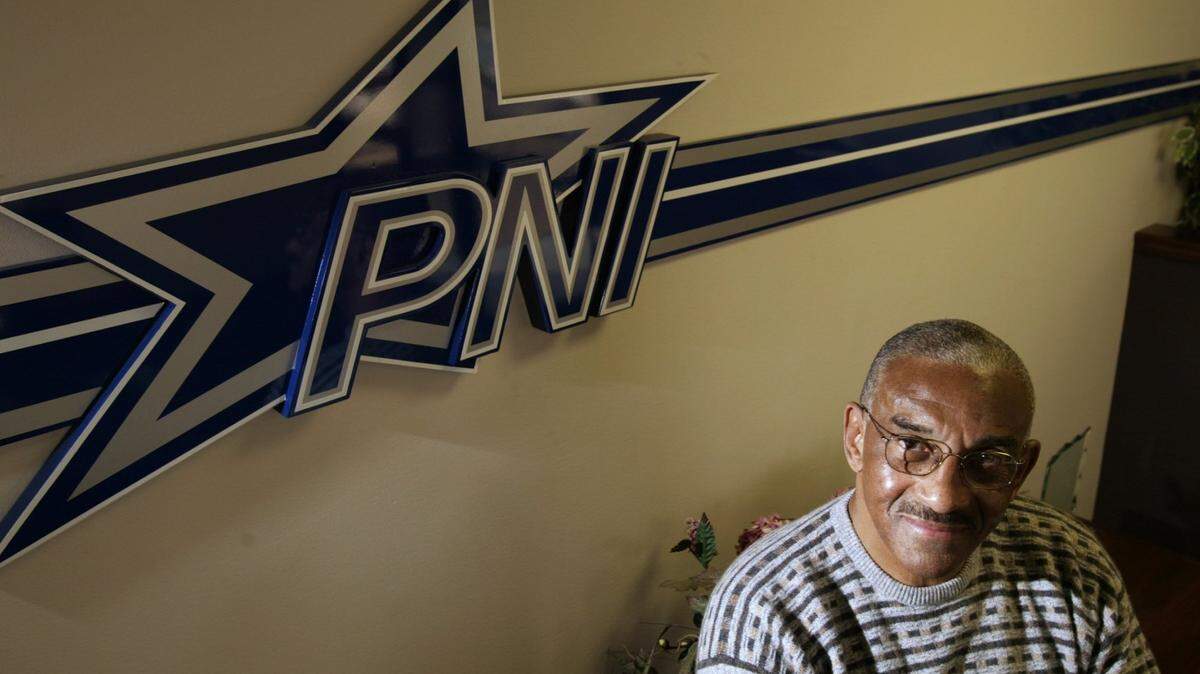
There’s a story from long ago that still echoes around Johnson C. Smith’s campus. It doesn’t bounce off the same streets it once did, or linger in the same corner stores. But it’s there.
It’s about a young man and a younger man and how their meeting was the beginning of something their city of Charlotte had never seen before. It was the summer of 1958. The young man was Eddie McGirt. He’d just been named head football coach at Johnson C. Smith University. The younger man was Pettis Norman. He’d recently graduated from West Charlotte High School and was headed to the Air Force.
McGirt, the story goes, visited a service station on the corner of Beatties Ford Road and LaSalle Street. The coach got into a conversation with one of the workers there. The worker then pointed across the lot to Norman — who was washing someone’s car, tending to his summer job, minding his business.
“That guy right there is the best player in the state,” the worker said.
Norman very well might have been. He was a nimble but ferocious tight end who’d played in the East-West Shrine Game that year. His high school stats aren’t available from that time, and it’s true that segregation prevented him from playing against the whole state. But anyone who saw him and had a pulse knew Norman was great. Norman himself didn’t need to say it — and wouldn’t say it. But everyone else did so for him.
And at 6-foot-3, 220 pounds, McGirt believed it — even if he had never seen Norman play.
“I want you to be my first recruit,” the young coach said, sticking out his hand.
“I remember Pettis telling me the story of how he got recruited from that gas station,” said Dorothy Yancy, a classmate of Norman’s who’d later serve as president of Johnson C. Smith from 1994 to 2008. “Coach McGirt was my good friend. And Coach McGirt confirmed that story.”
“Coach McGirt came by and offered him a scholarship,” said John Love, a 1962 graduate of West Charlotte High School, who’d also heard of this tale.
“He was a tremendous recruiter, Eddie McGirt was,” said JCSU trustee Tom Baldwin, recalling the same story. “He just had a conversation with the young man at the time.”
Norman would take McGirt’s hand and shake it. And in doing so, Norman would change his own life. He’d change his family tree. He’d augment Johnson C. Smith’s place in Charlotte, in North Carolina, across the country. He’d leave a lasting impact on the sport of football, in the enterprise of banking, in the fight for civil rights. He’d become the player widely believed to be the first Black player from Charlotte to make the NFL — playing a decade with the Dallas Cowboys and becoming the city’s first Black official at a bank after his playing days were done.
That recruitment story, the one people repeat with amazement today, is now written into Charlotte’s soul. It doesn’t exist anywhere else. That meeting, 67 years ago, took place at a service station that has long been torn down. The young man who eventually became the winningest football coach in JCSU history has passed on. And the younger man, Norman, died peacefully at age 86 on July 7.
But just because Norman died doesn’t mean that his impact has — or that his memory will.
The city of Charlotte won’t let it.
“A strong oak has fallen,” Yancy said. “He was Johnson C. Smith, is what I’m really trying to say to you. I looked up to him. And I think lots of people did.”
Pettis Norman, a child of Georgia and Charlotte
Ask John Crawford about Norman, the person, and he’ll say that he was “just a great fella.” “A good guy,” he’d add. Everyone agreed with that. Never was Norman seen “out of sorts” or disagreeable.
“I didn’t know nobody who didn’t like Pettis,” Crawford, 87, said.
And that’s nothing to dismiss. Because “everyone knew Pettis.”
Norman was born into a family of sharecroppers in rural Lincolnton, Georgia, but moved to Charlotte when he was 10 years old, after his father died. He was the youngest of 10 children. His family moved to a neighborhood in Charlotte called Biddleville. He took a liking to sports, as the rest of his family did, and was always working. In college, he’d work at service stations and the dry cleaners and other odd jobs in between football seasons.
He started to gain community acclaim when he went on to high school. He was one of the best tight ends and defensive linemen in the region — his speed for his size was remarkable, people say, and on the field he’d never back down from a fight. Playing at West Charlotte, he’d regularly be in front of the entire community during West Charlotte’s football matchup against Second Ward, what was then called the “Queen City Classic,” among the biggest games in the city, at any level, every year.
When he got to Smith, everyone got to know him more. Smith, in the words of Plato Price High School graduate Eddie Hoover, “used to be the only thing we had going on” in the city for college athletics. And Norman was at the center of the school’s rise in football — Smith was mostly a basketball school.
“I’ll be honest with you, (Smith) wasn’t traditionally a very good football team,” said Hoover, who was four years younger than Norman but remembers watching him play. “I would sit down and watch them get beat by Elizabeth State 56-3. And then along came Pettis. So then people before and after wouldn’t spend a Saturday going to Smith games. But when he was here, they did.”
“When he came to Smith, he became an outstanding football player,” Crawford added. The 87-year-old Charlotte resident is a CIAA Hall of Famer himself — in basketball. He was two years above Norman in school and remembers watching him play. “And he was that way until he graduated. All CIAA. In fact, he’s in the CIAA Hall of Fame. I thought he was one of the best players I’ve ever seen in the CIAA.”
Norman earned two-time All-CIAA honors in football while also running on the track team — and staying out of trouble. Everyone “heard about the things the athletes did,” by virtue of the city feeling like a close-knit town, Hoover said. But “there was never anything that Pettis Norman did that was an affront to anyone. He was the perfect citizen. That’s what endeared him to a lot of mothers because he never got in trouble.”
“He didn’t mind going at it on that football field,” said John Love, who went to West Charlotte around the same time Norman did and remembers him well. “Different person in real life. He wasn’t like that. He didn’t take no mess. But he didn’t do that out of the football arena.”
And when he went to Texas to pursue pro football, his visibility in the community somehow grew. He was drafted in the 16th round of the 1962 American Football League draft to the Dallas Texans but ultimately signed with the Dallas Cowboys as a free agent.
“The reason so many Black people are Dallas Cowboys fans, who haven’t ever been to Texas, is because of Pettis Norman,” Hoover said. “He was one of the first Black players drafted by any pro team.”
Hoover added: “He galvanized this community of Charlotte around something that we’d never had before. Every kid who played football in Mecklenburg County knew about Pettis Norman. And the whole community felt like he was us. He represented this whole Black community at a level that we’d never had before.”
Pettis Norman was never far from home
After Norman left to play pro football halfway across the country, he still had a lot of Charlotte and Johnson C. Smith in his heart. That was clear in many ways. The first: He never wavered from the “social gospel” he learned at Smith.
“I remember one professor said, ‘If Jesus were alive, he would be protesting,’” said Yancy, who’d regularly march alongside Norman and many other classmates during the early 1960s. “In other words, what I’m saying is, we knew that was what we were supposed to be about. I always admired the fact that he stood his ground when he got to Texas and continued the tradition.”
Not that it was easy. Norman played with the Cowboys from 1962 to 1970 before being traded to the San Diego Chargers, where he finished his career in 1973. He ultimately played in 162 games (122 starts) between the two franchises, making 183 receptions for 2,492 yards and 15 touchdowns.
There was the thought in the Cowboys locker room, at the end of 1970, that many of the team’s Black players felt Norman was traded because of his political activism, according to Hall of Fame running back Calvin Hill. Norman attended protests in Texas. He spoke his mind. He is credited with being one of the handful of players to approach Cowboys coach Tom Landry to stop assigning hotel roommates for road games by race, the Cowboys later shared in a documentary about Norman’s life.
That activism didn’t yield after his playing days were over. He became a successful banker and the first Black official to work at a bank in the city. In 1993, he founded the Dallas Together Forum, a group formed to address issues of equity and inclusion in corporate America. And that’s on top of several of his other ventures, including being the owner of multiple Burger King franchises.
He was also regularly back home — and a frequent visitor at Johnson C. Smith.
“When I was president, Pettis used to come back to Johnson C. Smith often,” Yancy said. “He never stopped coming back to his campus.”
He served on the Board of Trustees at his alma mater, voting on key decisions during the 1990s and early 2000s. He spoke to the football team. Johnson C. Smith still gives out awards to the most outstanding male and female athletes at JCSU that bear his name. He accepted his own awards, too: CIAA Hall of Fame and North Carolina Sports Hall of Fame, to name a few.
“He was always a hero in my eyes,” said Maurice Flowers, a Johnson C. Smith alum and the team’s current head football coach, whose last season echoed the McGirt seasons of the past. “For a gentleman who is Charlotte born and bred, and from here, then went to Johnson C. Smith, there’s a certain brotherhood. … He is the one you really wanted to be like when you came to Johnson C. Smith.”
And such a distinction will live on.
‘Stories that are passed down over time’
Tom Baldwin is one of those who remembers how Norman was recruited to play on the team. Baldwin now serves on the Johnson C. Smith board of trustees and was part of the 1969 CIAA championship team — the only one in the school’s history. He called it one of those “stories that are passed down over time.”
After Norman’s death, many of those stories all came to the surface. They’re carried on by his devoted wife, Ivette; daughters Sedonna and Shandra; his grandson Pettis Alexander Norman; his sister Gladys; three great-grandchildren; and a host of nieces and nephews, some of whom still live in Charlotte.
These stories, too, are written in the city’s soul. They endure even if the characters are gone, even if the streets are repaved. And, in Norman’s case, they’re less about a great man and more about a moment in time — about a generation of people.
Invoking Pettis Norman’s name might spawn a lengthy conversation about Charlie Scott. Invoking Pettis Norman’s name might summon recollections of Jimmie Lee Kirkpatrick, who transferred from Second Ward High School to Myers Park to break the city’s color line and whose football prowess later led to the desegregation of the Shrine Bowl.
Invoking Pettis Norman’s name might remind Yancy about how she and Norman picketed in front of a hospital just off JCSU’s campus when she was a student — and how, when she returned as president, was given surgery in that very hospital, a profound moment of progress.
For Baldwin, invoking Pettis Norman’s name reminds him of a moment of indelible humanity.
“When Eddie McGirt died, I was on the board,” Baldwin said. “I was sitting there in the chapel, and watched Pettis give his (eulogy), and saw Pettis become very emotional talking about Coach McGirt and how he changed his life. And how he brought him to be the person that he is.”
Baldwin went on about McGirt, and his own relationship to his coach, who became “a second father to me.” Baldwin started tearing up as he recalled the memory.
“And I sat there in amazement,” Baldwin said, remembering Norman’s eulogy. “The fame and fortune, that wasn’t what he was feeling. It was the passion, the emotional state that he was in, talking about a man we all loved and respected.”
In these ways, Norman feels intertwined with so much Charlotte history, with so many important Charlotte people, of a particular time in the city. Among those people he’s intertwined with, of course, is McGirt. He was the young coach at the service station 67 years ago who was talking to a young worker and offered his hand — and, as it turned out, so much more.
This story was originally published July 14, 2025 at 5:57 AM.