Clemson athletic director talks school’s future in ACC, conference realignment
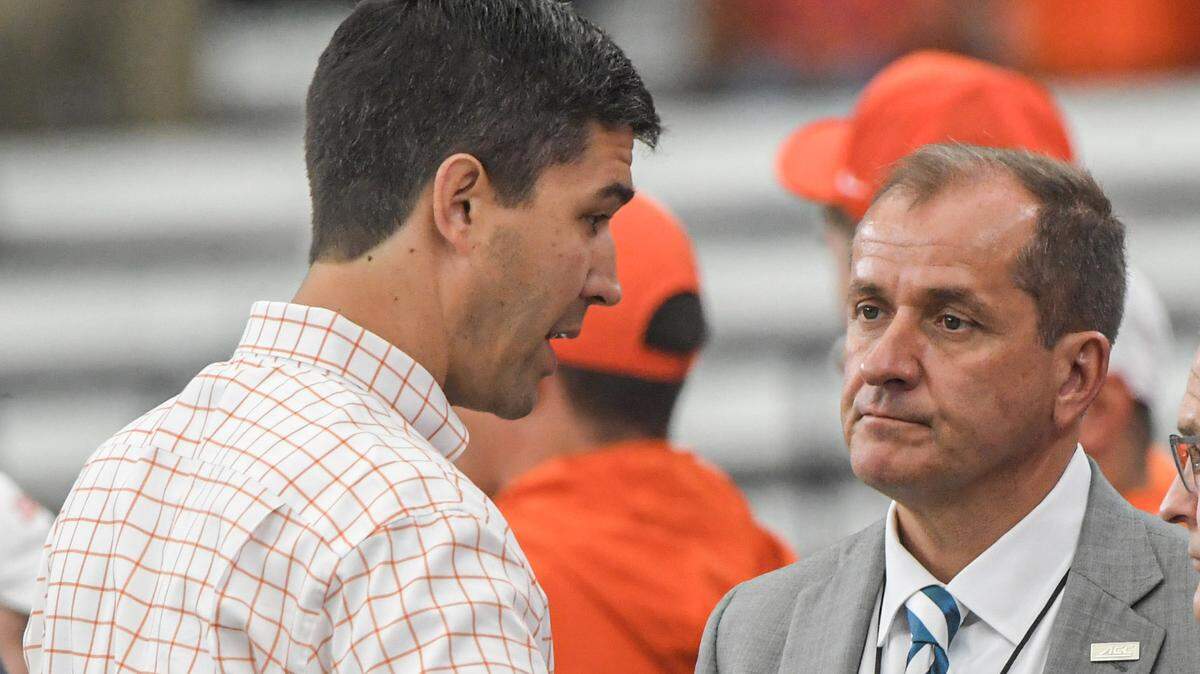
The wheels of conference realignment may have slowed, but they never really stop turning. Clemson athletic director Graham Neff knows that as well as anyone.
That’s why he and other members of the Tigers athletic department often engage in hypotheticals, plot things out and keep a close tab on major developments — weighing concepts such as football “super leagues” and revenue trends, and yes, their conference affiliation. It’s too unpredictable of a space not to.
“Anybody that tells you exactly how it’s gonna go is lying,” Neff said.
But Clemson, Neff emphasized on Tuesday, is equally committed to being “great members of the conference we’re in.” That, of course, would be the Atlantic Coast Conference, a league Clemson has called home for 72 years as a charter member — and recently settled a high-profile, realignment-related lawsuit against.
Speaking at a news conference ahead of the 2025-26 athletic year, Neff was asked if Clemson had become more active in seeking out potential offers from other conferences — such as the SEC or the Big Ten — now that the university has a better idea of what it how actually cost to leave the ACC.
Clemson and Florida State’s settlement with the ACC, reached after roughly a year of litigation, cleared the way for any ACC school to leave the conference and retain their media rights (worth hundreds of millions of dollars) as opposed to forfeiting those to the ACC through 2036 under what was known as the “grant of rights.”
The combination of what Neff framed as “certainty surrounding our media rights ownership” and a clearly outlined exit fee schedule for what it would cost to leave the ACC were viewed as a major win for Clemson within the settlement.
Along those lines, the website InsideCarolina.com recently reported that UNC is “aiming” to make a move from the ACC to the SEC at some point and is considered “at the front of the pack” alongside Clemson, when it comes to schools positioning themselves for possible moves. FSU is another prominent, vocal option.
Neff didn’t deny that Clemson is monitoring the current conference landscape — he has long said he’ll do what’s “best for Clemson” — but made a point on Tuesday of highlighting the Tigers’ strong relationship with ACC commissioner Jim Phillips and his staff, which persisted through their roughly one-year legal battle.
“I’ve said it a couple of times now because I love the phrase and I’ve said it a lot more internally: A strong ACC is good for Clemson, and a strong Clemson is good for the ACC,” Neff said.

A mutually beneficial school-conference relationship?
Thanks primarily to the success of its football program, Clemson anticipates earning an additional $20 million in revenue annually starting this year because of the ACC’s new “success initiative” rewarding football/basketball postseason success (adopted last year) and “brand initiative” giving schools additional earnings based on TV viewership (adopted this year).
As Clemson saw last year, the ACC’s status as a power conference league whose conference champion currently receives an automatic bid to the College Football Playoff is quite the perk.
The Tigers lost three regular-season football games and would’ve been comfortably outside of the field as an at-large team — but a win over SMU in last December’s ACC title game sent them into the postseason (and automatically earned them a $4 million “success initiative” payment).
The ACC’s new initiatives are “certainly something that we feel is going to have big upside for Clemson,” Neff said, adding that the fact schools aren’t just automatically handed the payments and must work to achieve them adds a competitive aspect.
“It’s not just because we’re Clemson,” Neff said. “We have to go earn it, continue to perform on the field, be a compelling brand, drive viewership and consider different scheduling strategies. All these things are interrelated.”

Will Clemson be part of next major realignment?
On a power-conference level, realignment has slowed down a bit. Texas and Oklahoma competed in the SEC for the first time last season, and that league appears comfortable at 16 members for the time being. The Big Ten (now at 18 teams) is similarly standing pat after adding Southern Cal, UCLA, Oregon and Washington.
There’s been speculation that the next major round of realignment could come in 2030, when TV deals for the Big Ten, the Big 12 and the CFP are up for renewal. That’s also the year the ACC’s exit fee drops to a flat rate of $75 million and stays at that rate through 2036. (For reference, it would cost $147 million to leave in 2026.)
At that point, could conferences see additional changes? Or could college football break off from other sports into its own “super league? Swinney has floated that concept multiple times as his prediction for how things will play out, and a “super league” model was specifically noted within the Clemson-ACC settlement.
Neff said there’s “a lot of logic” to think about 2030 as college sports’ next major inflection point but Clemson does not specifically have that date circled.
He prefers terms like “optionality” and “staying nimble” — keeping Clemson ready to pounce on a potential realignment move — while keeping the day-to-day focus on success within the ACC, and using the ACC as a platform to reach higher goals in football (considered a legit 2025 national championship contender) and other sports.
“But back to the optionality for us, being well read and connected is part of the game,” Neff said. “And those type of things that you reference are all very live and active right now.”
This story was originally published August 6, 2025 at 7:40 AM with the headline "Clemson athletic director talks school’s future in ACC, conference realignment."