
How one mother’s 24 hours of free throws raises big money for Special Olympics
AI-generated summary reviewed by our newsroom.
- Debbie Antonelli has raised $1,413,200 through her 24-hour free-throw fundraiser.
- Antonelli made 16,800 free throws over the first seven years at 94% accuracy.
- Her fundraiser benefits Special Olympics; she helped launch N.C. State’s Elevate program.
Frankie Antonelli, like his mother, Debbie, is a pure shooter. His best sport may be swimming — he’s racked up numerous Special Olympics medals in freestyle — but basketball is where his true passion lies. You see it in his myriad 3-point celebrations and the smile he wears on the court.
Frankie, 28, self-scouts as a small forward. His younger brother, Patrick, would tell you Frankie plays “no defense.” Frankie claims to be a shot-blocker. Patrick says he’s lying. The two still smack-talk like they’re back in the driveway at home. And Debbie, the longtime college basketball analyst and former player at N.C. State, by no means spared from her sons’ trash talk.
“My mom didn’t really dribble at all,” Patrick said. “She’s just catch and shoot. That’s all Frankie does.”
But even Patrick can’t argue this: his mom and brother have put their catch-and-shoot ability to remarkable use.
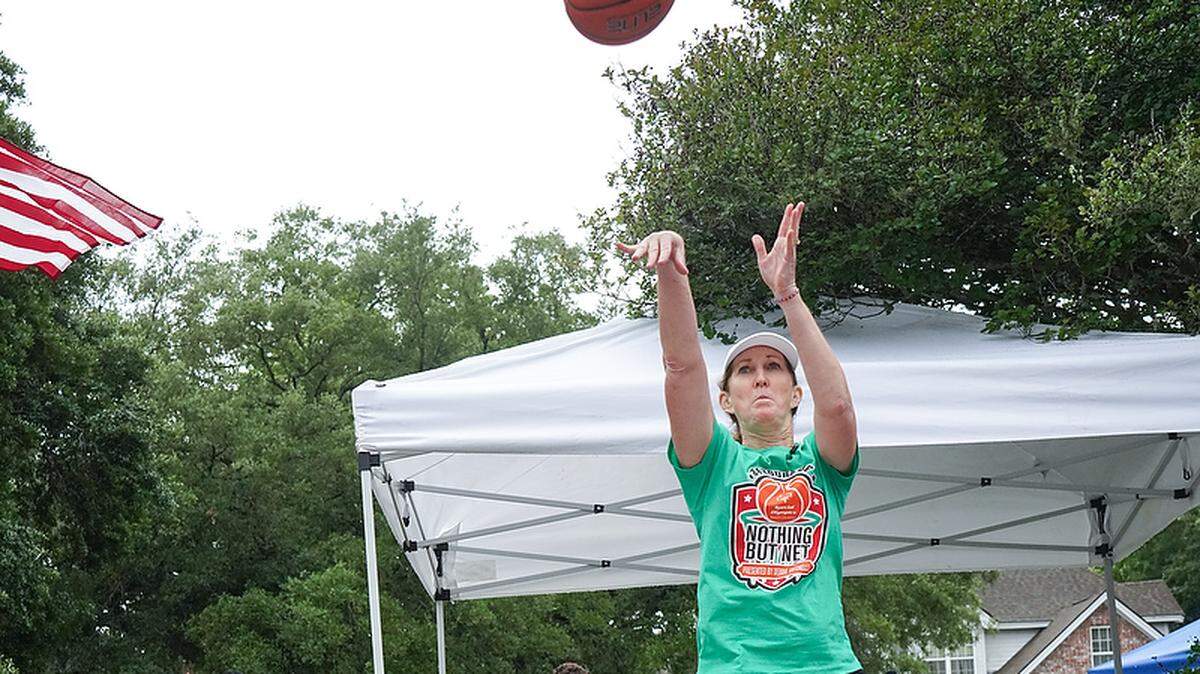
This weekend marks the eighth iteration of Debbie Antonelli’s “24 Hours Nothing But Net” fundraiser — a 24-hour free-throw shooting marathon benefiting Special Olympics. Over the past seven years, Debbie has made 16,800 free throws at a 94% clip.
The more important number, though, is the $1,413,200 she’s raised for Special Olympics.
All of it traces back to Frankie, who was born with Down syndrome — a genetic condition caused by an extra copy of chromosome 21 that can lead to intellectual and developmental challenges. Roughly 5,700 babies are born with Down syndrome each year in the United States.
Like all parents, Debbie and her husband, Frank, had the familiar concerns about their child: Would he find his people? Would he build a fulfilling life? Would he be happy?
But with Frankie, those questions carried a different weight than they did for his brothers Patrick (24) and Joey (31).
“You can’t make somebody want to be your son’s friend,” Debbie said. “It doesn’t matter how much you may try, how much you may invite or include them. When Frankie was in high school, not one time did any kid call the house and say, ‘Can Frankie go to the movies with us? Can Frankie go to dinner?’ Not once.”
Today, though, Frankie Antonelli is thriving.
Now 28, he lives independently at Clemson with support from ClemsonLIFE, a cutting-edge program designed for students with special needs. He works two jobs. He has friends and a busy social calendar and the kind of independence that once felt improbable.
“There’s not one piece of me that believes that without the Special Olympics he would have had the opportunity to do what he’s doing,” Debbie said.
At the center of the 24-hour challenge is Debbie. At the heart, though, is Frankie. He’s the reason Debbie trains rigorously for months so she can shoot hundreds of free throws, over and over again, for 24 hours straight.
“I work really hard to be ready,” said Debbie, who played for coach Kay Yow in the 1980s. “I believe the better I shoot it, the more people will donate. Because I think the older I get, the more ridiculous this whole thing sounds. Now we’re at 1.4 million (raised), so you can’t look away.”
“She never sleeps,” Frankie added. “(And) she never misses.”
A crazy idea
The fundraiser started, fittingly, with a shooter’s ego.
Years before she came up with the idea for “Nothing But Net,” Debbie created a summer shooting challenge. For each day of July, she timed herself making 100 15-foot jumpers. If a college player beat her posted time for the day, Debbie sent them a medal.
But after several years, she wanted to turn the concept into something larger. A friend running the New York City Marathon sparked the breakthrough.
Debbie knew she could not run 26.2 miles. But she wondered whether she could monetize the one athletic skill she still trusted most: her shooting.
The answer became “24 Hours Nothing But Net.”
Every hour for 24 consecutive hours, Debbie makes 100 free throws. By the end, she reaches 2,400 makes — a clean fundraising number attached to an endurance feat bizarre enough to grab attention.
Joey, Debbie’s eldest son, put it this way: “If you want to see a lady who gets AARP mail every other week come out at 3 a.m. and make 94% of 100 foul shots for the best cause possible, you should come watch.”
The first year, Debbie did not know whether she could physically finish. She did not know whether anyone would tune into the livestream to watch her shoot. And most importantly, she did not know whether anybody would donate.
Even her family was skeptical.
“We all were kind of like, ‘There’s no way she does well,’” Joey said.
Her husband, Frank, thought “she was crazy.” But he never doubted her commitment.
“She’s out in the driveway training in 90-degree heat, sweating, doing 200 burpees, and I’m sitting in a lounge chair with a cold drink watching her,” Frank said with a chuckle. “That doesn’t go over too well all the time.”
Debbie trains for the challenge each year with the seriousness of an endurance athlete. Her workouts include sprint-bike sessions, strength training and a drill she calls “free-throw burpees” — alternating free throws and burpees in her driveway for hundreds of repetitions.
“Trust me, my neighbors, they think I am nuts,” Debbie said. “They walk by and they shake their head.”
Her first free throw challenge in 2019 raised $85,000, which Debbie thought was “amazing.”
Last year alone, the fundraiser topped $300,000.
Now entering year eight, the challenge has outgrown the Antonelli driveway. This year’s event is moving to The Deb, a gymnasium in Debbie’s hometown of Mount Pleasant, South Carolina. The gym was renamed in her honor last October.
The Antonellis still struggle to process that sentence.
“All my friends give me some crap about it,” Patrick said. “Like, ‘Hey, we’re going to play in your mom’s gym.’”
But don’t let her sons’ occasional sass fool you — they’re all “pretty proud” of their mom.
“She blew it out of the water… now we’re seven or eight years into it and over a million bucks (raised),” Joey said. “Definitely I’m impressed. Definitely I’m kind of shocked.”
President Frankie
Joey remembers understanding, from a young age, that Frankie received different kinds of attention than he and Patrick did. What he did not fully understand until later was how difficult social inclusion can be for people with Down syndrome.
Special Olympics gave Frankie a space to play sports, but more importantly, build community.
“He just had so much fun doing it,” Joey said. “He was always smiling and laughing. And to be quite honest, he won a lot. He was pretty athletic. He has some pretty good genes from our family.”
Special Olympics, the Antonellis said, helped Frankie gain confidence. There’s “not a nervous bone” in Frankie’s body, per Joey.
So while the Antonellis may have had some nerves about Frankie attending Clemson — Patrick is pretty sure he “begged” his parents not to let his brother go off to college — Frankie knew he’d be alright.
On move-in day, when it was time for Debbie and Frank and the other parents to leave campus, Frankie pointed toward the door.
“The other two boys struggled more with separating, going to college and being nervous,” Frank said. “Not him.”
Frankie said he was “never scared” to attend Clemson because he knew he would have fun and make friends.
“That, to me, is what’s been so important with what Special Olympics has evolved to now,” said Barry Coats, CEO of Special Olympics South Carolina. “We don’t want people to feel sorry for us. We want to be a part of the community, just like everybody else.”
“The skills they’re learning through sports is in the confidence, self-esteem, teamwork and knowledge they gain,” Coats said. “All these things are going to help them in life.”
Today, Frankie’s life looks dramatically different than what many families like his were told to expect a generation ago.
Debbie still thinks about that evolution.
“Our society has changed in the 28 years that Frankie’s been alive,” Debbie said. “I mean, it’s gone from you can put them in an institution to living independently with two jobs.”
At Clemson, Frankie navigates life largely on his own. He walks to his jobs at The Shepherd Hotel and Your Pie Pizza. He Instacarts groceries. He works out with a trainer. He socializes constantly.
Joey describes his younger brother as “the most charismatic, outgoing person” he has ever met.
“The bigger the audience, the more personality comes out,” he said.
That personality now sits at the center of the free throw fundraiser.
“He’s the president of 24 Hours,” Debbie said. “He takes a lot of pride in it, and he’s my best fundraiser.”
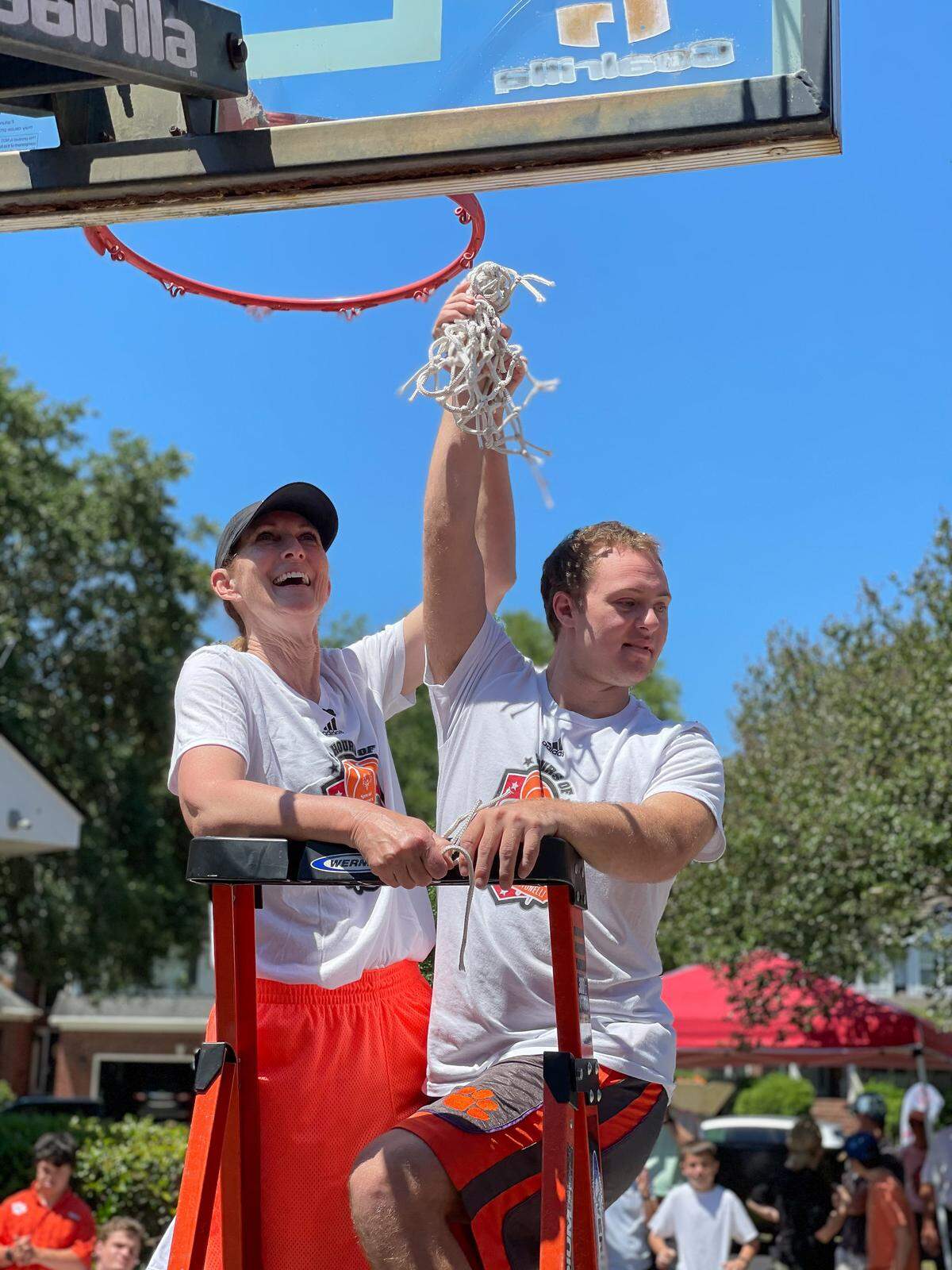
This year, Frankie will be entertaining the crowd with some DJing. He has his own equipment, and may be joined by his friend Noah.
“We have a live band coming,” Patrick said, “and Frankie will probably get up there and sing a song or two.”
Patrick prefers Frankie’s renditions of Frank Sinatra. Frankie said Morgan Wallen songs are his favorite to sing. Either way, attendees can expect a good show.
“If you were to meet Frankie and meet some of his friends, you would fall in love with all of them,” Joey said. “It’s the best cause you can probably get behind.”
Free throw line extended
The fundraiser’s reach now extends well beyond South Carolina.
Two years ago, leaders with Special Olympics Texas approached Debbie with an idea: custom trucks branded with the fundraiser’s logo, complete with basketball hoops and shooting machines attached.
“I was in tears,” Debbie said. “I could not believe it.”
This spring, after working the women’s Final Four in Phoenix, Debbie flew to Texas and drove one of the trucks more than 1,200 miles back to South Carolina.
The vehicle now travels to Special Olympics events around the region, drawing crowds and helping raise money.
For Debbie, though, her advocacy isn’t limited to Special Olympics.
Over years, she has quietly pushed her alma mater, N.C. State, to create a program for students with intellectual disabilities modeled after ClemsonLIFE.
Her most meaningful contribution, she said, has been that: helping launch the Elevate program at N.C. State. Elevate is a cohort-based program that provides opportunities for students with intellectual and developmental disabilities to thrive in college.
Launched last year with $3 million in annual funding from the North Carolina General Assembly, Elevate has since welcomed its first cohorts of students.
Debbie calls the effort — supported by football coach Dave Doeren and major donor Wendell Murphy — the best thing she’s ever done.
On April 30, Debbie was inducted into the Order of the Long Leaf Pine by North Carolina Gov. Josh Stein.
She suspects basketball alone is not the reason.
“I really believe it’s for the Elevate program, Special Olympics,” Debbie said. “And the basketball as well.”
Through the night
“24 Hours Nothing But Net” unfolds like a telethon crossed with a basketball practice.
Debbie shoots for roughly 15 minutes at the top of every hour — if she’s hitting at her normal 94% clip. The remaining time is filled with interviews and livestream programming highlighting Special Olympics participants from around the country. Interview subjects have included college basketball coaches, television actors and A-list sports celebrities like Caitlin Clark.
Debbie’s family handles the behind-the-scenes chaos — setting up tents, transporting guests, coordinating logistics and helping Debbie survive the overnight hours.
Friends stop by, which could mean Roy Williams, Dawn Staley, Dabo Swinney or one of Debbie’s neighbors.
Some stay for an hour. Others may stay all night.
And somewhere in the middle of it, Frankie is usually nearby — smiling, chatting and celebrating made shots like a Game 7 buzzer-beater.
“He’s the reason why I think a lot of us do everything, because we all just want to make sure that he’s OK,” Patrick said. “And he’s the most OK out of anyone I know.”
This story was originally published May 7, 2026 at 5:30 AM with the headline "How one mother’s 24 hours of free throws raises big money for Special Olympics."