
Looking back: Original Charlotte 49ers built foundation for current success
Charlotte’s short football history has built not-so gradually to this memorable week, when the 49ers will face Buffalo in the Bahamas Bowl on Friday in Nassau’s Thomas A. Robinson National Stadium.
What the 49ers (7-5) have accomplished under first-year coach Will Healy — most notably a first winning season and first bowl appearance — hasn’t escaped the notice of this team’s forefathers.
“I told coach Healy the other day I was jealous in a good way,” said Austin Duke, a player on Charlotte’s first four teams and still holder of virtually all the program’s receiving records. “This is what we worked for, what we wanted to accomplish. I’m proud of the new coaching staff, proud of the boys for earning this right. They’ve built something we laid the foundation for.”
If it doesn’t seem so long ago that the 49ers played the first game in program history against Campbell, it’s because it wasn’t.
Charlotte rolled out its first football team in 2013, starting as an NCAA Football Championship Subdivision independent before moving up to Conference USA and the Football Bowl Subdivision in 2015.
When Brad Lambert was hired away from Wake Forest to be Charlotte’s first coach in 2011, he had to recruit players to a program that had never played a game. He had to hire coaches who didn’t yet have players to coach.
There wasn’t even a stadium in which to attract high school players. But Lambert and his staff were selling a vision.
“It was a big hole of dirt in the ground,” said Napoleon Sykes, a linebackers coach on that first staff, of the site on which Richardson Stadium now stands. “But everybody jumped on the boat not knowing where it was going. Guys like (defensive lineman) Larry Ogunjobi and (defensive back) Des Cooper had no clue where they were going, but they jumped on. Austin Duke, a (Charlotte) city kid, could have gone to N.C. Central. But they stuck through it.”
Ogunjobi went on to the NFL, where he’s now playing for the Cleveland Browns. And Sykes, who’s now coaching in the XFL, remembers watching 49ers senior defensive end Alex Highsmith — who arrived at Charlotte as a walk-on in 2014 and is now an All-American — when he was a high school senior at Wilmington’s Ashley High.
“For us back then, we were fighting and clawing just to get guys to come as walk-ons,” Sykes said. “We went to see (Highsmith) play in high school and we were thinking, ‘Somebody’s missing something with this kid!’ He became a really high-priority walk-on for us. Then we realized it was a no-brainer about his talent and work ethic. And look at him now.”
Many of the players on that first team either didn’t have scholarship offers from other Division I schools or were considered Division II prospects. Quarterback Matt Johnson, who still holds most of the program’s career passing records, was one of them.
“I saw it as a challenge,” Johnson said of his decision to play for the 49ers.
Memorable play
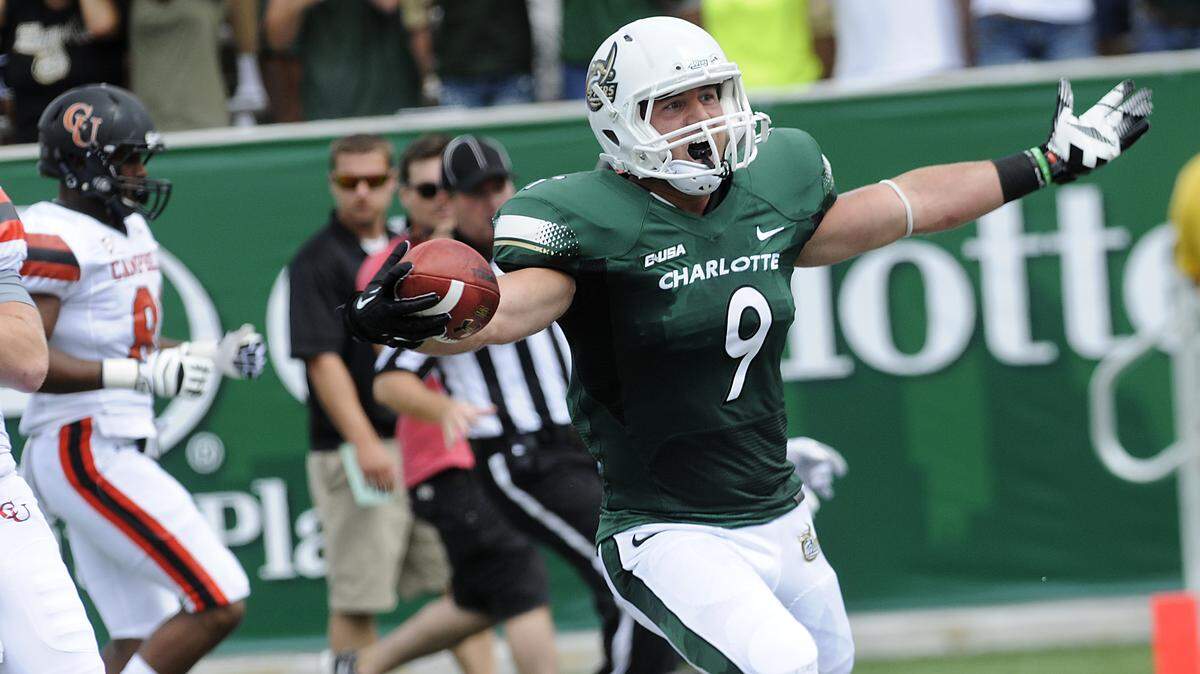
Another original 49ers player was outside linebacker Mark Hogan, a grad transfer who had been on Georgia State’s first team in 2010. He also happens to be responsible for one of the top plays in program history.
It came the first game in program history.
“I remember the buildup for the game was incredible,” said Hogan, now an assistant coach at Davidson. “I’d pulled my hamstring two weeks earlier and hadn’t practiced much, so I didn’t know if I was going to play.”
Hogan and his defensive teammates were happy to get on the field first.
“Everybody was fired up about getting out there,” Hogan said. “I’m sure the offensive guys were wanting to say they had the first catch, the first run, to be in there on the first play of the game.”
After Blake Brewer’s kickoff sailed into the end zone for a touchback, Camels quarterback Brian Hudson ran for a 4-yard gain (defensive back Tank Norman made the first tackle in 49ers history on the play). Hogan remembers being so amped up on the play that he allowed Hudson to get to the edge.
Hogan, however, had a hunch Hudson would throw on second down. And that’s what he did.
“I kind of played my responsibility this time,” Hogan said. “I looked at the quarterback, he threw it and it hit me in the hand.”
Hogan grabbed it and took the interception down the left sideline 32 yards for a touchdown, the first in Charlotte history.
Just like that, two plays into their existence, the 49ers were up 7-0.
Johnson, standing on the sidelines and concentrating on what he would do on Charlotte’s first possession, didn’t know what was happening.
“I was just going over everything in my head, looking down, thinking about our first series,” Johnson said. “Then the place erupted. What happened? Everybody in the stadium and on the sidelines was going crazy.
“I remember thinking it really took the monkey off my back. The defense had put points on the board and that took the pressure off us.”
When the offense got the ball for a first time, Johnson took the 49ers on a 10-play, 66-yard drive, capped by a 1-yard touchdown pass to H-back Justin Bolus.
The 49ers went on to win 52-7. They went 5-6 that season, beating nationally ranked Gardner-Webb 53-51, but also losing to Division III Wesley (Del.). It was the first of six consecutive years that Charlotte would finish with a losing record.
The losing seasons took their toll on the program. Lambert was fired in 2018, replaced by Healy, 34, whose youthful energy has had a transformative effect.
No longer a crutch
Winning has now become part of the culture at Charlotte. No longer can being a startup be used as an excuse for not winning.
“When I played, we were always told to be blue collar workers, to put your head down and work — and we were second to none with that,” said Duke, who signed twice with the Carolina Panthers and is still pursuing a pro career. “But it might have made winning seem bigger than it was, more impossible and unattainable at times. I think we used the ‘young program’ thing as a crutch.
“But there was always a sense that we’ll get there, we’re growing, we’re cultivating a culture that we just didn’t have yet. If we won, good, we’d defied the odds. If we lost, well, that’s to be expected. That was pretty frustrating.”
Johnson, who threw so many touchdown passes to Duke, doesn’t disagree.
“When we started out, we had the highest hopes,” said Johnson, who’s now associate student pastor at Hickory Grove Baptist Church. “I think we were helped with expectations. We knew every game was going to be tough, no matter what division we were playing in. It helped put a chip on our shoulder. We could play with reckless abandon.”
And it set the foundation for these 49ers, who take a five-game winning streak into the Bahamas Bowl on Friday.
“They’re the ones who paved the way for us to be here,” said 49ers running back Benny LeMay. “For them not to be here, it feels like it’s only right for us to win, to do it for them. To show what they did (wasn’t) in vain.”
Said Johnson: “We can look back and see how the program’s grown and how we contributed to it. Now we’re enjoying the fruits of all of it — without running wind sprints.”
This story was originally published December 18, 2019 at 4:08 PM.