
How shorter practices have sparked success for Charlotte 49ers women’s basketball
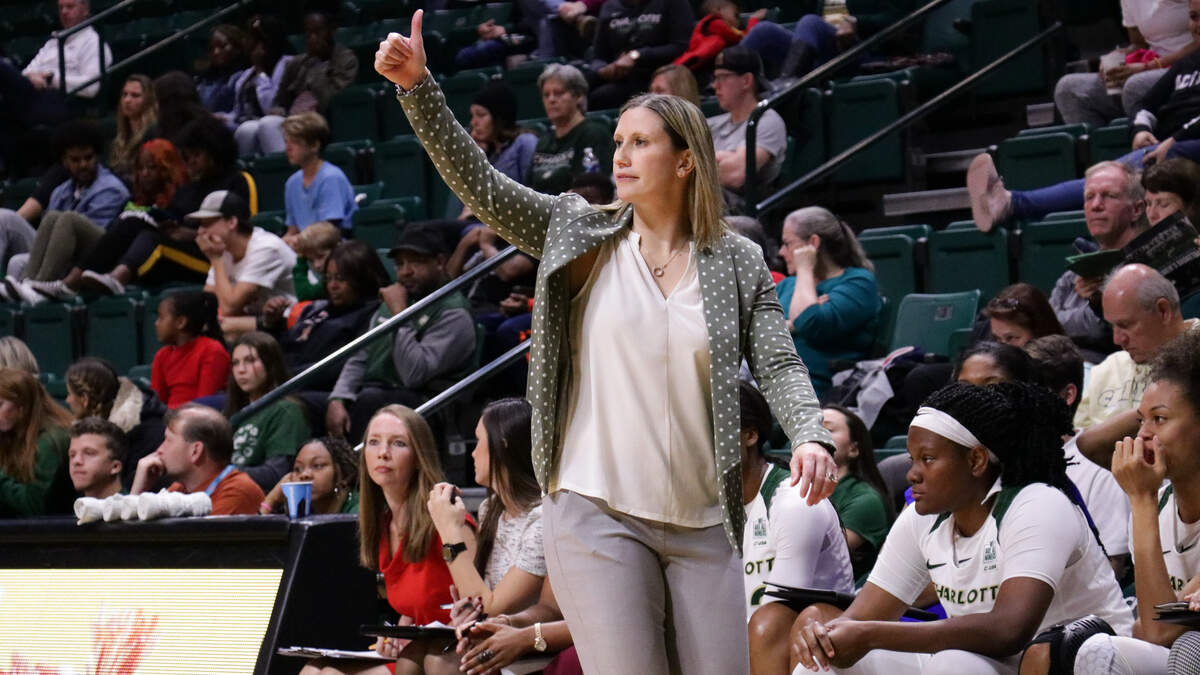
Charlotte 49ers women’s basketball coach Cara Consuegra freely admits change doesn’t always come easily for her.
So when members of her staff — once again — urged her to try what to her was a counter-intuitive method of getting the most out of their team, she — once again — pushed back before finally relenting.
The idea, championed by assistant coach Nicole Woods and director of sports performance Stacy Weaver, was that shorter, more-focused practice sessions would help save the players’ legs and energy for the stretch run of the Conference USA season.
“This is allowing us to go (practice), get whatever it is that needs to be done, and get back to taking care of our bodies, to recover,” said sophomore point guard Jada McMillian. “We’re using these things to keep our bodies fresh fresh and ready for games.”
It’s working: the 49ers (19-7, 10-5 C-USA) are among the league’s hottest teams, winning eight of their past nine games. Included in the stretch are victories against Rice and Old Dominion, the league’s top teams. The only loss came in overtime at Texas-El Paso.
Woods and Weaver have been suggesting the change to Consuegra for several years. Consuegra finally bought into the concept near the end of last season, and the 49ers won six consecutive games before losing in the quarterfinals of the conference tournament and the first round of the Women’s National Invitation Tournament.
“It’s been a huge shift for me,” said Consuegra, whose team plays Florida International (5-21, 2-13) on Saturday at Halton Arena. “Truthfully, it’s not in my nature. I’m a coach. I like to prepare. Everything I know, I want my team to know.
“It hasn’t been easy for me, but it’s been great for my players.”
Consuegra started cutting back on practice times much sooner this season. She floated the idea with the team’s leadership group after Charlotte beat FIU on Jan. 25.
Consuegra, who’s in her ninth season at Charlotte, said she stressed to the players that this wouldn’t work unless they stayed on top of the fundamentals they’ve worked on since practice began in October.
“You have to have a team that understands what you’re doing,” Consuegra said. “That practice time might be shorter, but the intensity and focus can’t change. It’s not an easy day. You’ve got to get just as much out of this hour or hour and 15 minutes as you did in two or 2 ½ hours. The responsibility is on the players to do that.
“I realize the team doesn’t need to know everything that I know. They need to know the basics, the personnel of the team we’re playing. They need to have the understanding that if this play has a staggered screen, they know how to play a staggered screen. So why are we spending time going over that?”
The players have responded. The proof is in the results.
“We’re in the part of the season, where teams know each other, we know their tendencies already and they know ours,” said senior guard Jade Phillips, Charlotte’s leading scorer (15.1 points per game). “So we’re just working on meat-and-potato things. It’s helped us, especially with recovery and our legs, tremendously.
“It’s a privilege for her to have cut the practice time for us. She’s looking out for us by doing that. We’ve got to look out for her.”
Consuegra, an all-Big 10 guard at Iowa in the late 1990s and early 2000s, played when college basketball wasn’t a 12-month endeavor for players. She used to be able to take summers off, unlike today’s players, who practice and play throughout the off-season.
“Basketball is not the same anymore,” Consuegra said. “It’s a year-round sport now. When I played, there were no summer workouts. If you didn’t want to, you didn’t have to work or play for four months, so you felt different in February or March than our kids do now.”
Consuegra has the full support of her staff. After all, it was Woods (in her seventh season at Charlotte) and Weaver (a former 49ers soccer player who also handles sports performance for Charlotte’s Olympic sports), who pushed her to make the change.
“Cara is a numbers- and data-driven person,” said Woods. “So Stacy has all these different ways to monitor the players’ recovery and performance. The numbers show it. We practiced this amount of time and we won. We practiced this amount of time and we lost.
“We put the numbers in front of Cara, and she said, ‘Hey, I get it now.’ ”
Woods glanced at her time planner as she prepared to leave for a practice that was scheduled to last for less than an hour.
“We’re getting on the court at 1:38 and finishing at 2:37,” Woods said. “Less is more. It all starts between the ears. If (the players) believe in something and they feel good about it, then we’re ready to go.
“I sure wouldn’t want to play us.”
This story was originally published February 27, 2020 at 11:06 AM.