
Can anyone take Chris Reynolds’ QB job? What Charlotte 49ers football taught us in spring
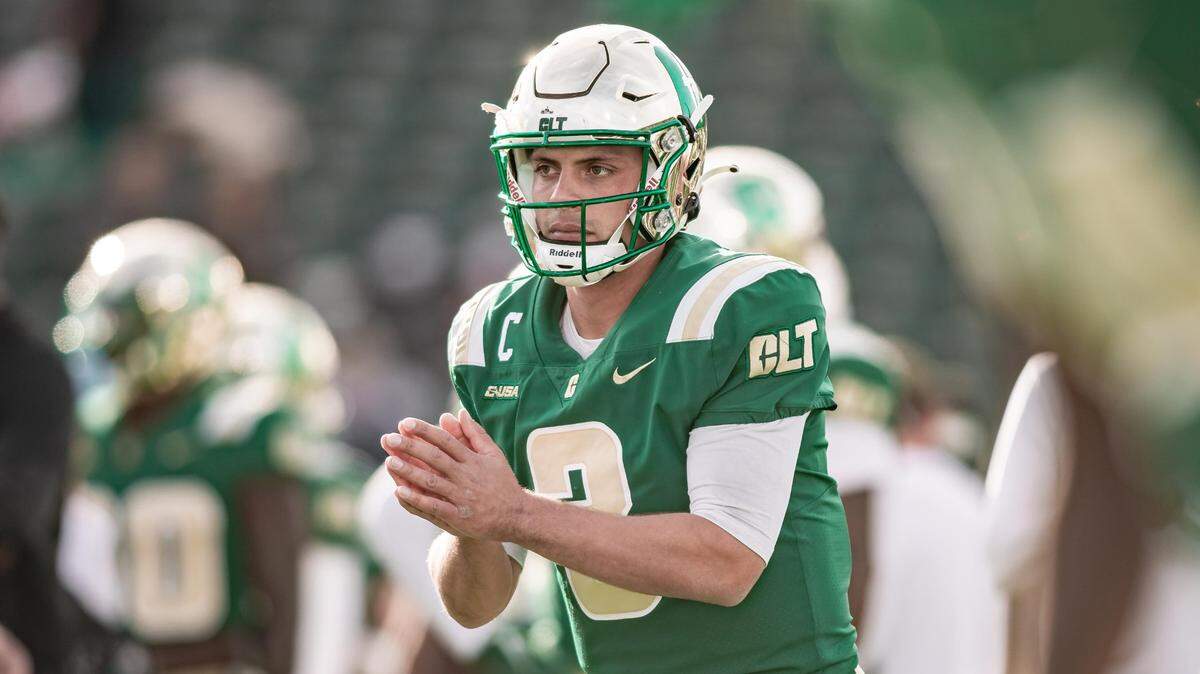
The spring session is complete for the Charlotte 49ers, and the team is beginning to take shape ahead of Will Healy’s fourth year as head coach.
The pressure is on for Healy, 37, following consecutive losing seasons and a historically bad defense in 2021, allowing 465 yards and 34 points per contest. Healy completely revamped the defensive staff this offseason, adding three new coaches with the announcement of a fourth in the coming weeks.
“Now that we’ve finished spring ball, our new coaches understand what our personnel looks like. We’ve seen what we do well and what we need to work on,” Healy said following the spring game. “Really good leadership came back, and really good players came back. That means they’re enjoying their experience here. It’s important to not only recruit but retain. I’m excited to see the next steps for us.”
Though Healy’s excitable demeanor remained the same, what was a youthful staff got much older on the defensive side of the ball. While the team fought to find its bearings throughout March, the series of 14 practices felt more like an acclimation period with many new faces among the roster and coaches.
Charlotte added plenty of experience to its staff with the additions of defensive coordinator Greg Brown and defensive line coach Brian Baker. Brown brings nearly 40 years of experience to the defense, including stints in the NFL and college at Alabama, Auburn and most recently Purdue in 2020. Baker adds nearly 36 years of coaching experience, 21 in the NFL across nine teams, including serving as the Carolina Panthers’ defensive line coach in 2009-10. His most recent collegiate position was under Nick Saban as the associate head coach and defensive line coach in 2019.
Here are three takeaways from the 49ers’ spring session:
Early observations about the defense
The defense continues to be a work in progress, implementing Brown’s scheme and simplifying the play calls. Schematically, the group has operated similarly to Auburn’s defense from the 2017 season, where Brown served as a secondary coach under defensive coordinator Kevin Steele. It is closer to a traditional 4-3 base defense, although the base varies depending on who the SAM linebacker is. Charlotte began to mix up the coverages late in the spring session, mixing in plenty of cover-4 and single-high safety looks with the cornerbacks in press-man coverage.
Brown is tasked with replacing both defensive captains and all three starting linebackers from last season. The safety combo of East Carolina transfer Davondre “Tank” Robinson and Solomon Rogers have served as the vocal leaders of the secondary, with returning defensive end Markees Watts manning the front seven.
Several newcomers and potential impact players have emerged on the defensive side of the ball, including Miguel Jackson (DT), Cam Burden (LB), Juice Martin (nickel), Kansas State transfer Wayne Jones (DB) and Central Michigan transfer Amir Siddiq (DE). Siddiq may be the only sure-fire starter of the bunch, but all five have been key contributors throughout spring practice.
The schematical simplification throughout the spring hopes to limit the big plays that bit the 49ers repeatedly last season. Charlotte is continuing to attack the transfer portal for assistance on defensive, recently offering Pig Cage, a defensive back transfer from LSU, and Mike Lockhart, a lineman from Georgia Tech with three years of eligibility remaining.
The offense was undoubtedly the superior unit throughout the session, but the defense began finding its identity during the back half of the practices.
Offense picking up where it left off
Charlotte’s offense has the tools to be one of the most dynamic in the nation. Highlighted by the return of sixth-year quarterback Chris Reynolds and wideout Victor Tucker, Charlotte is bringing back nearly 90 percent of its offensive production from last season.
“Charlotte’s a special place. I’ve been a part of a lot of firsts here, and I’m thankful for those opportunities. But there’s a lot more out there for us,” Reynolds said after the spring game. “There’s a bunch of veteran leadership. The whole offense is pretty much back and we’re continuing to grow as a team. The sky is the limit for us.”
The receiving corps of Tucker, Grant DuBose – the team’s leader in receiving yards last season (892) – and Elijah Spencer – Conference USA’s Freshman of the Year – has the potential to be one of the best in the country.
Offensive coordinator Mark Carney is back for his third season in the role, and his play-calling and execution took a step forward from 2020 to 2021. The spring session showed more of the same for the offense, and Charlotte will continue to spread the field and operate out of the shotgun with a plethora of weapons on the perimeter and in the backfield.
Nine offensive starters from the 2021 season will return, including four of the five starters on the offensive line. Left tackle Jaxon Hughes and tight end Taylor Thompson are both recovering from injury but are slated to be available for the season-opener on August 27 against Florida Atlantic.
It all starts up front, and the talent and depth on coach Pete Rossomando’s offensive line is a major step up from 2020. The likely starting group at this point is Jaxon Hughes (LT), D’Mitri Emmanuel (LG), Ashton Gist (C), Panda Askew (RG) and TJ Moore (RT).
Charlotte’s offensive line battled the injury bug last season, which opened the door for underclassmen B.J. Ragland, Arabee Muslim and Johnny King to see early action. Ragland has served as the left tackle in Hughes’ absence. Watch for tackle Jon Jacobs’ return following ACL tears in both knees over the past two years.
With so many returning starters, there aren’t many snaps up for grabs. But there are multiple newcomers and potential impact players to watch on the offense including Austin Peay transfer Eugene Minter Jr. (TE), Quinton Patton (TE), Jairus Mack (WR) and Henry Rutledge (RB). Mack and Rutledge both saw the field last season, and while they are buried in extremely talented rooms, both have a chance at making a significant impact in their rotational roles.
Backup quarterback battle
One area of concern on the offensive side is the backup quarterback. Following the spring session, it is safe to say that sophomore Xavier Williams is closer to Texas A&M transfer James Foster than Foster is to Reynolds in the quarterback battle.
Reynolds was automatic throughout the spring, connecting on the deep ball with regularity and extending plays with his legs when necessary. The offense has another gear when Reynolds is at the helm, and there’s no doubt that he will lead the team in his final season.
There is, however, inconsistency and a level of uncertainty when he exits.Foster and Williams improved through the spring, with the latter entering the conversation midway through March. Foster has the biggest arm on the roster, but his accuracy 15-plus yards down the field is inconsistent. His game has seen improvement with working through his progressions and seeing the entire field.
Foster split reps with the first and second groups, while Williams split between the second and third for much of the spring. Trexler Ivey is also in the mix, seeing the majority of his reps with the third team. As Williams continues to grow, expect this battle to continue into the season.
Reynolds battled injuries through 2020 (torn labrum, but didn’t miss a game) and 2021 (ligament damage in throwing hand, one game missed), but has been able to stay on the field for the most part.
While this isn’t a pressing matter this spring, Foster or Williams will likely take the 49ers’ first snaps in 2023, the program’s first year in the American Athletic Conference.
Offseason notes:
Running backs coach Sean Dawkins moved on from the program, taking the same role at Memphis. Cordae Hankton was added to the staff as the new running backs coach this week. Hankton served as the senior offensive analyst under Steve Sarkisian at Texas in 2021 following two seasons as a defensive graduate assistant under Mel Tucker at Michigan State
Kicker Jonathan Cruz entered the transfer portal following the spring session, finishing his career at Charlotte connecting on 69.5% of his kicks, 97% of his extra points and a career-long of 56-yards.
Incoming freshman Braden McAlister is expected to push for the starting role. He will battle returning kicker Aiden Laros during fall camp.
Defensive tackle Isiah Potts tore his ACL during the offseason and will not be available until late October.
Quarterback Dominique Shoffner entered the transfer portal.
Linebacker Jaylon Sharpe also entered the portal. Charlotte has just six linebackers on the roster.
Safety Marcus Robitaille missed much of spring practice with an injury but will be available for fall camp.