How does Charlotte move on from Will Healy? 49ers AD explains as huge offseason looms
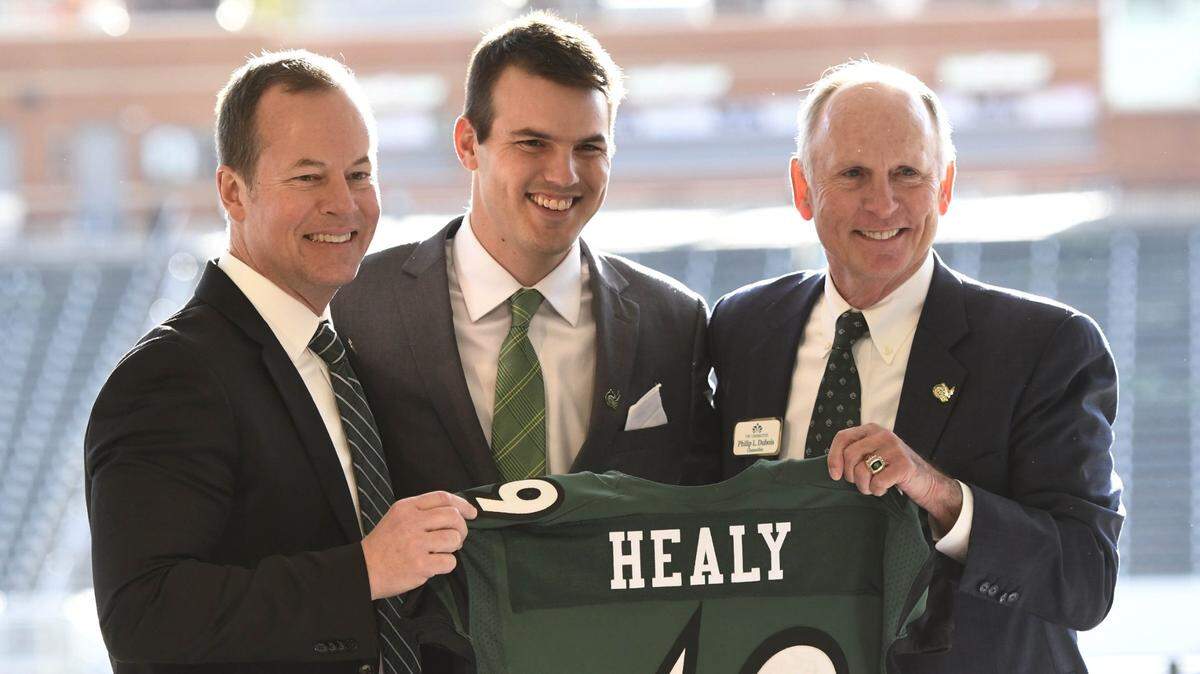
To open Monday’s press conference — the first media availability following the firing of Charlotte head coach Will Healy — 49ers athletic director Mike Hill listed off a handful of the biggest moments in the football program’s history.
He mentioned the rain-soaked win over Marshall, the five straight wins that led to a bid to the Bahamas Bowl in Healy’s first season and the win over Duke on national television. He lauded the general “enthusiasm and energy that was built around the program” early on in Healy’s tenure, adding that the school’s students are supportive and “hungry for a football program they can be proud of.”
Just over seven years since joining the FBS, though, another consequential moment lies in front of Charlotte.
And it comes at a particularly critical time.
“I don’t know if I would want to single it out as ‘biggest in history,’ but it’s a critical decision for sure, for all the reasons we’ve described,” Hill said on the hiring of Healy’s replacement. He added, “We’ve been a dominant program in Conference USA overall the last couple years, and we’re going to bring that excellence to this new league. But we’ve gotta step it up, for sure, and that’s the intention here. I think it’s a critical decision for our football team.”
There are four games left on the Charlotte 49ers football schedule, but most of the conversation on Monday looked to December and beyond as Charlotte transitions to the American Athletic Conference.
Here are some highlights from Hill’s availability.
Why did Charlotte move on from Healy?
Why are the 49ers undergoing a coaching search mid-season? In short: “the last 14 games.”
Charlotte has now lost 12 of its past 14 after its 34-15 loss to Florida International on homecoming weekend. One of those wins came in a one-point, overtime win over Georgia State — the only win of this season’s 1-7 run. Healy was fired on Sunday and found out about it first on Twitter, he told The Charlotte Observer. (Hill addressed the fact that Healy heard of his job status on the internet and added that “it was very unfortunate.”)
“Unfortunately, a lot of those losses over the last 14 games were one-sided as well,” Hill said. “It felt and looked — and not just felt and looked, but you could see in the data — that we were trending in the wrong direction competitively. And that was alarming.
“In sports, we all know we have highs and lows. ... But moving forward, we really have to assess, ‘What’s the trajectory of the program?’ And the reality is that 14 games in a row here, we’ve either hung on to win two of them or have been blown out in the last 12. And that’s not acceptable.”
Hill said he didn’t want to make a decision about the team’s coach until the team was bowl ineligible, which is what they became after Saturday’s loss.
“I did not want to make a decision about things until it was clear as to whether or not our football team had a chance to compete for a bowl,” he said. “And knowing how coach Healy and our staff in Year 1 took a 2-5 team and won the last five games and finished 7-5 before going to the Bahamas (Bowl), I wanted to give them every chance to get on a roll.”
He added: “The reality is we’re competing now. We’re competing for the best head coaching candidates in the country. There were already some programs who’ve made super early decisions in September, even, to make a move, and there will be a flood of others in the coming weeks. And so, there’s a lot of work to be done, and we need to get moving.”
What do the 49ers want in their next coach?
Hill didn’t specify a timeline for finding Healy’s permanent replacement, though he did mention that the situation is “urgent” considering the transfer portal opens the day after championship selections are made — this year, that’s Dec. 5. He also didn’t give too heavy of an indication of whether or not Pete Rossomando, the team’s offensive line coach and interim head coach now that Healy is gone, is a front-runner for the job.
But Hill provided some details in what he wants in his next coach.
Part of Healy’s appeal when he first arrived to Charlotte was his youth. He was 33 when he was hired, one of the youngest head coaches in college football, and was offensive-minded and largely well-liked. Will the program take a chance on another coach without FBS college football experience?
“There’s a tendency in any business, if you make a move where you maybe let someone go to try to hire someone who is the opposite what you had,” Hill said. “And I don’t know if that’s necessarily the case here. We’re going to go hire the best person who’s going to be the best fit for Charlotte 49ers football.”
He added that the program will use a search firm, though it hasn’t yet been finalized which one.
Among the biggest pluses coaching candidates can offer include a track record of good recruiting and of organizing and hiring a good staff — and who is “a great communicator.”
“It’s hard to follow a guy like Will Healy and not be a great ambassador in our community,” Hill said. “Will’s obviously beloved in this community, and that makes it that much harder when you make a decision about someone who is as popular as Will is.”
The financial commitments that come with entering the AAC
Entering the American Athletic Conference — along with Charlotte’s fast-growing enrollment and the fact that so many alum stay in the Charlotte metro area post-grad — adds to the positives of the job, Hill said.
But there are also real economic consequences to consider.
Healy’s salary, per reporting from The Athletic, was $835,742. That ranked seventh among the 10 full-time coaches in Conference USA. Head coaches in the AAC tend to make more than double that amount. According to a report from 247Sports, ECU’s Mike Houston made $2.3 million in 2021 — less than Houston’s Dana Holgorsen (who pulled in $4 million) and a few others, but also more than Tulane’s Willie Fritz ($1.9 million) and USF’s Jeff Scott ($1.8 million).
That also means assistant coaches will need to be paid more to be attracted to and retained by the program.
“We’re definitely going to look at everything in terms of compensation, (and we’re) having some conversations privately on how we might be able to fund some things,” Hill said. “Look, the other five schools that are moving in the American with us — many of them, not all of them — many of them are in a similar situation.
“We’re joining a league where the schools, the incumbents, have larger resources because they’ve been part of a league that had much bigger payouts than we had. So we’re not going to be able to jump from where we are today to the top of the league, but we’ll be competitive for sure.”
The financial aspect is just one of the “challenges” that he views as an “opportunity,” Hill said.
“When you’re trying to expand the football stadium and invest in the football program the way you need to, you’ve gotta have a competitive product,” Hill said. “And we’ve just not been competitive enough the last long stretch here, so that’s why in the end we felt like we needed to make a move.”
This story was originally published October 24, 2022 at 5:34 PM.