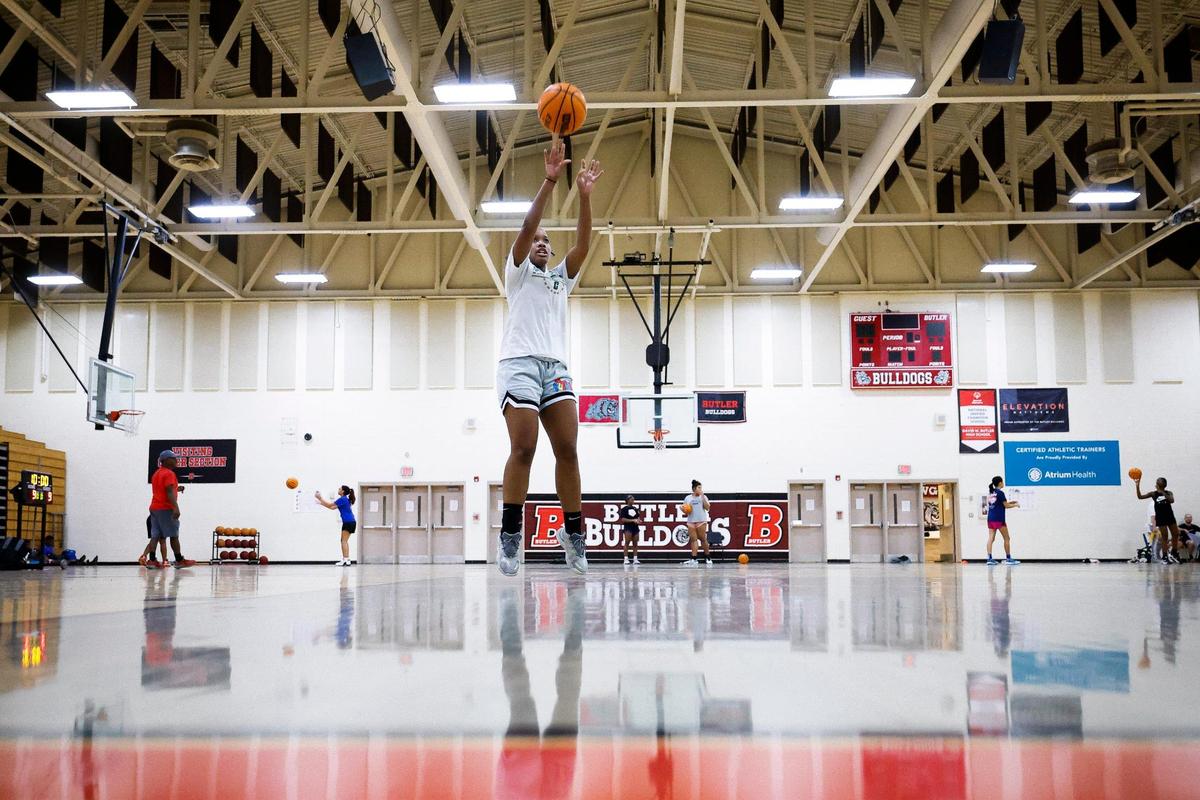
At Butler High School last week, 15-year-old Brooklyn Saunders was among just 11 players at a voluntary workout for the varsity girls basketball team. No one expects many more players when practices officially begin.
Butler probably won’t have a junior varsity team this season. Everyone who shows up will probably make the team.
As girls high school basketball tryouts begin in North Carolina — and across the country — that scene is expected to play out over and over.
Coaches at many schools are faced with having fewer and fewer girls who want to play high school basketball.
In the past 10 years, basketball has fallen from its perch as the second-most popular sport nationally for girls, behind track and field. Today, hoops is fourth, down more than 14% in participation.
Coaches don’t see that trend reversing itself anytime soon.
“Twenty-five years ago, you would get 50 girls for tryouts, and now basically everybody that shows up — as long as they have got the grades — they’re playing,” Butler head coach Mark Sanders said. “Last year, for us, we had a total of 16 girls that tried out.”
Sanders believes several factors are at play: Much like boys, girls are starting to specialize in one sport year-round; and unlike boys, there are not as many willing athletes. Sanders said additional sports being offered, like fast-growing lacrosse, are also draining the available talent pool.
His players said there are other factors to consider as well.
“There’s not as much ‘hype’ for girls sports as there is for boys sports,” Butler senior Sydney Reynolds said. “So where boys are excited to come out and play, and they know they are getting a competitive time, I think girls assume it’s just for fun and don’t continue to come out. You look around and there’s girls who maybe come to one or two practices and I haven’t seen them in weeks. They just don’t come back because maybe it’s not what they thought it was, or it was too much.”
Butler girls basketball head coach Mark Sanders jokes with players during practice at Butler High School in Charlotte, N.C., Tuesday, Oct. 25, 2022. Alex Slitz alslitz@charlotteobserver.com
▪ In the 2013-14 school year, a National Federation of State High School Associations survey listed more than 430,000 girls basketball players in the nation. A similar survey, from the 2021-22 school year, showed that number had fallen to around 370,000.
The survey found boys and girls participation overall had declined by 4% since 2019, but the first post-pandemic national survey, released this year, found girls basketball participation had fallen 7% in that same three-year span.
▪ And since 2002, two sports where girls are beginning to play year-round — soccer and volleyball — have exploded in popularity. Soccer and volleyball participation are up 15% each.
Girls basketball, in those same two decades, is down 19%.
“It’s very concerning,” said Charlotte-Mecklenburg Schools’ system athletic director Ericia Turner, a former high school and college basketball player, as well as a former girls basketball coach. “People’s motivations and interests have changed over the years.
“You’re talking about the 21st century child, and they have a lot going on. They have video games, the internet, and they’re doing different things. We’ve just got to meet them where they are, but I think a lot of them are turning to technology, and that’s just where they’d rather be.”
Butler’s Lauryn Foster shoots baskets during practice at Butler High School in Charlotte, N.C., Tuesday, Oct. 25, 2022. Alex Slitz alslitz@charlotteobserver.com
Charlotte-area hit hard
Statistics underscore Turner’s concerns.
In North Carolina, there were more girls playing basketball than boys in the 2002-03 school year: 9,451 to 9,321.
In 2021-22, there were 10,944 boys playing basketball, and only 7,264 girls.
The Observer then surveyed the 162 schools it covers, asking girls basketball coaches about participation. Among the 48 responses, more than half said numbers have dipped, sometimes dramatically. Most coaches, like Sanders at Butler High School, said they were losing players to other sports — soccer, volleyball and lacrosse — each with their own pressures to play year-round.
South Stanly High, about an hour drive east of uptown Charlotte, won’t have a girls varsity team for the second straight season. Athletic director Sean Whitley said South Stanly was forced to stop its junior varsity program 10 years ago, but kept a varsity team until last season, when only four girls showed up to play.
“We had two seniors and they were obviously upset that they would not get to play,” Whitley said, “and we tried to beat the bushes to find enough girls. But we just couldn’t find them.”
South Stanly has fielded strong athletic teams in the past. It won the 2012 N.C. 1A softball state championship, and plays in a county with other powerhouse teams. West Stanly won 2A softball state titles in 2013, 2019 and 2021. North Stanly won 1A in 2017.
Whitley said at a small school like South Stanly, which has 450 students, losing a few players who choose to specialize in one sport, like softball, can make a big difference. And the school has also lost about 50 students, overall, in recent years.
“We’ve had a lot of success in softball,” he said. “We’ve got thriving junior programs, even in volleyball. And even when we had girls basketball teams, a lot of times, that was the secondary sport. And I think a lot of the primary sports are becoming year-round and people are starting to focus on the travel end of the things.”
The latest North Carolina sports participation studies showed a 9.1% decline in overall participation for boys and girls, compared with a survey done in the 2018-19 school year, before the pandemic. It also showed a 12.5% decline in girls sports overall.
“I’m always concerned about a decrease in numbers of participation,” said Que Tucker, commissioner of the N.C. High School Athletic Association, the governing body for the state’s more than 400 mostly public schools. “It seems to be an issue nationally that overall numbers for girls are down. I can’t put my finger on it other than specialization. Where we were concerned with it for guys, girls pledge themselves more to the specializing piece and picking the sport they love, and that’s where they have focused on.”
Tucker notes the NCHSAA is adding sports like lacrosse and girls wrestling, and said that has appeared to affect basketball numbers. To help combat this, the association is trying a “five quarter rule” this season, where a player can play up to five quarters of junior varsity and varsity games in one day.
Tucker said the hope is that coaches will be able to field junior varsity teams, particularly in girls basketball, knowing they can use some of the junior varsity players to fill gaps on the varsity roster. In the past, when players had to play on only one team, the junior varsity would suffer.
‘I tell my kids to play another sport’
Zoe Bell, shown here exhorting a player, understands being cut from the team. She once was cut from the Appalachian State team. DIEDRA LAIRD DIEDRA LAIRD - dlaird@charlotteo
Twenty-six years ago, Ardrey Kell High’s Zoe Bell — one of the state’s most decorated volleyball coaches — started Carolinas Juniors, a club team.
Bell has won five high school state championships and was named national high school coach of the year in 2019. She said she encourages her players to play other sports after high school volleyball season ends in October, just as basketball is beginning.
Club volleyball season typically starts practice in December, Bell said, with weekend tournaments beginning in January. She said the bigger events don’t start until March, after high school basketball season has ended.
“I’ve got kids that swim,” Bell said. “That’s in the wintertime. I’ve had girls play soccer, basketball. If I heard one of my coaches say (‘just play club volleyball’), I’d light into them ... During the month of November, I said, ‘You should take a break or go play another sport.’ I’d love for my players to play basketball.”
Bell said she believes playing more than one sport helps with injury prevention and overall athleticism.
‘Somebody’s got to lose’
About 20 minutes away, at Myers Park High School, nine-time state championship coach Barbara Nelson said she’s not having much trouble with girls basketball participation, but she recognizes that specialization is having an effect.
“I think in general,” she said, “we’re seeing more single-sport athletes. Somebody’s got to lose, and the club sports have kind of taken over and forced the single-sport athlete.”
Myers Park head coach Barbara Nelson talks with her team during a timeout at the SoMECK conference tournament championship game against South Meck at Harding High School on Friday, February 18, 2022. Joshua Komer The Charlotte Observer
The pressure to go to college — and potentially play a sport in college — is also a factor.
“Our volleyball coach and I were talking,” Nelson said, “and if we’re not training we’re getting behind. That encourages a kid to play one sport. She said college (volleyball) coaches do not come to watch high school teams play. They’re at the club scene.”
Nelson said today the clubs have a large footprint in the area and dominate youth sports.
“Look at lacrosse,” she said. “It was a northern sport, and when it came down South, it wasn’t a school-based sport, and the clubs figured out they could make money. Soccer started this, and they figured they could make themselves a full-time job, charging $1,000 or $2,000 per season. You do the math.
“If that’s your job and livelihood, you don’t want a kid to play for the school during club season. And now it’s summer camp, and we’re running club all fall, then indoor in the winter, and that’s just the truth. If you look at it, a kid is now playing three seasons of the same sport and in the off-season, the summer, he’s now training with these same coaches.”
Nelson coached summer AAU boys and girls basketball for years, but said the operation is not nearly as sophisticated. The clientele is also generally not as well off as in soccer, volleyball and lacrosse. Nelson said she and her husband, Vern, often paid hotel costs for teams. She only knows of one basketball organization, Pro Skills Basketball, that is paying its coaches and it operates year-round with monthly payments from parents, similar to the club sports.
Ultimately, that type of specialization, Nelson believes, is hurting girls sports.
“Boys think they can play every sport and they all think they are going to the NBA,” she said. “They hang in there longer. Girls realize, ‘I’m not as good. I won’t play as much,’ and they’ll find something else to do.”
So what now?
At Butler, Brooklyn Saunders continues to work hard each day in practice, surrounded by a dedicated group of players just like her.
But there is someone missing. Saunders wished her sister, Addison — a Butler freshman — would give basketball a try.
“She found a love of volleyball,” Brooklyn Saunders said. “That’s her new thing now. I think she’s a good basketball player, but she’s like, ‘No, I don’t like the contact.’ I’d say a lot of girls are going into volleyball who would’ve played basketball. Women’s basketball is not a common thing anymore, mainly because we don’t have as much publicity as other sports. People just see men’s basketball and don’t think, ‘Why don’t women play?’”
Chloe Ross, a 6-foot-4 sophomore at Butler, is a relative newcomer to the sport, having just started playing last year as a freshman. She hopes the girls game grows at the high school level.
Butler’s Chloe Ross rebounds the ball during basketball practice at Butler High School in Charlotte, N.C., Tuesday, Oct. 25, 2022. Alex Slitz alslitz@charlotteobserver.com
“I think people are maybe a little intimated to try it out,” Ross said. “I know I didn’t want to play basketball. I was told growing up I should play because I was tall, but last year was my first year because of my coaches who pushed me to do it. I played AAU over the summer and I actually really love it.”
Officials like Turner, in Charlotte, and Tucker, who runs high school sports in North Carolina, are hoping to turn the numbers around, to find more students like Ross who join — or rejoin — high school athletics.
Parents, Turner said, can play a big role in that.
“If you look at athletics as a whole,” the CMS athletic director said, “and you look at the pressure put on these babies at a young age, by the time they get to high school they don’t want to play. We’ve got parents fighting at (junior) games and I think that pressure turns them away. Let them have fun.”
Reynolds — who transferred to Butler last year from 1A Queens Grant Charter School — has seen the shift to a more competitive atmosphere from an early age..
“My freshman year,” she said, “we probably had 10 girls and everyone got to play and it was competitive. My sophomore year, people graduated and people were like, ‘Maybe I don’t really want to do this,’ or ‘this is too competitive for me.’ Even when I got (to Butler), there’s been girls who say, ‘This is not what I want. They just want to play for fun.”
Reynolds, echoing many of her fellow student and administrators alike, just wants the game to grow — and last — and hopes girls basketball in the area has a real future.
“Hopefully it sticks around,” she said. “With the right people pushing it and athletes and parents and coaches and administrators getting behind it, it can grow.
“But it’s going to take a lot of work.”
This story was originally published November 3, 2022 at 6:00 AM.
Langston Wertz Jr. is an award-winning sports journalist who has worked at the Observer since 1988. He’s covered everything from Final Fours and NFL to video games and Britney Spears. Wertz -- a West Charlotte High and UNC grad -- is the rare person who can answer “Charlotte,” when you ask, “What city are you from.”Support my work with a digital subscription
Sports Pass is your ticket to Charlotte sports
#ReadLocal
Get in-depth, sideline coverage of Charlotte area sports - only $1 a month