
‘Growth process’: Why NCHSAA won’t officially sanction high school flag football — yet
North Carolina’s experiment with high school girls’ flag football will continue, but without the official endorsement of the N.C. High School Athletic Association — for now.
The NCHSAA decided Thursday to refrain from sanctioning girls’ flag football as a championship sport, saying it is unable to determine how many schools are participating in the program.
The flag football issue was among several considered on the final day of the NCHSAA’s two-day winter meeting.
The board also decided not to act on a request from a Nash County principal to move the state’s charter and parochial schools to separate playoff classifications.
A group of girls’ high school flag football supporters organized a first-ever state playoff this fall, involving 41 teams. The championship is set for Saturday, with three Raleigh-area schools — Apex, Apex Friendship and Wakefield — and Wilmington’s Ashley having reached the semifinals.
But that championship won’t be officially recognized by the NCHSAA — not yet, anyway.
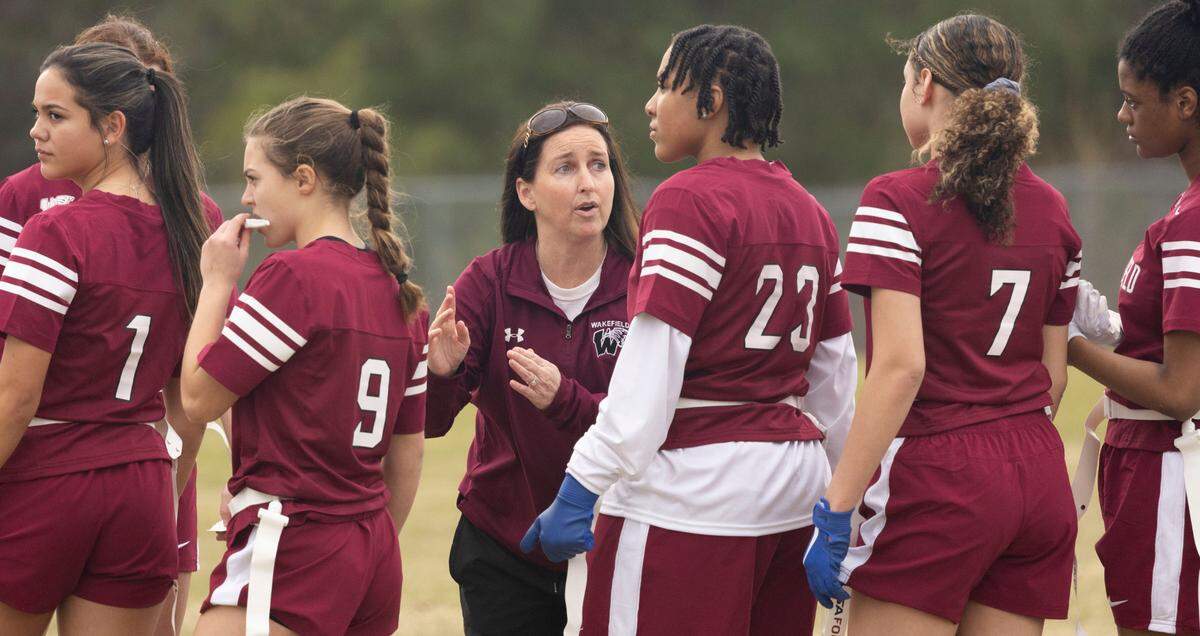
NCHSAA officials said Thursday the problem with sanctioning girls’ flag football is, in part, due to conflicting numbers supporting just how much the sport has grown.
Paige Badgett, principal at North Surry High School and chair of the NCHSAA’s Policy Committee, told board members that a survey showed 52 of the organizations’ 440 schools have flag football programs. That differs greatly from the 119 participating schools reported by the Carolina Panthers, who have sponsored the sport in North Carolina.
NCHSAA Commissioner Que Tucker said the organization can’t start conducting state championships in flag football “until we have data that is solid, and evidence that schools are sustaining the sport.”
“There’s no question that it’s gaining traction,” said NCHSAA Board President Stephen Gainey, superintendent of the Randolph County Schools. “But we have to do what is right for all our schools. We need more data.”
Tucker cited the development of lacrosse and girls’ wrestling, each of which took several years before gaining NCHSAA sanctioning.
“There’s a growth process involved,” she said.
A dozen states nationally have officially-sanctioned flag football programs, and another 19 states are in the trial process, like North Carolina.
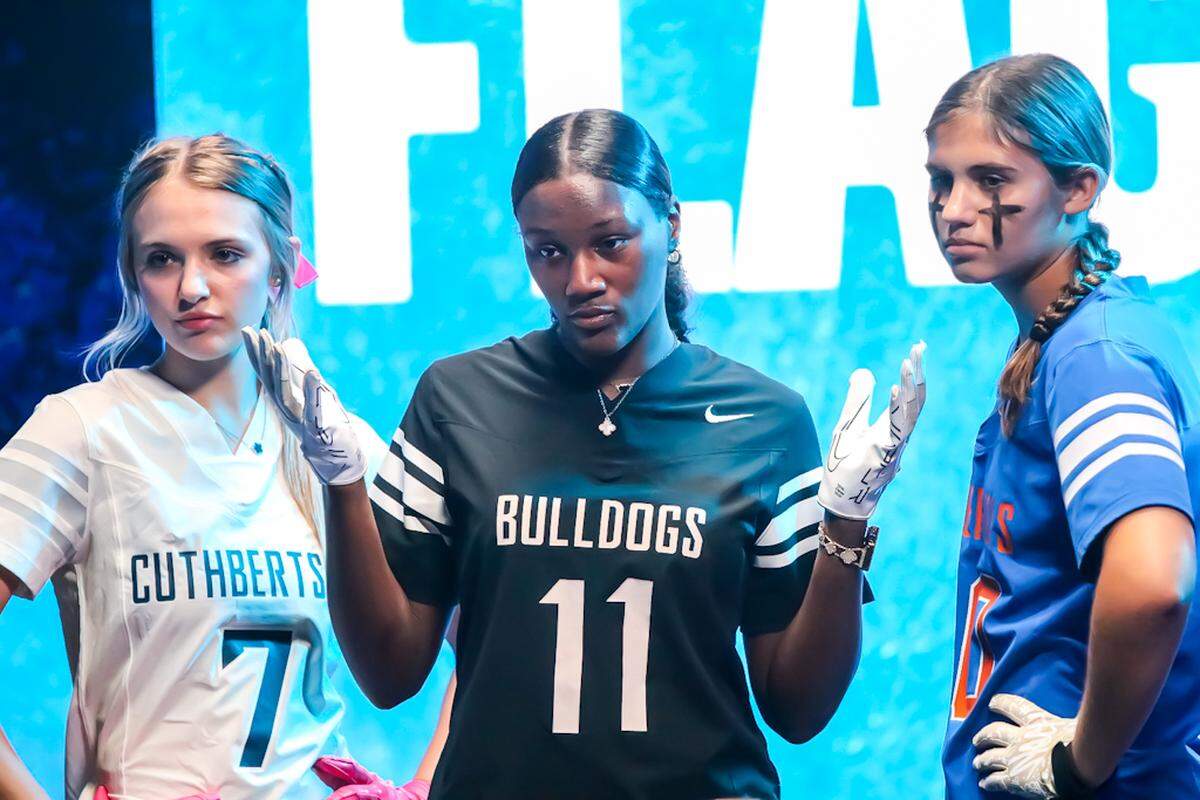
The Panthers launched the state’s program with a spring 2022 season in Mecklenburg County. Girls’ high school flag football has expanded into Cabarrus and Union counties in the Charlotte area, and it’s also strong near Raleigh and in a few other spots around the state.
NCHSAA bylaws require that half the member schools in a size classification, or 25% of the entire state’s membership, sponsor a sport before it is recognized. That would mean 52 of the state’s 104 schools in the 4A classification would need to have flag football programs.
The problem, according to Tucker and Gainey, is not knowing whether enough schools are participating to meet that threshold.
Another problem mentioned at Thursday’s board meeting was when to conduct the season.
Charlotte-Mecklenburg schools play in the spring, but teams elsewhere, including in Union County, have fall seasons.
“There are some things we’ll have to organize before we can get this going,” Gainey said.
Charter/parochial proposal
The board reiterated Thursday what it had said Wednesday — that this is not the right time to act on a proposal to move charter and parochial schools to separate playoff classifications.
The proposal, from Nash Central High Principal Jonathan Tribula, asked for schools without “a defined attendance zone” to be moved into either of two playoff classes that would be separate from the other NCHSAA classes. This would come at a time when the NCHSAA is expanding from four to eight classes for next school year and realigning its conferences.
“We owe it to our membership to focus on our No. 1 priority — the realignment,” board president Gainey said..
Gainey and Tucker also acknowledged that the proposal possible could affect magnet schools and early colleges, which also do not have localized attendance zones like other high schools.
“That’s why we need time to explore the issue,” Tucker said, adding that studying the proposal should wait until after realignment is finished.
Gainey also noted that separating the schools might require a change in NCHSAA bylaws, which would mean getting approval from the state’s 400-plus member schools.
Paying the bills
Higher costs and added expenses are putting a bit of a financial squeeze on the NCHSAA.
Mark Garrett, superintendent of the Henderson County Schools and chair of the Finance and Personnel Committee, told the NCHSAA on Thursday that expenses are up and ticket sale revenue is down.
And, he added, the cost of doing business will increase next year, when the NCHSAA starts sponsoring championships in eight classes rather than the current four.
“You can’t expand anything without incurring costs,” Garrett said. “Moving to eight classes will have a financial impact.”
Garrett also said ticket sales for state playoffs this fall were down.
“That,” he said, “can depend on who is in the playoffs — and how far the venue is from the competing schools.”
The biggest issue, board members agreed, is finding a way to pay for twice the number of state tournaments and championships. The NCHSAA has tried to hold state finals at colleges or professional sports facilities, when possible.
“Will we have to bring some of these championships back to high school sites?” Tucker asked. “And is that equitable to all of our members?”
During the two-day meeting, board members talked several times about trying to provide a first-class experience for schools of all sizes during state championships.
“No matter what we do, finances will factor in,” Gainey said.
In other developments from the meetings:
▪ The board delayed acting on a proposal to change the RPI rating system used to determine playoff seeding. Board members said they wanted to finalize realignment first, but acknowledged that they have received considerable interest from schools in changing the formula.
▪ Approved a one-year experiment to allow baseball coaches to communicate electronically with pitchers and catchers before pitches next spring. The NCHSAA experimented last spring with coach-catcher communications and will expand it to pitchers in 2025. Softball coaches and catchers also will be able to communicate, starting next spring.
This story was originally published December 5, 2024 at 2:03 PM.