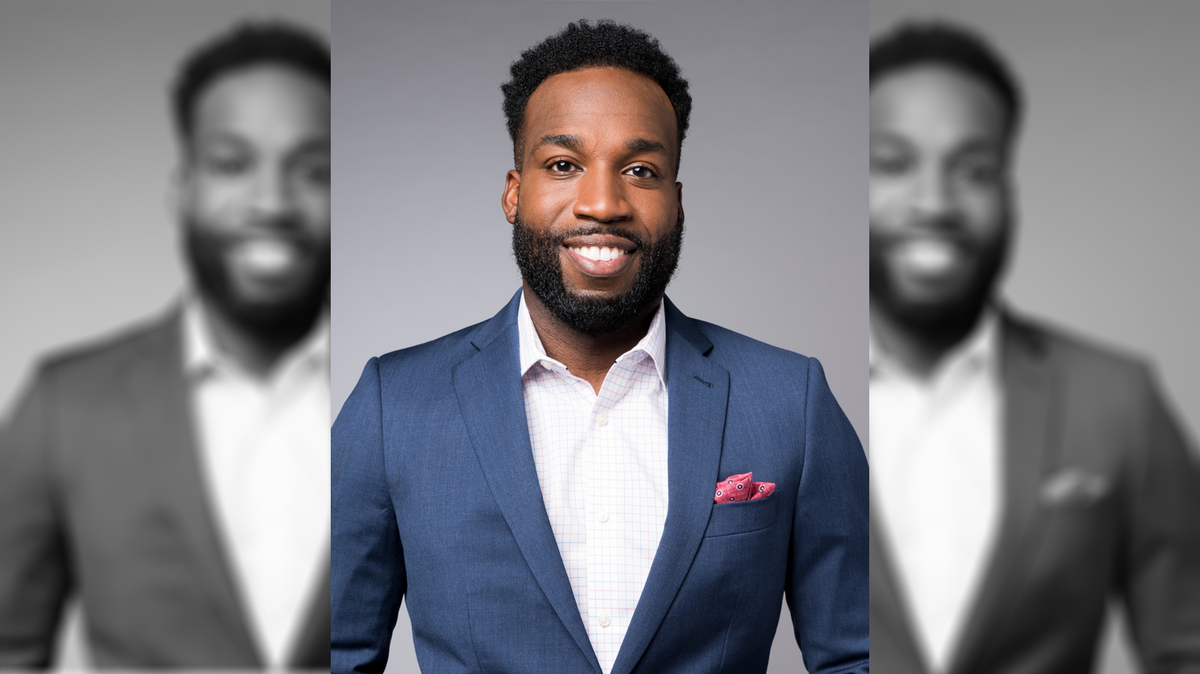
You know Josh Sims from Fox 46. Now he’s the first Black full-time NASCAR pit reporter
Josh Sims’ first Daytona 500 was in 2016, in which a photo finish characterized the end of the race. It was the closest finish in the event’s history with Denny Hamlin beating Martin Truex Jr. to the line by 0.010 seconds.
Sims was a broadcast reporter for FOX 46 at the time, and adjusting with as much speed to cover NASCAR, among other professional sports, for the local Charlotte network. Six years later, Sims is in a new role that has further plunged him into the fast-paced industry.
He’ll be a pit reporter for NASCAR’s broadcasts on FOX covering the full Truck Series season this year after jumping into the role last summer and covering select races in the later part of the season. He’ll also make his ARCA Series debut on pit road at Daytona, in addition to continuing as a reporter on NASCAR Race Hub and RaceDay programs.
Sims is the first and only Black full-time pit reporter for the network’s NASCAR broadcasts, and he’ll have even greater visibility this year. He spoke with The Observer about the career move, the demands of the job and why representation matters.
This interview has been lightly edited for brevity and clarity.
Alex Andrejev: How was your experience with pit reporting last season? You came in mid-season (joined the network as a Fox NASCAR pit reporter in summer 2021) so it seemed like you had to learn a lot on the fly.
Josh Sims: The best way to improve and learn anything is to throw yourself in there. I wasn’t necessarily thrown right into the fire because FOX did a great job of allowing me to come in and shadow for a couple of months, so I got a chance to go to some races with Regan Smith at Gateway and Watkins Glen, and I got to be with him while he was pit reporting to see how he handled things … So that was very helpful. During that time, those first couple months, I had a chance to sit down and pick the brain of anybody and everybody at FOX, whether it was Larry Mac helping out, Kaitlyn (Vincie), Shannon Spake, Vince Welch, the list goes on of people who gave me advice and feedback on what I’d been doing, so that was helpful. And then just doing it was the best way to learn about what works and what doesn’t, so doing that first race in Darlington was definitely a big help for me … I ended up doing four races to finish out the season last year for Trucks and each and every time I did it, I felt more comfortable with what I was doing, so I was happy to get that under my belt heading into this full season … For anything you do in life, each and every time you do it, you learn more, you pick up more and you’re always growing and getting better, so I’m looking forward to doing that, starting at Daytona and going through the rest of the year.
AA: Timing and adjusting quickly to information is so crucial as a pit reporter. Things happen so fast in a race.
JS: You’re juggling a lot of things at once. And the good thing is you’re always a part of a team when things are happening, so you’re never on an island, even if you’re one of two, three pit reporters, because you have a spotter with you that’s helping you pay attention to what’s going on. Before the race even starts, during the week, assignments come down to break down the drivers that you will be assigned to — so if it’s two pit reporters, then you’ll have about 20 trucks (to keep track of), or if it’s three of us, you’ll have a few less than that. Then you’ll go through the truck and teams and drivers you’re assigned and look at the background, what they’ve done, the story lines for them heading into the next race. And then once you arrive at the track, you have the chance to go talk to the driver, talk to the crew chief, get information from the team that you might use during the race, or practice or qualifying … Then once the race starts, you’re paying attention to a lot of different things. You’re listening to the radio. You’re scanning the drivers you’re assigned to, listening to the conversations between them and their crew chief and their spotter during the race. You have the help of the pit spotter, who’s paying attention to the drivers that you might not be able to pay attention to at the moment and he or she is relaying that information to you. At the same time, you’re also walking up and down pit road, and watching things going on with the team.
AA: Do you have a producer in one ear and team radios in another?
JS: It’s funny. You have a bunch of different voices in your head. It sounds like you’re crazy, but you’re not. There actually are people talking to you. You have a producer in one ear, and in the other ear, you’re listening to the race broadcast and you’re also listening to the radio of the trucks, so you’re scanning and at the same time listening to what’s going on. And the good thing is you can also talk back and forth to our producer so if something happens, you can say, ‘Hey, I got an update on the 4 team of John Hunter Nemechek.’ You can easily tell them that. We talked about the speed in which things happen. You could one minute say, ‘The 4 team is saying they’re unhappy with the way the truck is handling now and they’re gonna pit early and come in for an adjustment.’ I relay that to my producer and then I can be on-air seconds later because of the immediacy of what’s going on, so you’re always balancing those different things and listening to a lot of different people.
AA: It seems like a big jump from your role with WJZY (FOX 46 Charlotte). How different is this role and what was your familiarity with NASCAR before then?
JS: It certainly is different from local reporting, but when I got to FOX 46 back in 2015, we did a pre-race show every week and we’d shoot features. It was a lot more hosting duties, putting together stories. Pit reporting is a little bit different just in terms of reporting — I’ve been reporting 10 years in the business — but this is just a different type of reporting. You already have the wherewithal to know how to handle a situation where things are unfolding in front of you. You’re looking at and deciphering the information, and relaying that on-air. That’s something I’ve been doing my whole career. This just happens at a much quicker pace with a lot more things going on at once. I knew that NASCAR was one of the main things I’d be covering (at FOX 46), so even before I came down here, I made sure to dive into the sport. Growing up, I knew of the big names, the Jeff Gordons, Tony Stewarts, Dale Jr. and Sr. But the biggest thing for me was just coming down here and becoming a part of it. The first Daytona 500 I went to was in 2016, and at the time it was the closest finish ever. That was my first race, was the biggest race, and that was such a cool experience for me. And then getting the chance to establish a relationship with the teams and drivers over the years made things better and gave me so much more of an appreciation for the sport, so when this opportunity came about, I felt comfortable. I felt like I was just moving over to work with people I’d seen from afar and talked to, and now we’re on the same team. It made the transition smooth working in local TV for the last six or seven years.
AA: You’re the only person of color that’s regularly in front of the camera on the FOX NASCAR broadcast team. Was that a point of consideration for you when taking this job — that either made you hesitant to do so or more motivated to help diversify the industry?
JS: I think representation matters. One of the coolest moments for me was right after I accepted the job and I was focused on what I’m trying to do to get up to speed and I (wasn’t) even thinking about that sort of thing. I was just thinking about what I was doing from a reporting aspect and my contributions, and proving myself at the company. I was at the Brad Keselowski announcement when he was making his transition to his new team, and a young Black man came up to me and he was like, ‘Hey man, I just wanted to say, ‘What you’re doing is so impactful. We’re so proud to see what you’re doing. I’m not just speaking for me. We literally have this group on Facebook of African Americans that follow the sport and love the sport, and I just want to shake your hand. We really look up to you and what you’re doing.’ And that was a moment when I really stepped back to think about that sort of thing. While I’m aware of it and my place in the sport, in the industry as a person of color, I don’t always think about it because I’m so hyper-focused on what I’m doing to be a great reporter and great storyteller. That kind of hit me. I was like, ‘Wow. I’m glad I can provide that kind of representation and let them know that they too maybe one day can be a pit reporter, maybe one day be a host or an anchor on Race Hub, whereas before, they maybe haven’t seen someone like themselves. It all comes back to that representation that matters. I’m glad I could be that and can help a sport that is ever-growing and has been working so hard to be more inclusive as much as it can in the past year.