NASCAR races at the LA Coliseum this weekend. Here’s everything you need to know
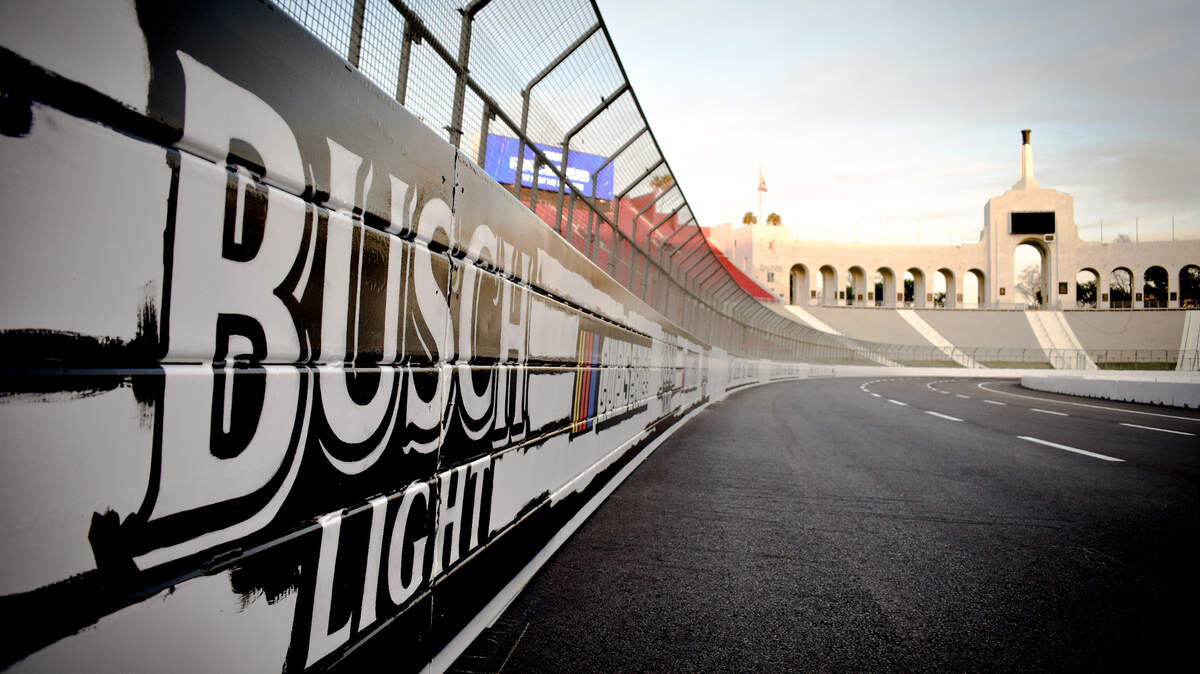
NASCAR’s first event of the 2022 season will be on top of a football field and it might look more like a Hollywood party than a stock car race.
The Cup Series and its Next Gen cars will make their highly anticipated debut on a purpose-built track at the Los Angeles Memorial Coliseum this weekend. Deep under the track’s asphalt surface is the same grass that the University of Southern California’s football team last played on.
The 150-lap exhibition Clash will feature a pre-race concert by Pitbull and a mid-race performance by Ice Cube. The breaks in action during the cautions will remain loud with a performance by DJ Skee.
As soon as the engines stop revving and the basses stop thumping when the race ends, a crew will arrive to dismantle the entire setup by the time the next green flag waves for the Daytona 500 on Feb. 20.
Have questions? Read on. Here’s everything you need to know about the NASCAR Clash at the Coliseum.
A race at a football stadium? That’s wild, right?
It’s not as wild as you might think. While it’ll be the first time NASCAR is racing at the Coliseum, which hosted events such as the Olympics, Super Bowls, concerts and even a Papal Mass in 1987, this won’t be the first time the series races on a quarter-mile track in a multi-purpose sports venue. Between 1958 and 1971, NASCAR’s top series raced 29 times at Bowman Gray Stadium in Winston-Salem, North Carolina. The stadium is home to a quarter-mile track that still holds weekly stock car races and football games for Winston-Salem State University, a nearby HBCU. NASCAR has modeled its Coliseum track after Bowman Gray.
“Obviously [the Coliseum] was totally new,” said Marty Flugger, vice president of engineering services for NASCAR’s design and development, who helped construct the track for the Clash. “But you fall back on everything we’ve done in the past and all the other tracks, what we know has worked and hasn’t worked.”
“You take those pieces that we’ve done on past projects and apply them to this,” he said.
Flugger said his team started constructing the track on Dec. 13. The surface will look very similar to other NASCAR tracks despite being on a smaller scale, he said. Wall barriers and SAFER barriers have been installed and the track will have 2.5 degrees of banking.
How is the race gonna work?
The event will take place over two days Feb. 5-6, with the main event on Sunday at 6 p.m. ET on Fox, MRN and SiriusXM. It will feature practice, qualifying and heat races. Practice will take place on Saturday with the 36 entries split into three groups for eight-minute sessions. Qualifying will also take place on Saturday to determine the starting order for the heat races on Sunday. Four heat races (25 laps each) and two Last Chance Qualifiers will determine which 23 cars make the final event. The Clash will be 150 laps with a break on Lap 75 that will last around six minutes for teams to work on their cars. Cautions will not count for heat races or the main event.
“We have a pretty tight TV window and it’s really hard to predict what’s gonna happen in this one,” NASCAR senior vice president of competition Scott Miller said, talking about the transition between the LCQ and the Clash. “Theoretically, we could get ahead of schedule if we don’t have a lot of cautions, but I think we all are expecting something a little different than that.”
For more details on practice, qualifying and the heat races, click here.
Why is NASCAR racing in Downtown L.A.?
NASCAR has long been aiming to shake up its schedule and diversify its venues. Executives originally considered holding a race at Soldier Field in Chicago, which hosts NFL games for the Chicago Bears and MLS matches for the Chicago Fire, but they determined that the tight spacing in and around the field wouldn’t make it feasible.
“That led us to exploring where, if any, facilities we could race at that were different, that weren’t racetracks,” NASCAR’s chief racing development officer Steve O’Donnell said.
NASCAR connected with the group operating the Coliseum, which is managed by the University of Southern California, and put a deal together to race there for potentially up to three years, according to NBC Sports.
“We obviously like the racetracks we’re at and we feel like we’ve got a lot of fans in those marketplaces,” O’Donnell said. “But when you look at our schedule and trying to differentiate, we did look at if there was maybe once a year we could look at this as a possibility. That’s the reason we went forward with the Coliseum.”
What does NASCAR want out of this?
Exposure is probably the key word. O’Donnell highlighted the large Fox television window NASCAR was getting for the event, which falls a week out from the Super Bowl. He also said that more than 70% of ticket-buyers for the Clash had not previously purchased a ticket to a NASCAR race, and that the venue would be near its capacity.
NBC Sports reported that a crowd of 50,000 to 60,000 is expected for Sunday’s race with the venue opening seating to around 60,000 fans.
“The number of celebrities showing up, the enthusiasm and promotion that we’ve seen from Fox for this race, even during NFL broadcasts, it’s been unprecedented and it’s been on a level almost equal to the Daytona 500,” O’Donnell said.
NASCAR’s Cup Series will return to Southern California after the Daytona 500 for a race at Auto Club Speedway on Feb. 27.