Dust clouded NASCAR’s Bristol dirt race last year. Here’s what’s changing this year
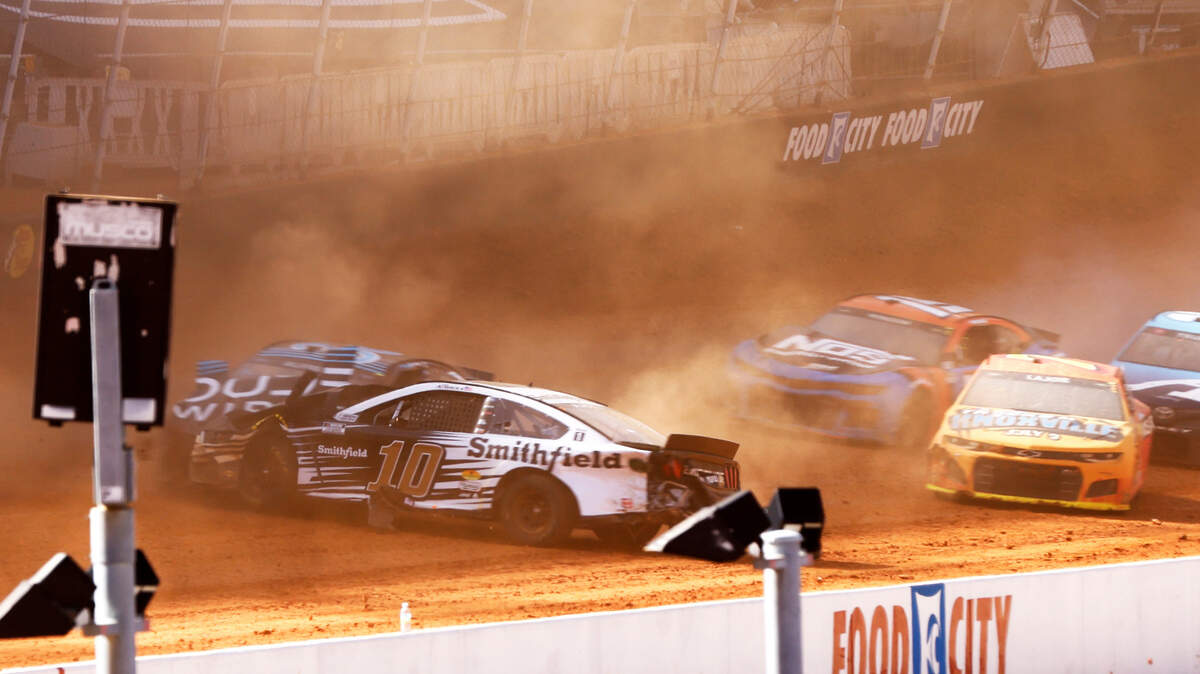
Last year’s NASCAR race on a dirt track at Bristol Motor Speedway could have been named the Bristol dust bowl as a giant red cloud hung in the air above “The Last Great Colosseum.”
Driver Joey Logano, winner of the 2021 spectacle, called the lack of driver visibility unsafe. Fans in the stands wore goggles, and at least one attendee reportedly suffered an asthma attack due to the dust.
The excessive dusting wasn’t something NASCAR was expecting as part of its Bristol dirt experiment, nor was the torrential flooding near the Bristol, Tenn., track in the days prior, which washed out heat races, delayed the main event and contributed to dry track conditions when the Truck and Cup Series races finally ran on a Monday afternoon.
Despite the hiccups, before last year’s Cup race ended, NASCAR’s return to Bristol dirt in 2022 was announced at the track and met with loud cheers from the stands. With a new Cup car this year and different timing for the race on Easter night, NASCAR is expecting the dust to be mitigated and make for a better show. Here’s how.
Night race
Last year’s Bristol dirt race ran at 4 p.m. under sunny skies. The temperature at the time ranged from the high-50s to the low-60s. This year’s race is at 7 p.m. Sunday (FOX, PRN, SiriusXM) with similar temperatures as last year expected.
It’s largely the sun, or lack thereof, that NASCAR believes will make the biggest difference.
“The water needs to get into the racetrack and with the sun coming out, it sucks some of that moisture out,” NASCAR Cup Series managing director Brad Moran said. “When you race on it, you pull all of the moisture out of it …When you are fighting against the sun, the heat and racing on it, that combination on a dirt track, it can only handle so much of it, and then it gives up.”
The flooding last year added an unpredictable element for NASCAR, and both the Truck and Cup Series races were re-scheduled for the same day. That meant that by the time of the Cup race, the surface layer was severely packed in, with the sun further baking the red clay on the half-mile oval.
The speedway crew has a particular process of tilling, watering and packing the dirt down to make it race-ready, and extreme weather conditions, such as too much rain or too much sun, upset that balance.
Interestingly, a little rain on Saturday morning, as is expected in the forecast before heat races, could help the process.
“If it does exactly what the weather says (this year), that’s the promoter’s dream,” Moran said. “It’ll get the moisture on the track, it’ll sit there, suck into the track, get deep into the dirt surface. If it’s a little overcast, that’s the perfect storm for a great dirt track.”
Heats and other changes
Heat races will return this year, barring severe weather, in a nod to typical dirt events.
Four heat races are scheduled for Saturday night (15 laps each) featuring nine cars in each heat. Drivers will get points for their finishing position (10 points for first place, nine points for second, etc.) and they will also receive passing points (one point for each position gained from their starting position). Points will not be deducted for positions lost, and will be totaled to determine the starting lineup for Sunday’s 250-lap feature.
The Truck Series will also run heat races on Saturday followed by its 150-lap feature at night at 8 p.m. (FS1, MRN, SiriusXM).
Other changes from last year to this year include gradual banking that gets steeper closer to the wall, with NASCAR aiming to create a “cushion” up top with more moisture that drivers will search for.
The Next Gen tires are already wider this year at 18 inches compared to 15 inches a season ago, and will feature a different tread that Goodyear intends to help with heat. Additionally, the underwing assembly in the Next Gen cars will be replaced by debris shields for the dirt race and the cars will have mud flaps behind their rear tires.
Moran said that it would cost teams more to run a Gen-6 car than the Next Gen car, and that decision-makers were “all in” on running Next Gen cars each race this year, including on the Bristol dirt. Truck Series driver and dirt racing aficionado Stewart Friesen tested the Next Gen car on the Bristol dirt and had positive reviews, and NASCAR is expecting that it will perform well.
“(This car) is just going to react a lot differently,” Moran said. “The steering is different. It’s got rack-and-pinion steering. This vehicle has a lot more modern technology built into it and it’s probably going to really shine here at the dirt track.”
NASCAR racing on Easter
This year’s Bristol dirt race will also be on Easter Sunday, a move that is polarizing to some fans given that NASCAR has long avoided racing on the holiday. The last time NASCAR raced on Easter was more than three decades ago in 1989, when a Richmond race was postponed to Easter.
Moran said that the timing for this year’s night race at Bristol, “just worked out that way.”
“The schedules move around,” he said. “It’s a total combination of broadcasting, track partnerships and what else goes on in the schedule, so there are a lot of moving parts that go into putting the complete annual schedule together.”
Moran said that there are “no guarantees” that the schedule looks the same next year regarding Bristol dirt, nor that a decision would be based strictly on viewership metrics. Last year’s race averaged a 1.8 rating and 3.11 million viewers on Fox when it ran on a Monday afternoon into the evening.
“As far as the future, it’s always up for discussion,” Moran said. “I believe this race got announced last year during the race that we’re coming back and doing it again. It wouldn’t surprise me if something like that happens again, but it’s all up for discussion.”
But Moran said that he’s hoping for better weather this year, which he’s fairly certain would make for a better show.
This story was originally published April 16, 2022 at 6:30 AM.