The crazy 4 days of turning Martinsville’s magic into a NASCAR documentary finale
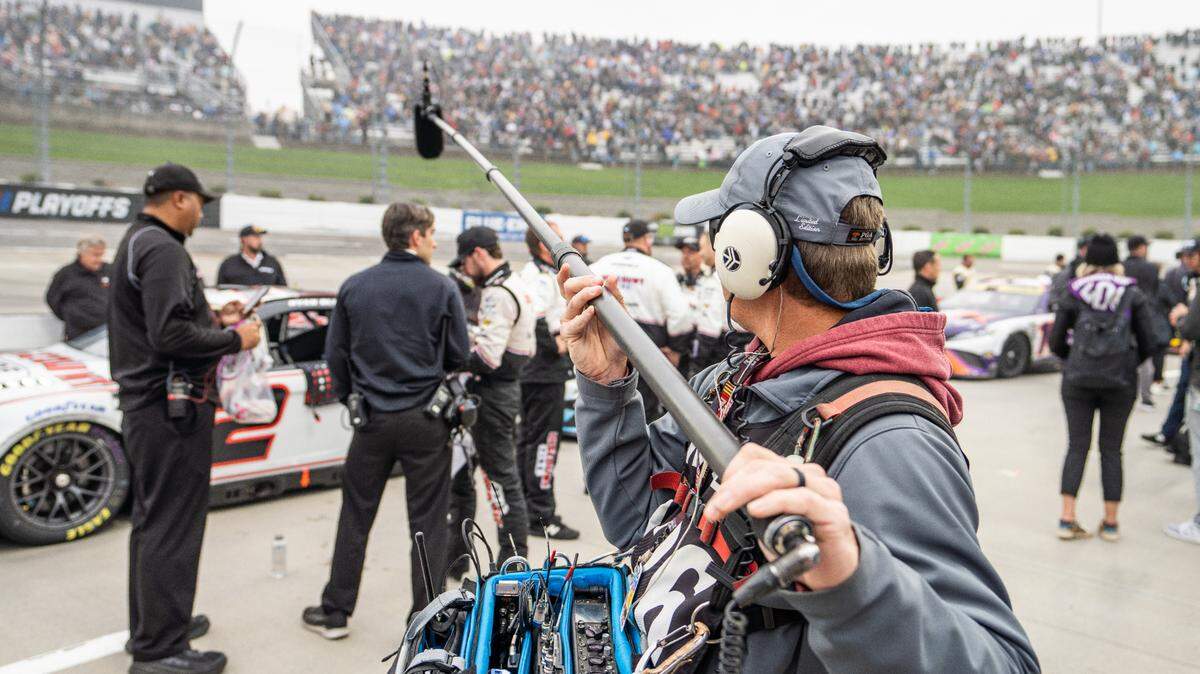
Outside, engines are fired. Pit road is clear. It’s just past 2 p.m. on Sunday, and the sold-out crowd at Martinsville Speedway hums with life as it readies to witness the elimination race of the 2022 NASCAR Cup Series Round-of-8 playoffs.
Inside, meanwhile, Brett Ramker is trying to help do the impossible.
The post-production supervisor is seated in a cozy corner in the media center at the track’s infield. He’s focused on a big monitor in front of him. A stack of camera cards containing hours of video footage are piled up next to him, and his job, on this day, is to drill through those cards and organize and upload them so that those at NASCAR’s headquarters in uptown Charlotte can get a head start on editing.
On a normal schedule, for a normal production, Ramker and his four assistant editors would be tackling these first-line-of-editing-defense responsibilities on Monday, the day after an important event.
But this isn’t a normal production.
Ramker is part of a team that only has four days — three days, really, after race day — to turn this raw footage into a documentary season finale.
“In terms of doing a long-form, episodic docu-series, this is about as fast as you can turn around an episode,” Ramker said, in the middle of a three-minute break that he probably doesn’t have time for. “Like, it’s really, really insane.”
This “insane” project is the docu-series called “Race For The Championship.” Its initial pitch was simple enough: Give new and old fans an unencumbered look into the lives of their favorite Cup drivers.
But there was an ambitious twist: After the show premiered on Sept. 1, it spent the next nine weeks catching up in real time to the Cup Series schedule. And now, mere days away from this weekend’s championship race in Phoenix, the documentary story will be caught up to the present.
In so many words: The season finale will air at 10 p.m. Thursday on USA Network and be available on Peacock on Friday — and it will include all the mayhem from Martinsville in it.
“This (project) is the biggest one in NASCAR’s history, I would say,” said Amy Anderson, NASCAR’s head of content strategy.
She added, “We’re doing longer-form features and documentaries. I think it’s in our wheelhouse. But this is the biggest and most advantageous project that we’ve taken on, and it’s been a really fun ride to see the challenges and the opportunities we have to share stories with fans. It’s been exciting.”
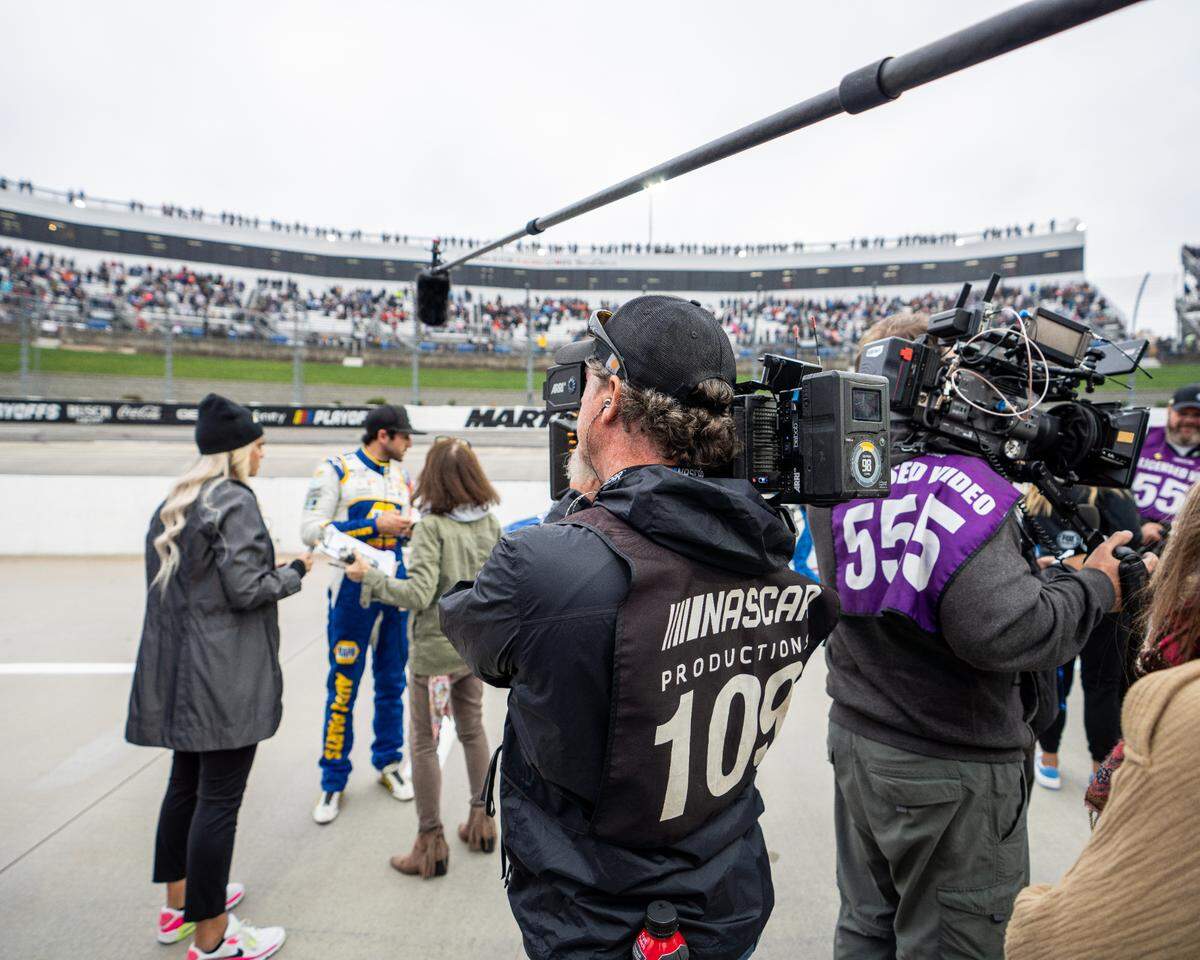
Ross Chastain’s haul up the wall
While Ramker was in the media center room in the infield at Martinsville, a few “Race For The Championship” production team members were watching the race in uptown Charlotte.
For a moment, Martinsville looked like it would be pretty tame. Passing proved difficult. Denny Hamlin won the first two stages without much of a struggle. There’d be bankable emotional highs and emotional lows after the race. It’s what makes elimination contests across all sports worthwhile, meaningful, universal.
But midrace on Sunday? Smooth sailing.
Then Ross Chastain hauled up the wall.
The driver No. 1 car — staring down elimination, needing to advance two spots on the final lap to extend his season — rammed into the fence, shifted into fifth gear and mashed the throttle, hoping the wall would steer his car, which was running about twice as fast as the others on the oval short-track, toward glory. And it did: Chastain ended up passing five cars in two turns to earn a spot in the Championship 4, a move that was instantly immortalized.
Back in uptown Charlotte, the editors for “Race For The Championship” erupted in excitement. In the words of Mike Hayden, the director for episode 10 of “Race For The Championship,” it was the sort of moment that prompted baffled pointing at the screen like that Leonardo DiCaprio meme from “Once Upon a Time in Hollywood,” as if to personify some of the most thrilling words in filmmaking: That’s it. That’s our story.
“We were all in this room,” Hayden said, pointing around one of the many dark, monitor-filled video editing bays in NASCAR’s uptown offices. “We had it up on the TV, and honestly, we were talking about, ‘OK, what do we do at the end of this race? How do we explain the checkered flag? What are we going to do, and how are we going to talk about our guys who we’ve been following all year?’
“‘How are we going to tell their stories, some of heartbreak, you know, hopefully some of (triumph)?’ And then all of a sudden. Boom. He just comes flying around. And we’re like, ‘Oh my God, what is that?! Did he get in?’ We were living it the same way (TrackHouse Racing owner) Justin Marks and those guys were living it.”
Tally Hair, an executive producer on the show, shared a similar feeling.
“Every elimination race, from Daytona to get into the playoffs, to every one of these episodes, you don’t know if the guy you’re tracking is going to get in or not get in,” Hair said. “We thought Kyle Larson was going to get in at the Roval, and then all of a sudden we’re in shock at the end. … I think elimination races — not all are as exciting as this one — but those all have that element at the end.”
And those elimination races all require more work, none more than on this week’s tight schedule. Every minute of footage gets sent from the track to NASCAR’s headquarters and then gets passed around to a handful of production members who turn it into the show people will watch on Thursday night and afterward.
But the work created from those moments aren’t a burden, editors say. Far from it.
“Yes, it creates more work,” said Jon Housholder, a lead editor on “Race For The Championship.” He then smiled, “But we’re also, like, weirdly obsessed with what we do in the strangest way. Our job’s pretty fun, so we get pretty excited. You live for those moments.”
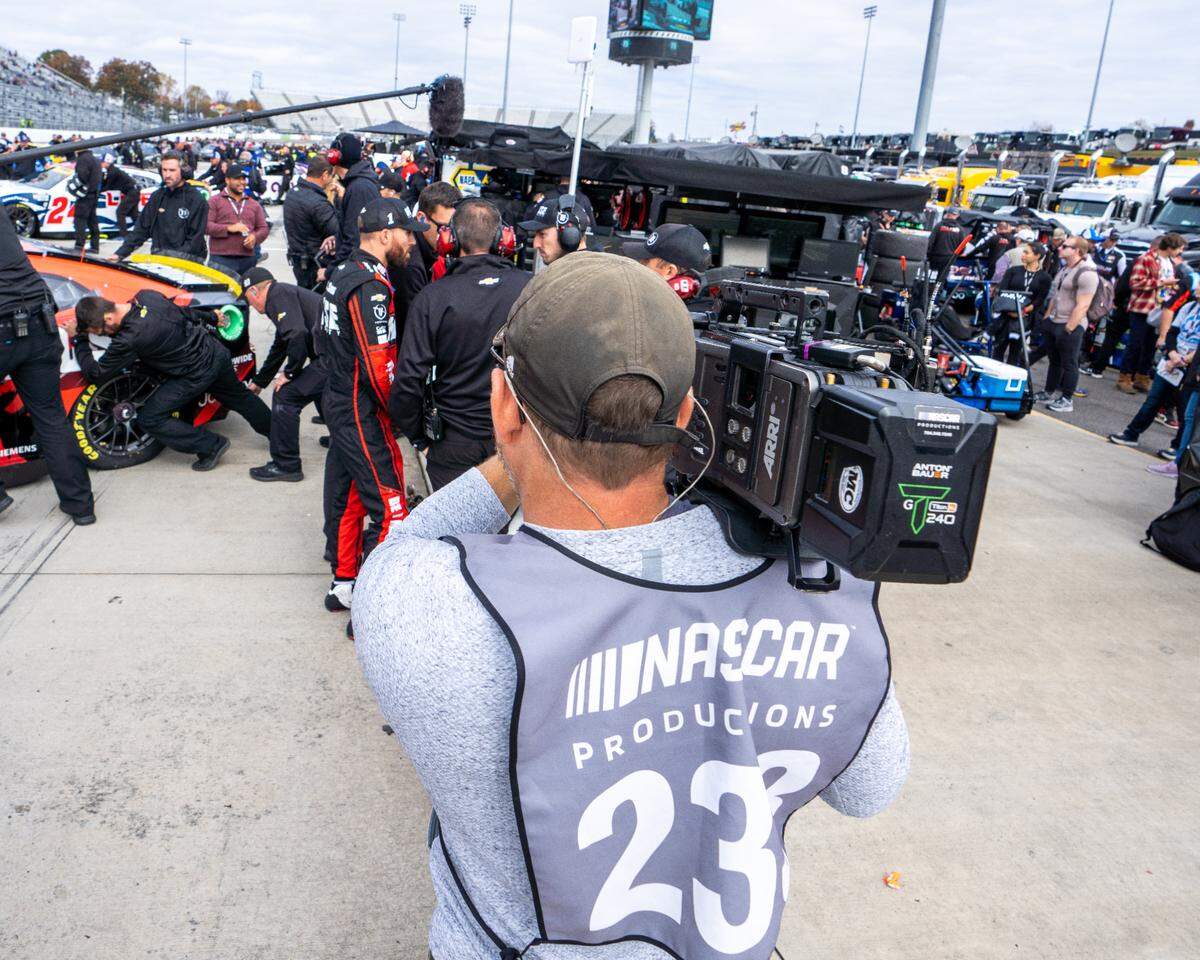
What’s next for “Race For The Championship?”
The episode on Thursday night might cover some of the most compelling story lines of NASCAR’s 2022 season.
In the past three weeks, a lot has happened: Kurt Busch, still recovering from a concussion he sustained in the summer, announced he wouldn’t compete full-time in a Cup car next season. Larson and Bubba Wallace got into a shoving match that went national. Larson dominated at Homestead. Alex Bowman, who sustained his own concussion, announced that he’d return to racing at Phoenix.
And that’s all before the race at Martinsville.
These past three weeks aren’t the only eventful moments.
The Next-Gen car has paved the way for unparalleled parity: 19 different drivers have won a race during this season, tying a modern-era record; five drivers have won their first career races; and this might be the first year in Cup Series history that no drivers will have led 1,000 laps or more. (Chase Elliott, the regular-season champion who has had a documentary crew following his highs all season, has led a series-best 857 laps thus far.)
Drivers have called on NASCAR officials to redesign the Next Gen car in unprecedented volume and vitriol. Race teams went to the media to explain that they needed additional revenue streams to fix NASCAR’s financial model. Kyle Busch, one of the sport’s undeniable stars, spent most of the season with his free agency status up in the air before leaving Joe Gibbs Racing and signing with Richard Childress Racing.
Anderson said that fitting these story lines into a documentary series like this has broadened the sport’s fanbase, much like other sports documentaries have. Hard Knocks humanizes teams and players in the NFL. Shows like Sunderland ‘Til I Die and Drive To Survive have spiked American interest in soccer and Formula 1 racing, respectively.
Anderson said having future seasons of Race For The Championship, or shows like it, is only good for NASCAR.
“The idea of telling these stories from a behind-the-scenes perspective,” Anderson said, “it’s something we want to continue to do.”
This story was originally published November 3, 2022 at 7:00 AM.