Ahead of return to NASCAR, North Wilkesboro Speedway renovations aim to ‘hold onto history’
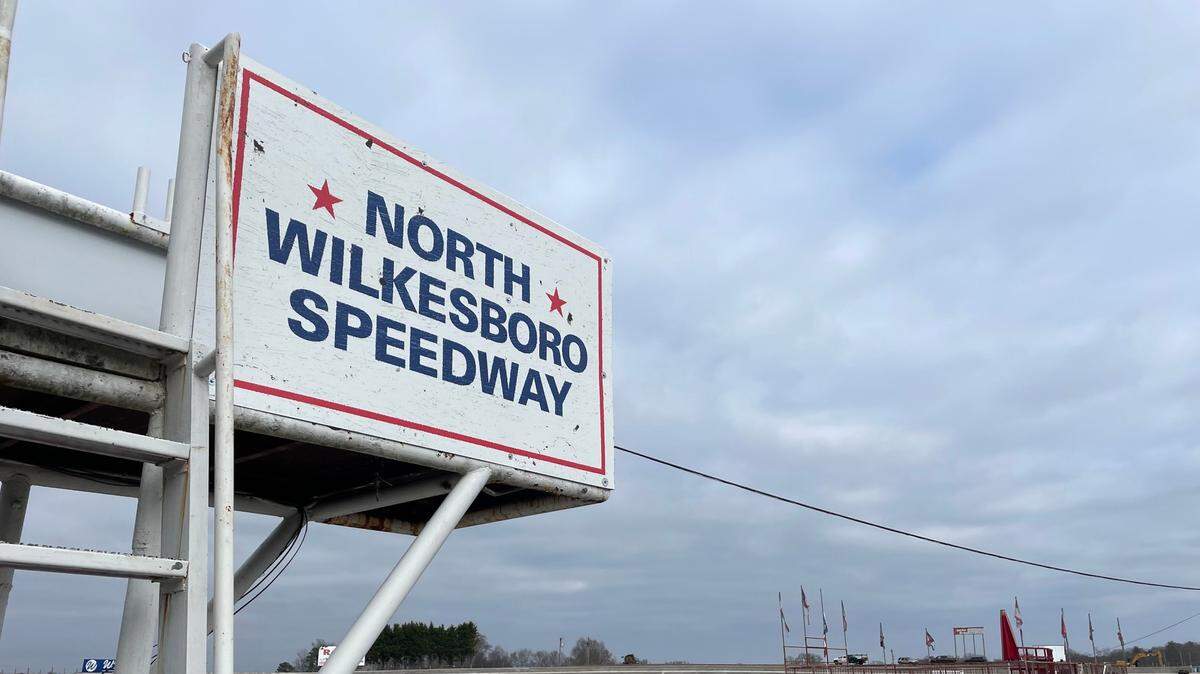
Once Speedway Motorsports received final approval to begin renovating the hallowed racing venue of North Wilkesboro Speedway in late September, one strange word kept cropping up.
“The key word is patina,” said Steve Swift, Speedway Motorsports’ senior vice president of operations and development. “We want to maintain the patina of the facility.”
“Patina” is green or brown film that’s produced by oxidation, and it’s littered all over North Wilkesboro Speedway: on the “Junior Johnson Grandstands” sign still standing near Turn 3, on the scoreboard pylon in the infield. It’s what gives the track its uniquely rustic look — and as ordered by Speedway Motorsports CEO Marcus Smith — it serves as the motif for SMI’s task of bringing North Wilkesboro Speedway up to snuff before it hosts NASCAR’s All-Star Race weekend May 19-21.
“Marcus has tasked us with holding on to the history of Wilkesboro,” Swift told reporters at the racetrack on Tuesday afternoon. “So when you show up as a fan to the All-Star Race, the facility will look like it did — as close as possible — to when it was running back in the 90s and 80s.”
He added: “For those who were there for the August event that Dale (Earnhardt Jr.) ran, it was that energy of stepping back into time in present day. It was really cool. So Marcus has really versed us in making sure that we maintain that.”
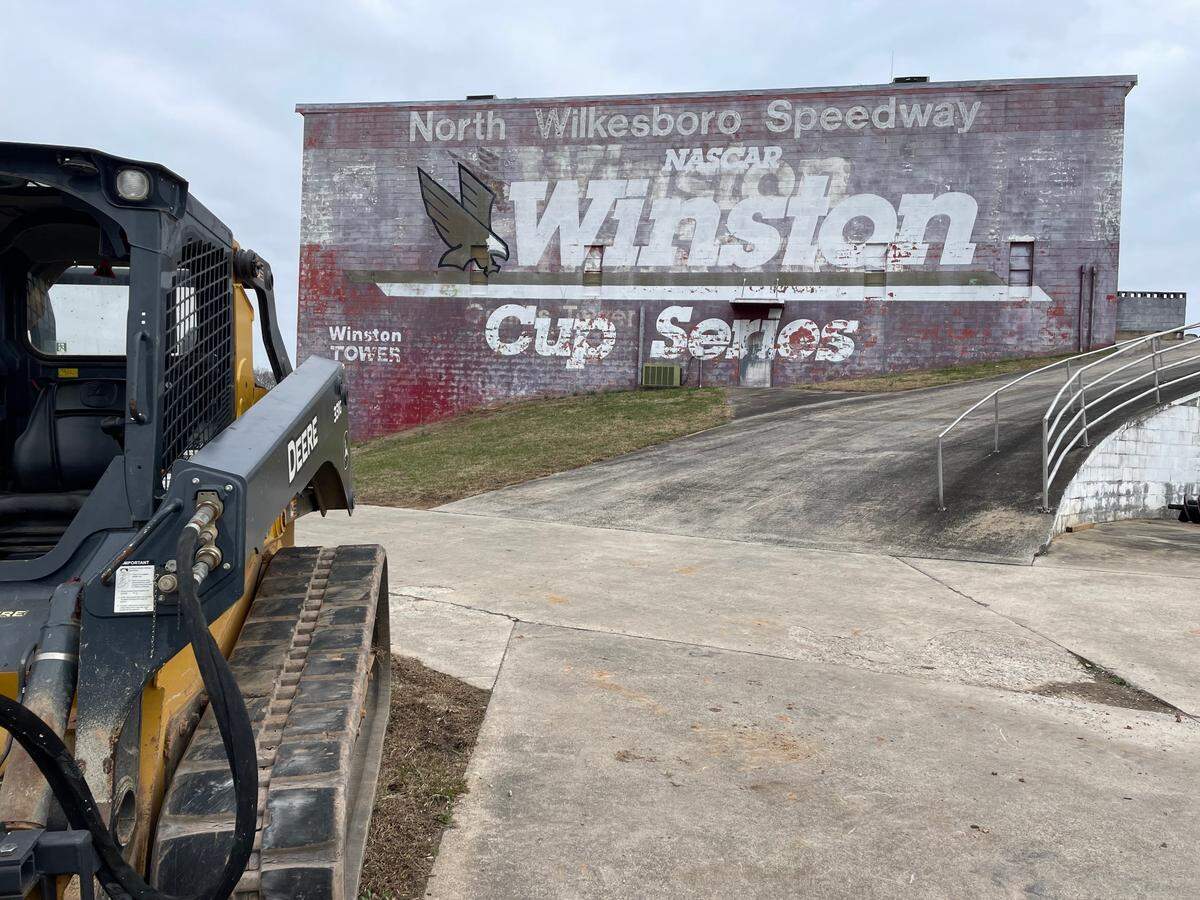
In a brief tour of the new 0.625-mile racetrack on Tuesday, the effort of modernizing the racetrack for today’s safety and viewing standards without washing away what makes North Wilkesboro special — a delicate balance that NASCAR as a sport knows well — was on full display.
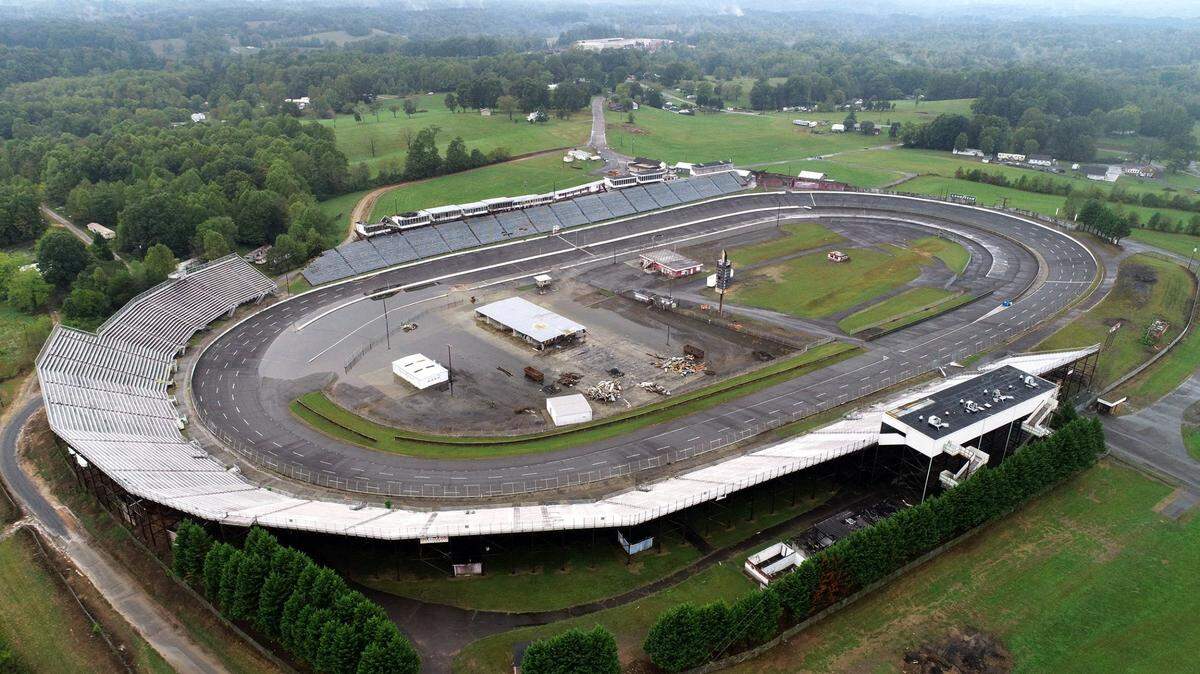
In the infield, at present, that effort is particularly clear: The infield has been almost completely leveled and cleared, a result of the construction crew addressing the racetrack’s drainage issues before it is fully paved. Swift said that there used to be one big storm pipe that led out of Turn 2, which was the only place water could get out. “We would have a lake inside the infield, on the racing surface,” he said. He then joked, “We could’ve raced boats but not cars.”
But while the infield is renovated, some of its landmarks from long ago still stand tall and largely won’t be touched. The medical center, in red dilapidated paint, still stands. The racetrack’s Victory Lane — which uniquely sits on the roof of the medical center — will remain, too. (The hydraulic system that lifted the winning car to Victory Lane for decades still work, as August’s grassroots races proved.)
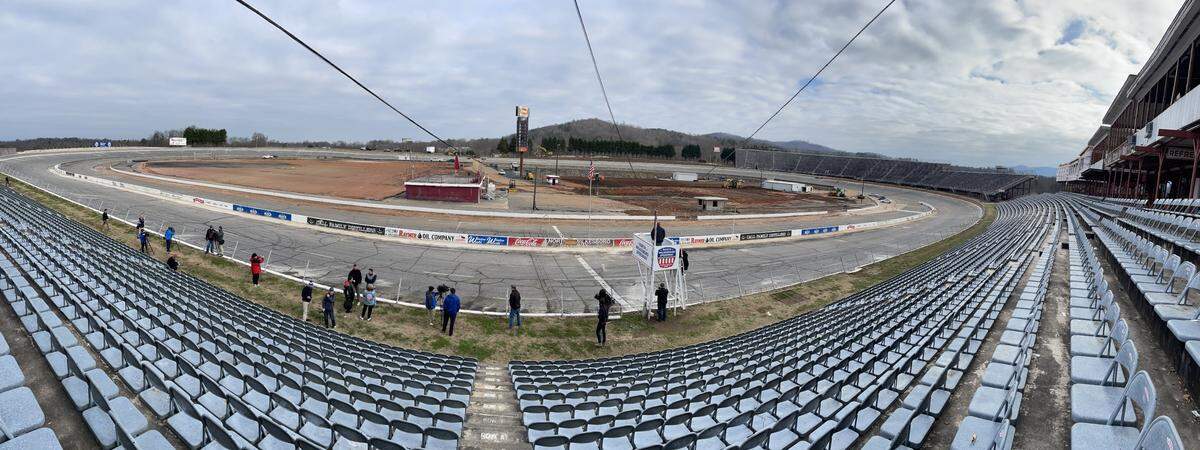
Safety requirements in NASCAR have elevated since 1996, when the final Cup Series race took place at North Wilkesboro. That means the racetrack had to order new, safer walls. It means the old wheel fence will have to be replaced. It means that pit road, which was a bit “tore up,” required (and still does require) work.
Viewer and racing team expectations have changed a bunch since 1996, and the racetrack has to be updated for that, too. Fiber infrastructure technology, so the track has WiFi and broadcast and other competitive-side capabilities, “will have to be put in,” Swift said.
A technological feature that has Swift particularly excited? The speedway’s lights.
“A really cool thing that they’re putting in and that I’m super excited about — and I think the sport will be excited about — is the new lighting that is going in,” Swift said. “Musco (Sports Lighting) has to go in. This track never ran under the lights back in the day because it didn’t have lights, so we’re putting in a new Musco system. Those are on order, the foundations will go in in January, and then shortly after that, there will be new LED Muscos, so they’ll be able to turn on, turn off, dance the lights, spotlight, some cool features that will be new to NASCAR.”
All this said, the track won’t be repaved, per the wishes of Earnhardt (The thinking: old racetracks create loose race cars, which makes for better racing.) The asphalt has been crack-sealed.
And while it’ll feature a large video LED board in the infield, it’ll also have a manual scoreboard mounted right on Turn 3 for fans to see.
“We came upon some old pictures that had the old scoreboard that put five positions and the laps, manually like you’re at an old baseball game or an old high school football game where they’d keep score manually,” Swift said. “So Marcus came upon those pictures and was adamant ... that that goes back in place.”
Swift told reporters that the operation is running on time, and he is confident it will be a great venue come early May.
“(It’s been) rewarding and exciting,” Swift said. “There’s a lot to do between now and May, but naturally we have great teammates and great partners, and we’ll be there.”
North Wilkesboro Speedway’s revival
Tuesday marked the latest encouraging day in a triumphant year for North Wilkesboro Speedway.
The racetrack has roots to NASCAR’s beginning. For decades, from when it began hosting Cup Series races in 1949 to when NASCAR left in 1996, the 0.625-mile track stood at the cultural center of NASCAR. North Wilkesboro Speedway meant moonshine and small-town Southern Americana. It was the birthplace of The Last American Hero, and it was the economic beam of Wilkes County, a land of about 65,000 people in the foothills of northwestern North Carolina.
By the early 2000s and for years afterward, though, the racetrack largely sat abandoned. It collected rust. Weeds poked through the crumbling asphalt. When NASCAR left, lifelong residents said, “it really hurt the area.”
Enter Earnhardt.
In December 2019, a volunteer effort led by Earnhardt took on cleaning the racetrack so the venue could be scanned onto the iRacing platform. The project — along with the documentary that dropped with it — got the attention of Smith, the Speedway Motorsports CEO, and the rest of the racing world.
The attention it received set off a whole bunch of other dominoes: In Nov. 2021, the North Carolina state budget earmarked $18 million “for service” to the speedway, money made available via North Carolina’s cut of the federal post-pandemic stimulus package passed in Feb. 2021. And then in April 2022, Speedway Motorsports announced that it would schedule “grassroots racing events” at North Wilkesboro Speedway so the company could “learn more about what needs to be done for a grand re-opening in the future.”
One of those grassroots events was an emotional, magical late-August night in North Wilkesboro, where Earnhardt raced in a lime green No. 3 Sun Drop late model stock car in front a sold-out crowd. Earnhardt crossed the start-finish line third that night, but in every other way, he’d won. The Hall-of-Famer, overcome with emotion, said postrace that it “felt exactly like being here in 1990.”
That event delivered the racetrack momentum and attention and prompted possibility. About a week after that late model stock car race, in downtown Raleigh not far from the Governor’s Mansion, Speedway Motorsports and NASCAR announced that North Wilkesboro Speedway would host the 2023 All-Star Race.
Tickets to the All-Star Race went on sale to the general public at noon on Nov. 2. Three hours later, the racetrack announced that the race had sold out.