When not assisting cancer patients, she’s driving fast — with help from her dad
Mike Riley, president and COO of Novant Health Huntersville Medical Center, vividly remembers the day he discovered one of his employees was sneaking off on her weekends to go for 200-mile-per-hour joyrides.
He was organizing a tour of the hospital for a group of local community leaders, and near the top of the list of things he wanted them to see was the radiation oncology department’s linear accelerator room — because of his fascination with both the high-tech machinery and the 16-inch-thick concrete walls.
“Who can give us a really good tour?” Riley asked Kim Ellingson, the manager in radiation oncology. She recommended radiation therapist Lauren Freer.
Before going to meet with Freer, he tried to find a photo of her online, set on being able to recognize her upon arrival. “And when I Googled her, all these pictures came up of this drag-car driver,” says Riley. From a 2024 Drag Illustrated profile headlined, “Lauren Freer is Having Her Say in History.” From a 2023 National Hot Rod Association feature titled, “Lauren Freer’s history-making double.” Et cetera, et cetera.
Riley continues: “I’m like, Well, that’s not her. I don’t know. I can’t find her, so I’m going down there blind. ... I went down there, and lo and behold, this person I had just Googled and saw all these race car pictures of was Lauren.”
Yes, the Lauren Freer who has helped operate that cancer-fighting linear accelerator (LINAC) for Novant Health in Huntersville for the past six years is also the Lauren Freer who has an adrenaline-fueled passion for drag racing — a penchant that’s way more serious than just a hobby, but generally way too much of a money pit to qualify as a side hustle.
The 37-year-old Mooresville resident is a semi-professional drag racer with a packed racing schedule and an impressive track record.
That aforementioned “history-making double,” for instance, refers to the time in 2023 when Freer became the first woman to win twice in one day at an event sanctioned by the NHRA (which is basically the drag-racing equivalent of NASCAR; she competes at the “Sportsman” level, which is one notch below the fully professional “Championship” division).
She’s been racing since she was 10 years old. And all along the way — from her start on a riding lawnmower to her practically overnight jump from 80 mph to 150 mph runs at age 16 to a current-day operation that includes a cavernous Yadkinville shop and a massive hauler that can fit four of her cars — it hasn’t just been Freer’s thing.
It’s been her dad’s thing, too.
A drag-racing family is born
From his adolescent years into fatherhood, Paul Freer dabbled in a few different types of racing.
He entered a motocross race one time when he was 16. In his late 20s, he helped out with a late-model stock-car team (but didn’t like the whole going-around-in-circles business); and then, in his early 30s, he spent a few years “turning wrenches and working on heads” for a drag-boat racing team (but got spooked away from doing it himself by the idea of high-speed wipe-outs on the water).
Like Lauren after him, however, Paul also had a regular job: In 1984, he started a plumbing business that was growing quickly by the time she was born in 1987.
Meanwhile, Lauren got a few tastes of fast engines here and there. Dad periodically took her to professional drag-boat races that left her wide-eyed. He bought her a dirt bike when she was 5 or 6.
She was also engaging in something dichotomous, though, involved increasingly heavily in all-star cheerleading and dance competitions, spending time around a lot more screaming moms than roaring engines. Lauren, in fact, remembers riding around on that dirt bike in a tutu.
The shift came unexpectedly and abruptly when she was about 10 years old.
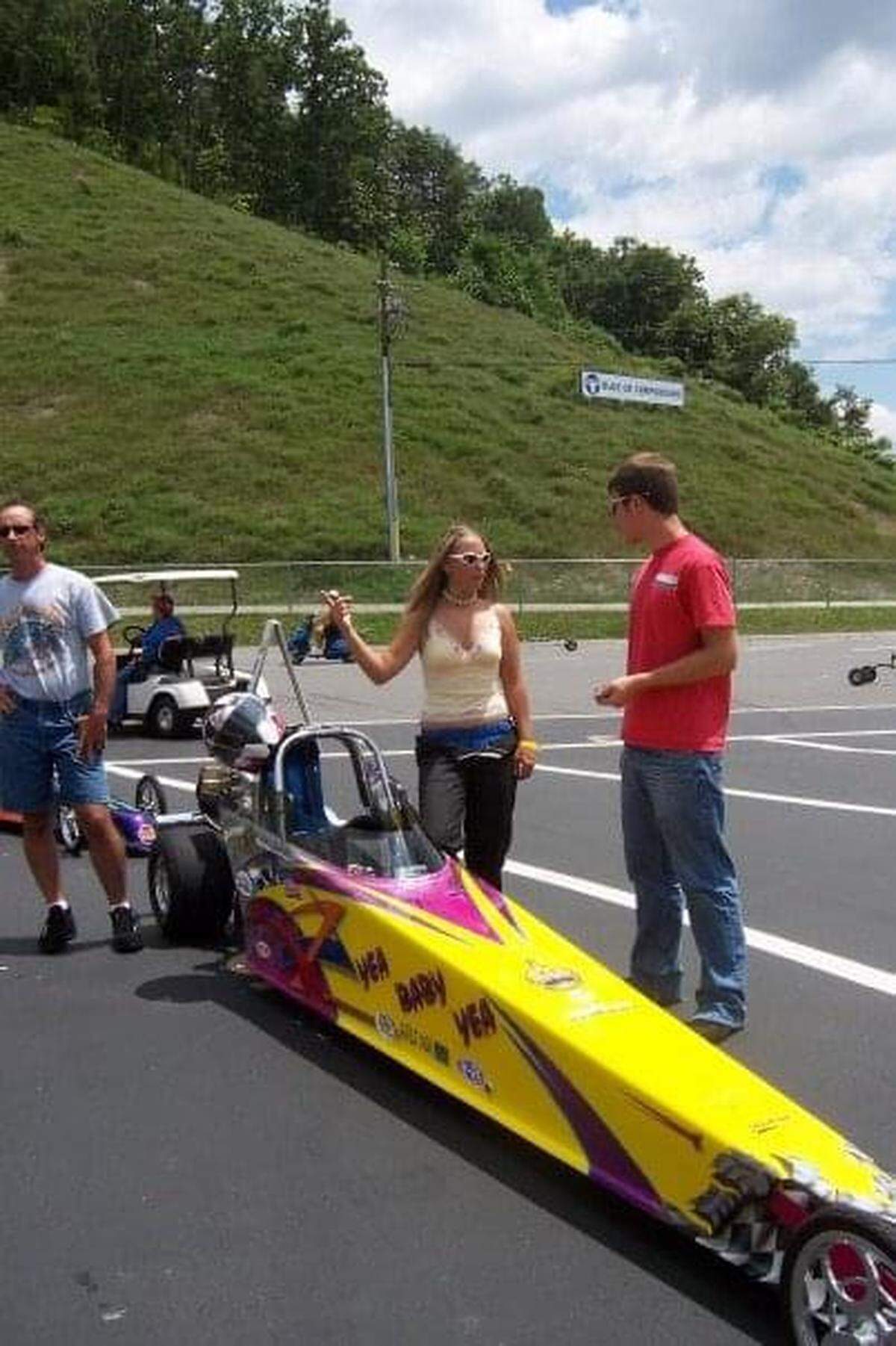
While visiting a friend’s steering components shop near their hometown of Lewisville, N.C. (15 minutes west of Winston-Salem), Paul noticed a junior dragster — a scaled-down, kid-friendly version of a supercharged dragster — randomly sitting inside the store. “What are you doing with that?” Paul asked.
The friend explained that he’d built it for his daughter, who competed in it once but decided she wasn’t interested. So, he was trying to sell it.
Paul drove home deep in thought, and upon arrival suggested to Lauren she try sitting in the driver’s seat of his riding lawnmower as he challenged her reaction time by blurting, “Go!,” “Stop!,” “Go!,” Stop!,” over and over.
She picked it up quickly. She also seemed to be having fun. The next thing she knew, her dad’s friend’s daughter’s junior dragster was in the driveway.
“I brought it home, and two weeks later, we weren’t cheerleading or dancing anymore,” Paul says.
“We were racing.”
Father-daughter duo dynamics
Lauren loved being in that car from the get-go.
Initially, it was about the pure thrill of going fast (only about 40 mph at first, though you can imagine how fast that could feel to a 10-year-old riding 10 inches off the ground). But as soon as she started winning against competition made up largely of boys, it was, quite frankly, mainly about the winning.
If there were bumpy rides in the early going for the Freers, they typically were caused by friction in their relationship, not the car.
“Neither one of us really knew a whole lot about it until we kind of worked our way into it,” Lauren says of her and her dad’s knowledge of junior drag racing. And neither of them, both agree, handled losing very well. “We argued a lot when I was in little cars. ... He’d yell at me, and ... I was horrible. I would throw stuff.”
They weren’t very discreet about it either, and one day, a close friend of the family whose granddaughter raced with Lauren happened to see Dad and Daughter fuming at each other after a bad race.
Recalls Paul: “He pulled me aside ... he said, ‘You’re not having fun, are you?’ I’m like, No! No, I’m tired of losing,’ and ... this and that. And he said, ‘You know, if you’ll just leave her alone, she’ll win. She’ll start winning. She’ll do a lot better. ... Just let her race.’ So I started trying to cool my jets. I mean, you probably know how it is. (When it comes to youth sports) the parents are generally the worst part about it. The kids are there to have fun — win or not — and the parents can kind of screw that up.
“It took me about eight months or a year to figure that out.”
“Three years,” Lauren says, trying gently to correct him.
“Hmm?” her dad says, innocently.
“Three years,” she repeats.
“Was it three years?” Paul asks, sounding slightly sheepish. They both burst out laughing.
Then, after the giggling dies down, Lauren straightens her face and declares, matter-of-factly: “It got a lot better after that.”
A grown-up job, in health care
At 12 — by then driving an upgraded half-scale dragster — Lauren won an International Hot Rod Association (IHRA) “world bracket championship,” which basically means she was the top individual racer in her class over the course of a full season of competition. (The IHRA is the second-largest drag-racing sanctioning body, after the NHRA.)
As soon as she turned 16, she made the jump to full-size cars and started racing against adults at speeds exceeding 150 mph, nearly twice as fast as she’d gone as a junior.
And she was competitive with those grown-ups.
But while she might have dreamed of a career as a drag racer, by the time she finished high school, Lauren knew the sport probably wasn’t ever going to pay the bills she’d eventually have. So, at the suggestion of a drag-racing buddy’s radiation-therapist girlfriend, she applied for and got accepted into the radiation therapy technology program at Forsyth Tech in Winston-Salem — while continuing to race, and continuing to do well.
In fact, at age 20, she won an event in New Jersey that netted her a payday that still stands as her most lucrative ever: $25,000.
The following year, Lauren was a new radiation therapist at Atrium Health. She spent 10 years juggling work and play with Atrium, then continued that balancing act after joining Novant Health in 2019.
Two to three times per month, from February to November, she’s traveling all over the Eastern U.S. so she can sit in a rumbling race car waiting to push a button that will send her hurtling down eighth-mile and quarter-mile tracks at speeds exceeding 200 mph.
This also means that two to three times per month, from February to November, Lauren’s using PTO on Thursdays and Fridays to facilitate this lifestyle. Yet her boss Kim Ellingson still considers Lauren a star employee, the type she’d readily recommend to lead a tour of their department for a group of local community leaders.
“She connects great with the patients,” Ellingson says. “She is one of those ones that has an amazing work ethic. So even though she’s out for her races, when she’s at work, she’s at work. She helps me work out staffing issues. And I think from her racing, it’s taught her how to fix things mechanically ... so the service guys love her. ... She definitely is a big asset when it comes to the LINAC and figuring out what’s wrong with it, either computer-wise or mechanically inside the machine.”
The only downside to using most if not all of her time off for racing? “I haven’t had a real vacation since my honeymoon,” says Lauren — who married her husband Jonathan 10 years ago.
But she has no plans to give it all up. At least, not until her dad does.
How long can the Freers keep racing?
If you need any proof of how dedicated Paul Freer is to his daughter’s pastime, it’s this:
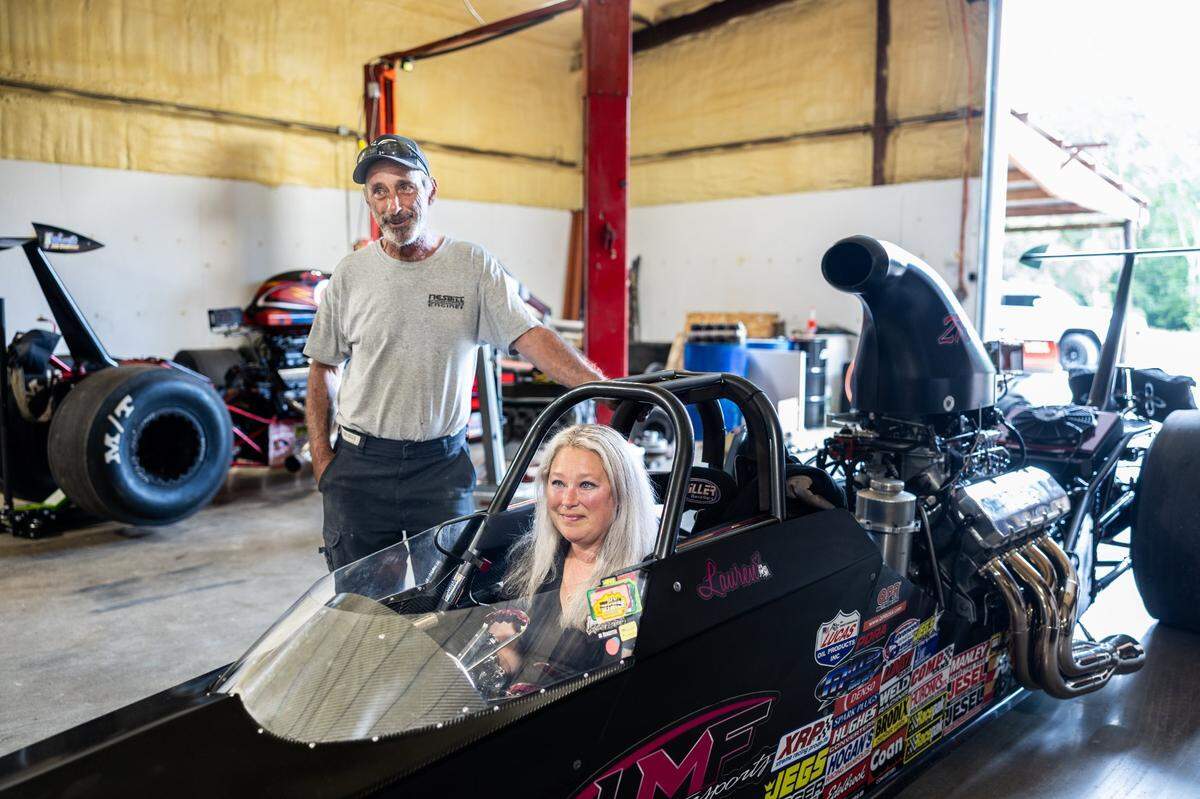
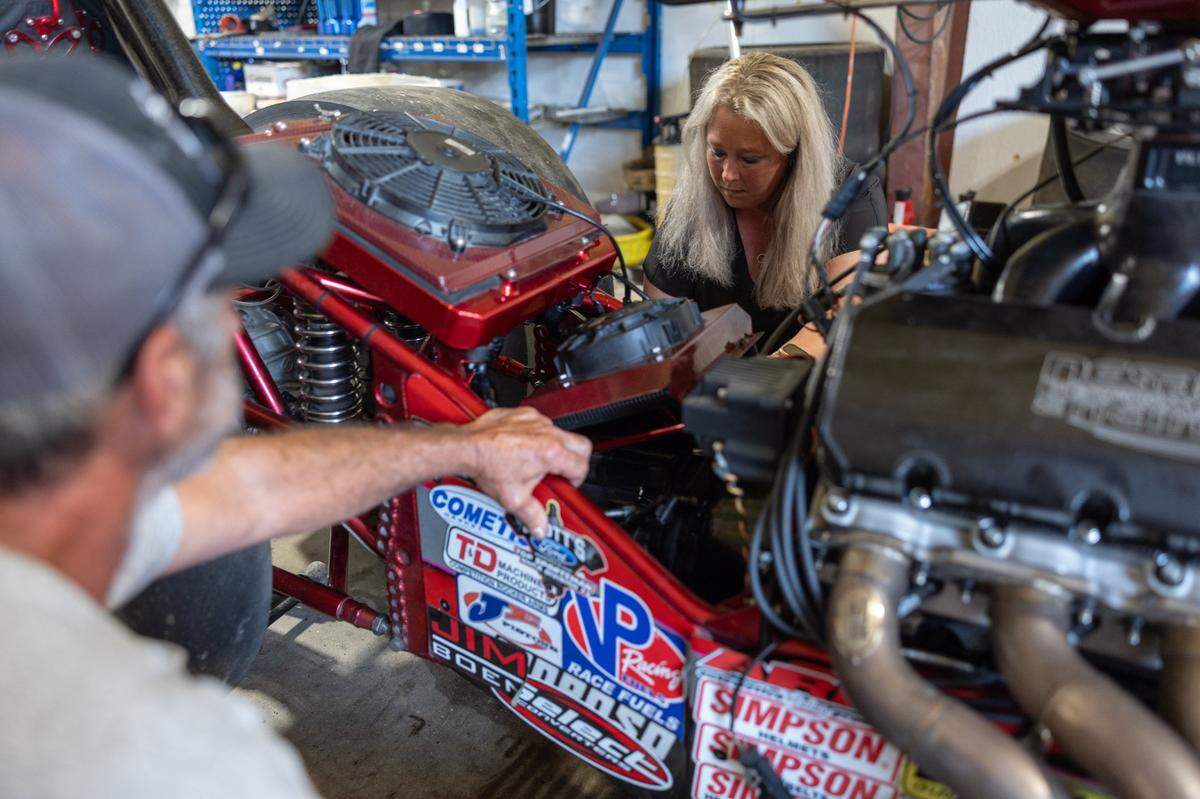
In 2020, he moved from Lewisville to Yadkinville after buying a 150-acre farm in large part because it included an outbuilding the size of a small airplane hangar. “We needed a good place for the race cars and the hauler and a good shop to work out of,” explains Paul, who’s essentially his daughter’s crew chief. “Before, we were working out of a basement shop and two-car garage, and it was awful. Just couldn’t get anything done.”
If you need more proof, just consider that he supported Lauren’s pastime to the tune of six figures last year, even though she only typically wins back a fraction of that amount.
Paul is 64 and retired now, having sold his prosperous plumbing business in 2022. And although they live 50 miles away from each other, they’re about as close as they’ve ever been. He calls it making up for lost time.
.jpg "IMG_7785_2_(1).jpg")
When she was young he says, “I was just starting a business, so I worked 14, 16 hours a day. I didn’t get to see Lauren very much … I worked a lot. So I missed a lot of her childhood. I really did. And then beginning with the races ... we got to start spending more time together.”
Nowadays? “We get to spend a lot of time together. And it’s good, quality time. ... We’re cleaning cars, or we’re talking strategy, or maybe just sitting in a lawn chair (at the racetrack, waiting) till our next round of eliminations.
“It’s been good,” Paul adds. “Been really good.”
They nod, and look warmly at each other. Then someone asks how much longer she plans to race.
Lauren sighs. “Until he wants to quit,” she says. “Till he’s done. I won’t race to the extent of what I do now, I’m sure, when he’s done. I don’t know. I’d love to have another 30 years out of him, but that ain’t gonna happen.”
Paul chuckles. “Hopefully she gets another 10 years out of me. I’ll be 65 this year, and hopefully my health stays good and I can travel around with her for at least another 10.”
“I would think 20,” she says, perhaps only half-jokingly. Now they’re both laughing again.
“I can’t picture myself at 85 years old driving that motor home,” Paul says, shaking his head.
Lauren’s silent for a moment, then posits: “I mean ... when he’s ready to be done — since it’s not my husband’s cup of tea — I’ll probably keep that car,” she says, pointing to her favorite, “and a dragster, and just have something much smaller than all of this,” she continues, as she looks around her dad’s giant shop, “and a trailer, just so if I want to go somewhere local for the weekend, or even if I do decide that I want to keep running divisionally nationally, I can still.”
“I can do it by myself,” Lauren concludes. “I don’t want to do it by myself, but —”
Her dad interrupts, now nodding.
“You can,” he assures her, with a smile. “Absolutely.”
.JPG "IMG_9560 2 (1).JPG")
This story was originally published June 17, 2025 at 5:01 AM.