Why Cup teams are asking for over $350 million in damages from NASCAR at trial
%20-%20DJI_20240519204929_0021_D_M3P-16.jpg "Airspeed, located off Interstate 77 in Huntersville, is the new home of the Michael Jordan-owned NASCAR team 23XI Racing.")
The nine-member jury that could decide NASCAR’s future has heard several times over the past six days that the plaintiffs are asking for a lot of money in damages.
More than $350 million, specifically.
And on Monday, the jury heard from the economist who came up with that number.
Edward Snyder, an esteemed economics professor who has led several prestigious business schools — including the one housed at Yale — took the witness stand Monday in the U.S. District Court for the Western District of North Carolina in uptown Charlotte. He was directly examined and cross-examined for nearly 6 hours as a result of his expert opinion — the one that states that NASCAR is an unlawful monopoly and that the two plaintiff teams are owed hundreds of millions of dollars because of it.
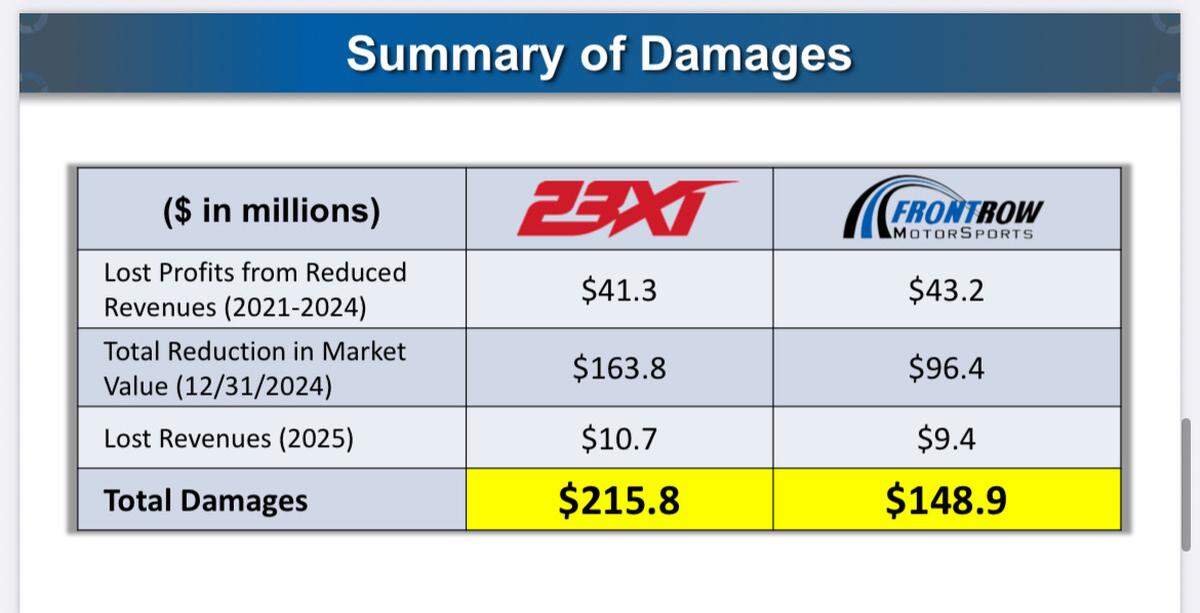
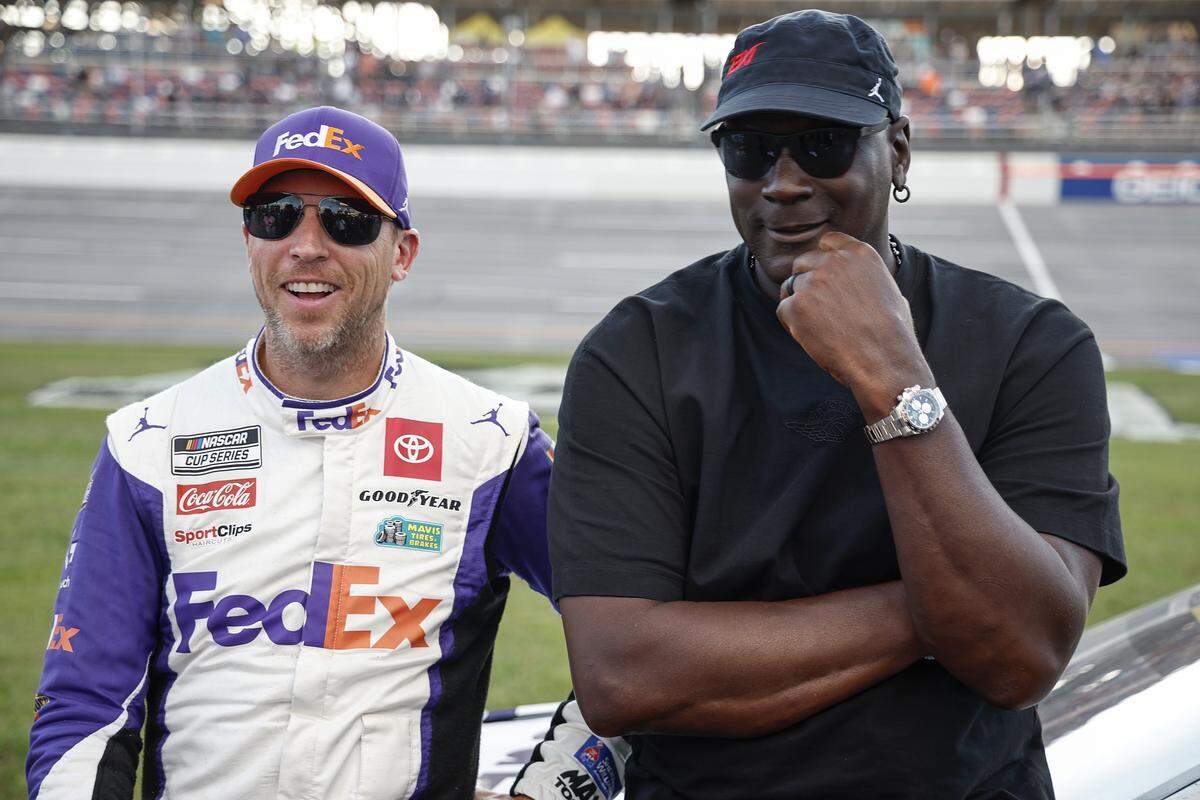
Specifically, according to his calculations, Snyder asserted Monday that Cup Series team 23XI Racing, owned by sports icon Michael Jordan and driver superstar Denny Hamlin, is owed $215.8 million in damages. Front Row Motorsports, owned by entrepreneur Bob Jenkins, is owed $148.9 million, he said. That’s 364.7 million total.
The economics behind that figure is complicated. Six-hours-level complicated, as aforementioned — with more cross-examining to go Tuesday morning. But the high-level explanation of how he arrived at the damages figures can be found in the sum of three numbers.
Those three, according to Snyder:
- Lost profits from reduced revenues: That amounted to $41.3 million for 23XI and $43.2 million for FRM.
- Reductions in the teams’ market values: That amounted to $163.8 million for 23XI and $96.4 million for FRM.
- Additional lost revenues in plaintiff teams: That amounted to $10.7 million for 23XI and $9.4 million for FRM. These were from the fixed owner income payments and performance payments the teams didn’t receive as a result of not being “chartered” teams for the last 16 races of the 2025 Cup season. (Why were they not chartered teams for the last 16 races of the Cup season? That’s a months-long story that was decided well before the trial.)
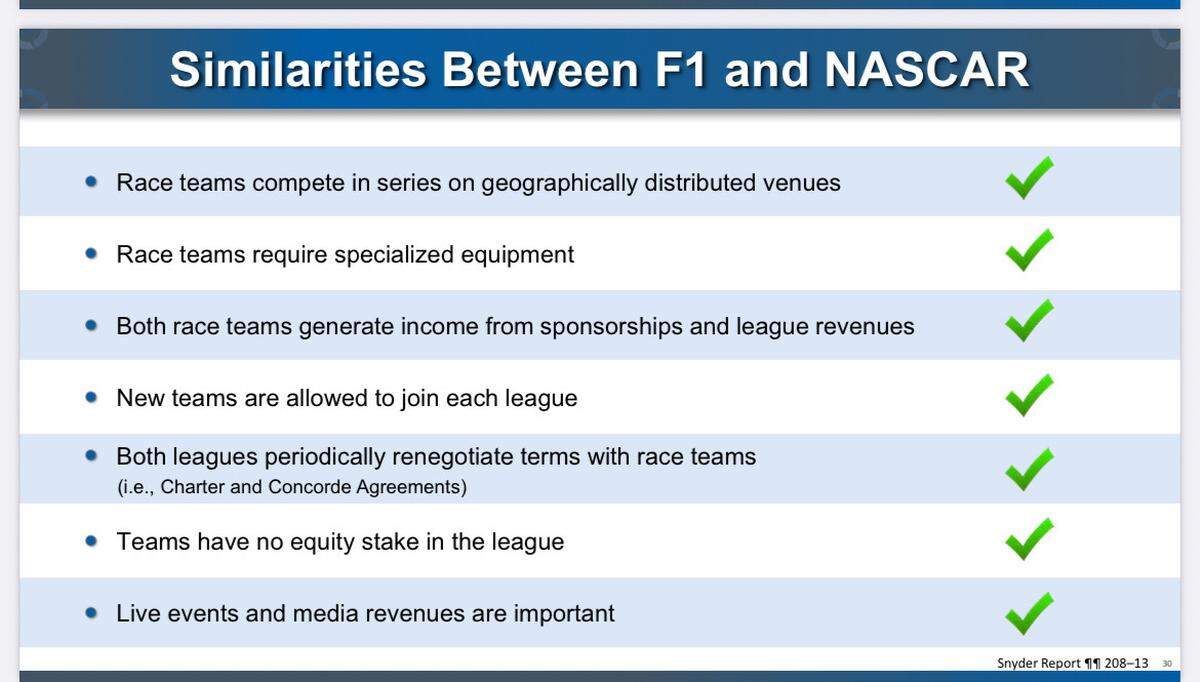
The figures that correspond with “reduced revenues and reductions in the teams’ market values” required Snyder to use Formula 1 as what economists call a “benchmark” to find numbers in a “but-for” world. And what is a “but-for” world? It’s a standard tool used in antitrust economics that helps create a world in which anti-competitive acts weren’t executed so economists can extrapolate what might’ve happened to the businesses had they not been impacted by those anti-competitive acts.
So specifically, for this case, it creates a world that would exist if NASCAR didn’t employ anti-competitive acts — if they didn’t “lock up” its tracks via exclusivity agreements; if they didn’t forbid teams from competing in other series; if they didn’t engage in other acts preventing other premier stock car racing leagues from entering the marketplace, plaintiffs said.
All this, Snyder said, led to the predictably tense 2025 charter negotiations, which were done to set NASCAR’s financial fate for the next handful of years.
“The teams had no other options,” Snyder said.
$367 million is a lot. How can teams expect NASCAR to pay?
Pretrial public filings found that NASCAR made just over $100 million in profit in 2024. A logical follow-up: How could the sanctioning body be reasonably expected to pay the plaintiff teams triple that should they lose the trial?
Snyder had a line of answers ready for such a query.
For one, Snyder testified that NASCAR actually has a bunch of “financial flexibility.” The series had $2.2 billion in assets as of December 31, 2024 — made up of the racetracks it owns, its real estate, its intellectual property (Next Gen car), its media rights and more. Snyder also testified that Goldman Sachs estimated NASCAR’s equity value at $5 billion in 2023.
The most compelling part of Snyder’s argument used pro golf as an example for how NASCAR could navigate having to pay such damages.
More specifically, he cited the PGA Tour and LIV.
The PGA Tour for decades went unchallenged as the pro golf league in the world. Then LIV Golf — backed by Saudi Arabia’s Public Investment Fund (PIF) — was founded in 2021; it launched as a rival to the PGA Tour, attracting some of the world’s best golfers with massive prize moneys, larger salaries and slightly different tournament formats.
As a result, Snyder showed, the PGA fought back using open market forces available to it. The organization increased purses; lured in other investors; launched PGA Tour Enterprises, a new program that transformed players into equity holders; among other things.
“They got creative,” Snyder said. “PGA responded. They fought. They adjusted.”
And, Snyder said, NASCAR would be able to do the same.
NASCAR doesn’t agree with Snyder’s calculations
NASCAR, unsurprisingly, doesn’t agree with Snyder. The sanctioning body’s counsel pushed back on several points during cross-examination Monday and will continue to do so Tuesday.
The main two points of tension:
- Snyder argued that if NASCAR didn’t utilize anti-competitive acts — ones Snyder specifically referenced just before and during the charter system era (2015-present) — then a competing premier stock car racing series would’ve sprouted. NASCAR’s counsel questioned this conclusion even though there had been no premier stock car racing series in the 50 years before the charter system. (Snyder maintained that evidence showed that NASCAR executives were concerned about a competitive series sprouting and took anti-competitive action to stunt its growth.)
- Snyder testified that using F1 as a benchmark was the right move; he did so in large part because NASCAR, via internal emails, compared itself to the global motorsport series. NASCAR’s counsel during cross-examination later said that a critical part of his choice of F1 was that the series didn’t have exclusivity agreements with its tracks and teams — meaning that it didn’t face the same hurdles Cup teams did in the unlawful monopsonistic world furnished by NASCAR. F1, however, has exclusivity with its teams and with several tracks, NASCAR attorney Lawrence Buterman stated.
Other notes from Day 5 of NASCAR
—The plaintiffs plan on bringing to the witness stand NASCAR president Steve Phelps, Cup team owner Richard Childress and NASCAR CEO and chairman Jim Phelps over the next few days. Once through with those witnesses, NASCAR would call its own list of people to testify. Bell told the jury that “it is my great hope the plaintiffs rest on Tuesday,” though that now appears unlikely. The judge previously said that the trial must conclude by the end of next week and is now elongating the days — 8:30 a.m. to 5:30 p.m. — to try and meet that end.
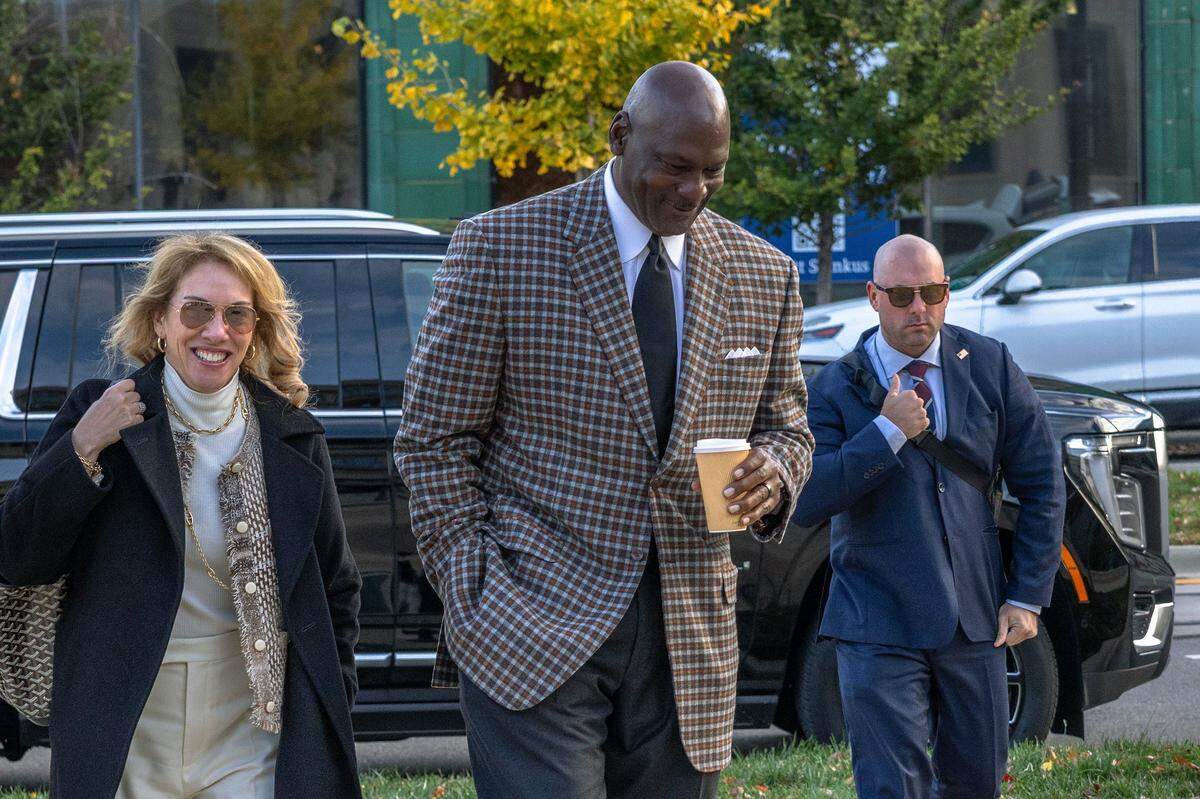
—The entrances and departures of Michael Jordan from the courthouse have become appointment viewing. On Monday one fan stood outside with a speaker playing the soundtrack to the famous “Be Like Mike” Gatorade commercial from 1992. Jordan chuckled and shook the fan’s hand before loading up into one of his convoy of SUVs.
This story was originally published December 8, 2025 at 8:02 PM.