
Larry Dixon’s 2 crashes 15 years apart show NHRA safety changes
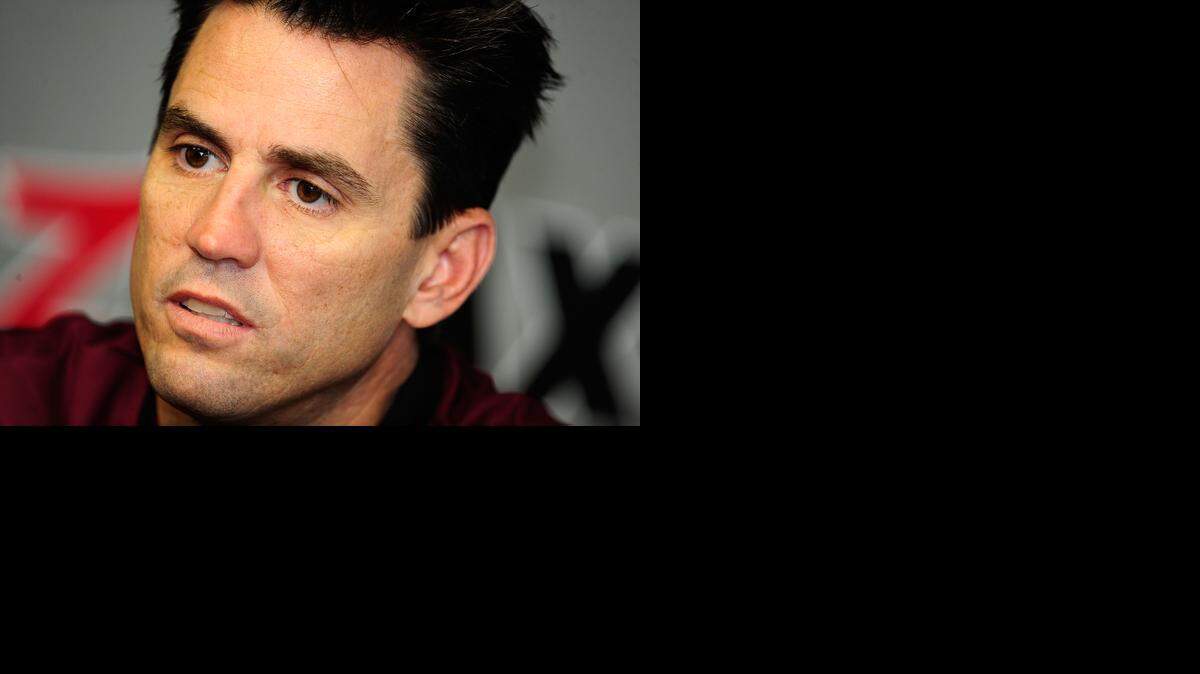
Larry Dixon’s most recent race began like most of the races he’s run over a 20-year career in the National Hot Rod Association’s Top Fuel division.
In the blink of an eye, that all changed.
A catastrophic chassis failure broke his Bob Vandergriff Racing dragster in half March 14 at Gainesville, Fla. – a crash eerily similar to one Dixon suffered nearly 15 years earlier in Memphis, Tenn. Then, Dixon left the track in a helicopter, strapped to a stretcher.
But at Gainesville, he was able to walk away from the wreckage – a testament to the improvements in safety equipment, and changes implemented by the NHRA and the race teams themselves over the years.
“To see, 15 years later, all those safety improvements we made back then come into play, and play a part in why I was able to walk away,” Dixon said. “It wasn’t luck why I walked away – a lot of effort went into making sure that if it happened again, we’d be better prepared. We certainly were this time.”
Reacting to danger
Like most major racing series worldwide, the NHRA has generally been reactive in making safety improvements on its cars or to protect the drivers – an accident happens or someone gets hurt, and changes are made.
However, in just the past decade, that has led such changes as improvements in the driver’s compartments in both Top Fuel and Funny Cars, with additional roll bar padding to protect the driver’s head; the mandatory use of the HANS head-and-neck restraint; improved seven-layer Nomex fire suits – twice the layers worn by NASCAR drivers – and even automatic fuel- and engine shutoff systems that also deploy the drag parachutes in case of problems.
“There’s been quite a bit done to the cockpit to protect the driver,” said Glen Gray, the NHRA’s vice president of technical operations. “While the chassis on a Top Fuel car needs to flex, and is not as rigid as a (NASCAR) car or an Indy car, the cockpit has to be very rigid and very strong to protect the driver.”
None of those things were in place when Dixon’s Top Fueler broke in half at Memphis, which left him with serious injuries, including a broken leg, eye injuries and a concussion.
Dixon still doesn’t remember much from that wreck, but one of the first things he did in its aftermath was buy a HANS device – the first NHRA driver to use one, and now mandated for all NHRA divisions.
However, compare the Memphis wreck to Dixon’s wreck at Gainesville, which sent the back half of his car nearly 20 feet in the air before it landed hard on its back wheels – the only reminder he had, outside of the wrecked race car, was a sore back and knee.
“When I crashed at Memphis, we didn’t have the HANS devices, the seven-point harnesses or the head pads we do nowadays,” Dixon said during an interview 90 minutes after his crash.
“I’ve been through worse – the last one resulted in a helicopter ride. This one was definitely better.”
Finding the cause
The investigation into why Dixon’s race car broke in half began literally as the Safety Safari – the NHRA’s full-time safety crew – raced onto the track.
According to Gray, members of the sanctioning body’s technical staff were on the track with the Safety Safari as they helped Dixon out of his wrecked Top Fueler.
“They stayed back until we know they’ve gotten the driver taken care of,” Gray said. “After an incident like that, everyone’s instructed not to touch any of the parts or any part of the car they don’t have to to get the driver out, or picking up any of the components off of the race surface.”
After the technical staff documents the extent of the damage, with hundreds of photos taken of the chassis and pieces of the race car where they landed on the track, Gray said the next step was to impound the chassis and pieces for more photos and closer inspection before releasing it back to Dixon’s team.
Gray also said the NHRA’s technical staff studies information from the car’s accident data recorder – another safety feature that has been mandated for Top Fuel and Funny Cars since 2009.
“We’re looking at that to see if there’s any indication of what happened or why it happened,” Gray said. “These recorders are pretty sophisticated, and we have every run since the recorder was put on that car.”
According to Gray, once the team returned to its shops in Indianapolis, Ind., the broken chassis was once again inspected by NHRA officials, crew chiefs from other area teams and members of the SFI Foundation’s chassis committee, a group of experts that sets the regulations for all of the NHRA’s car construction.
Sections of the chassis – made from high-strength chrome-molybdenum steel tubing – have also been sent to a metallurgist for more detailed examination, as well as to experts who will examine areas such as the welding between the tube sections.
“Once we get all the information, if there’s something that suggests we need to make a change, we’ll get with the SFI chassis committee and come up with something,” Gray said.
“We don’t want to rush into it, because there could be unintended consequences. We need to make sure that whatever change, if needed, doesn’t create some other problem.”
An element of risk
Still, Dixon expects that his team will make some changes in his Top Fuel chassis before leaving for this weekend’s NHRA Four-Wide Nationals at zMax Dragway – a thought echoed by Mike Guger, Dixon’s crew chief.
“I couldn’t in good conscious not do something,” Guger said. “Even though the car we’re running has a brand-new front half and a brand-new back half, I don’t know I could go out there and run again without changing something.
“If I went out there and ran it in the same configuration, and didn’t change or reinforce anything, and something happened, I couldn’t live with myself. It may affect the performance of the car, but I don’t care. We’ll make it work.”
Officials said there has been only one other instance of a Top Fuel chassis breaking in half like what happened to Dixon in 2000 and two weeks ago – to eight-time champion Tony Schumacher’s car in 2003, ironically also at Memphis.
“We’ve had how many runs since then – 20,000? 30,000?,” Guger said. “You look at any accident, and so many things have to line up in that one moment, and you have a bad result.
“Larry went through his own incident 15 years ago, but there’s much better safety equipment... The surrounding protection from the roll bars, the HANS device, and the cockpit’s much better.”
Even with all the improvements in safety, Dixon said there is always going to be an element of risk every time he straps into his Top Fuel ride.
“If race cars were safe, we’d still be wearing T-shirts and leather caps,” he said. “But through the course of time, things get implemented to make it safer.
“Looking back, the car I drove when I started in Top Fuel in 1995, I’d be nervous driving that car today, yet that car was tons safer than the car they had back in 1975. That’s development, the manufacturers working to not only make the cars quicker and faster, but also safer.”
This story was originally published March 26, 2015 at 3:24 PM with the headline "Larry Dixon’s 2 crashes 15 years apart show NHRA safety changes."