
Insanity, or genius? Panthers special teams coaches have turned madness into method
Carolina Panthers special teams coordinator Chase Blackburn and assistant coach Heath Farwell woke up at 6 a.m. the morning of the team’s first preseason game, because they always do.
They immediately began to move, because sleeping for eight hours was much too long to be still.
They met for breakfast, then went for a walk around their hotel.
Then, a workout. Farwell forgot his shoes, so he worked out with Blackburn while wearing the dress shoes he brought to wear on the bus to New Era Field later that night.
They had lunch together. Then another workout. Are you keeping track? That’s No. 2 for the day.
They rode to the stadium, walked out onto the field, scanned the surroundings. Took a lap around the perimeter.
Blackburn threw on his black Panthers shirt and baseball cap. Farwell laced up his black hightop cleats and pulled on his receiver gloves, and the two started jogging from end zone to end zone.
That turned into sprinting; neither wanted the other to be even a step ahead. Situps in the end zone. Then pushups, and then, just for kicks, the much more difficult triangle pushups.
One. Two. Three. Fo---
“OK. OK. We’re not PSYCHOS,” Farwell interjected, as they recapped the workout a few days later.
“Yeah, that day was an anomaly,” Blackburn cracked.
Actually, it’s the coaches themselves who are anomalies. And both of them are perhaps a little crazy.
But their plan for changing everything about the way Carolina plays special teams, from intense effort to unusual analytics to classroom structure, might just be genius.
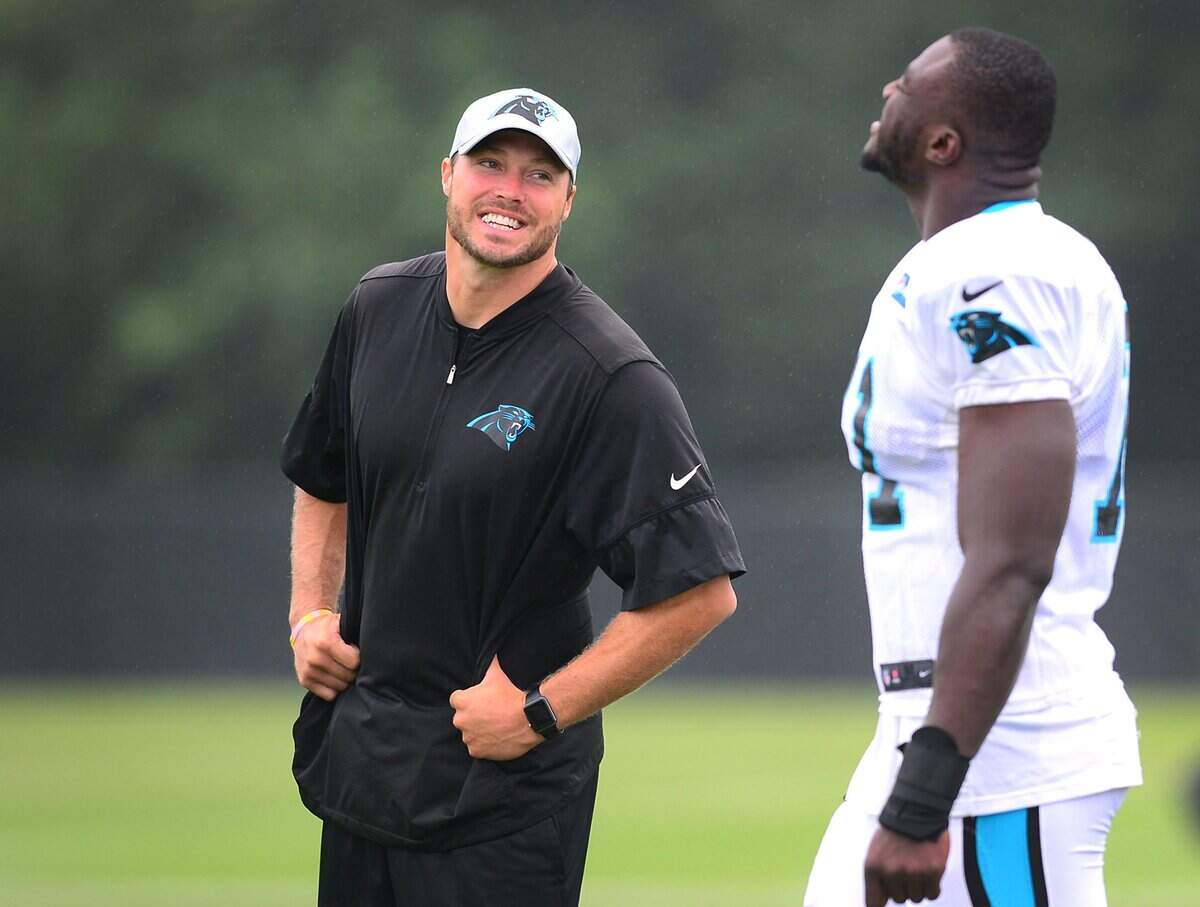
From enemies to friends
Blackburn and Farwell were built from the same mold: former 10-year NFL linebackers with uncommon energy and confusing stat sheets.
Blackburn made just 32 starts in 145 career games. In 2012, he had a history-shifting interception in the New York Giants’ Super Bowl victory over New England — after he had been pulled midseason out of the eighth-grade classroom where he was teaching math and signed as a free agent.
Farwell played in 114 games for Minnesota and Seattle and didn’t start a single one. Yet he made the Pro Bowl in 2009.
It was their ability on special teams that made them valuable.
And their passion for it, as well as their restless energy, actually brought them together after their playing careers ended.
Blackburn joined the Panthers as an assistant special teams coach in 2016, after a year out of football that he absolutely hated.
“It’s tough,” he said. “I don’t care how prepared you feel like you are for retirement at 32, nobody is meant to not be doing anything at 32 years old. My brain doesn’t work that way.
“Sitting still, or in an office, nothing fit.”
He’d watch NFL games on Sundays with his wife, and they couldn’t get through a game because Blackburn would pause and rewind every play, break things down and question decisions aloud.
“She didn’t get to watch a game all year,” he laughed sheepishly.
On the other side of the country, Farwell was doing the exact same thing. And going a little stir-crazy.
So Blackburn spoke with Panthers head coach Ron Rivera about a job, and Rivera put him to work as an assistant to former special teams coordinator Thomas McGaughey. Rivera said Blackburn “basically volunteered” for the job.
That was humbling. So was Rivera’s advice.
“I told him, ‘Just because you played doesn’t mean you’ll be a better coach than everybody,’ ” Rivera said. “It’s just going to give you a different perspective to see things.”
But ego had long since left Blackburn, who spent his last two years as a player in Carolina as the driving force on special teams.
In January, Blackburn was promoted to special teams coordinator. Rivera asked him who he wanted to bring in as an assistant, and the first name that came to his mind was Farwell’s.
They used to be enemies, actually. Blackburn and Farwell had some truly legendary special teams battles over the course of their playing careers. Each described the other as the guy a coach would circle on the whiteboard and say, “we need to stop him.”
But there was a mutual respect, too.
So much, in fact, that when Blackburn called Farwell, who was working for the Seahawks, to ask him if he was interested in the job, Farwell accepted without asking where it was.
The two are still extraordinarily competitive. But that’s the point: It’s not just about pushing each other to run sprints or crank out pushups. Each energetically challenges the other to be a better coach.
And so far, that energy has completely changed how the Panthers approach special teams.
Teaching in motion
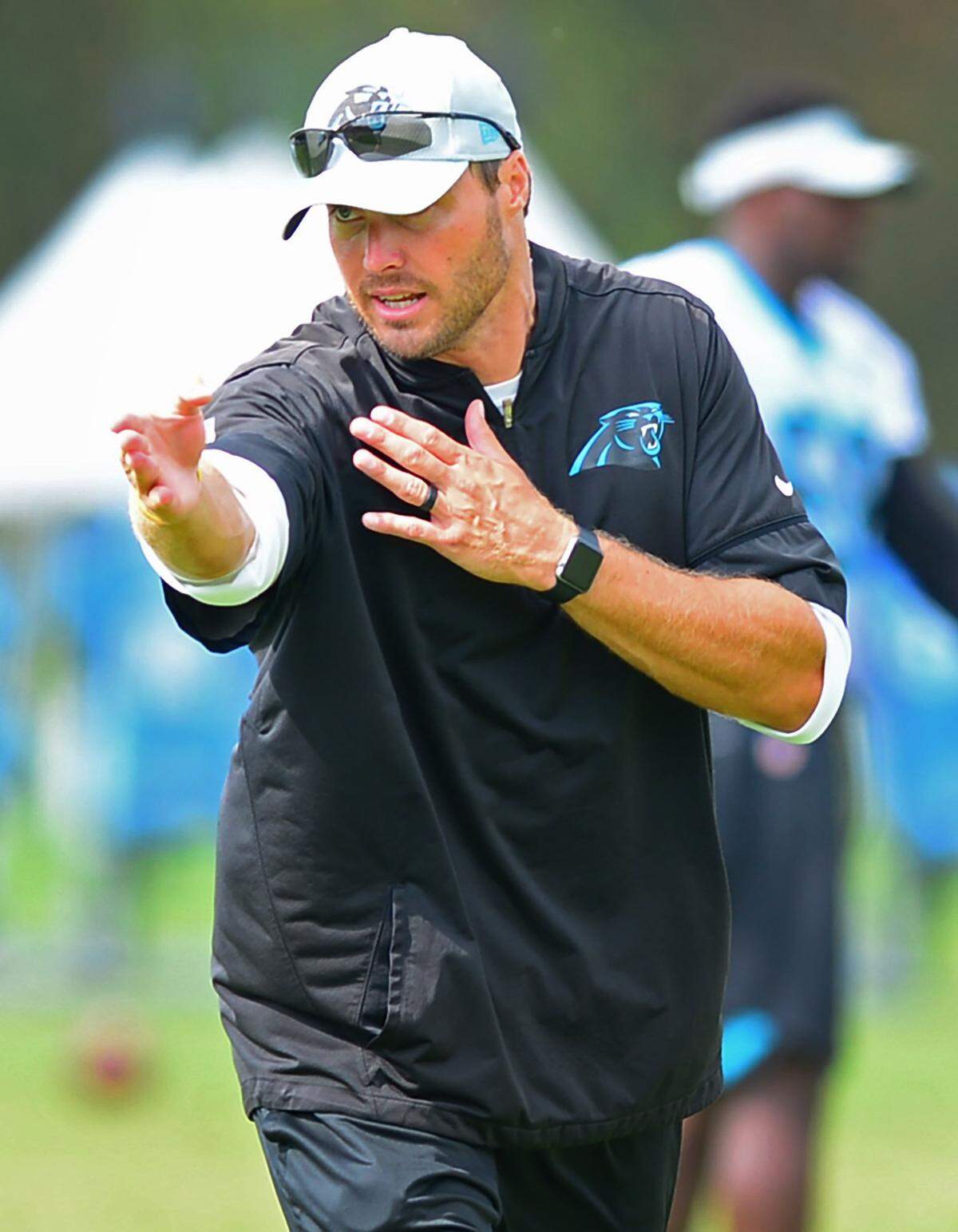
Throughout a practice, Blackburn and Farwell constantly move.
One moment, Farwell will dive on coffin-corner punts from Michael Palardy. The next, he’ll strap on a chest plate and slide pencil pads over his arms, daring guys to make contact on coverage drills.
He’s the only NFL coach some of the players have ever seen who wears cleats and receiver gloves to practice.
“I was kidding him as they were running drill work,” said long snapper J.J. Jansen, who over a nine-year career has played against Farwell and with Blackburn.
“He was trying to get guys to not only press a double team, but then turn a guy. And on film, behind the guy ... he’s like, doing the arm motions. He’s doing it. And I’m like, ‘What are you doing?’ And as he’s talking to the guy he’s just remembering it, remembering how it felt.”
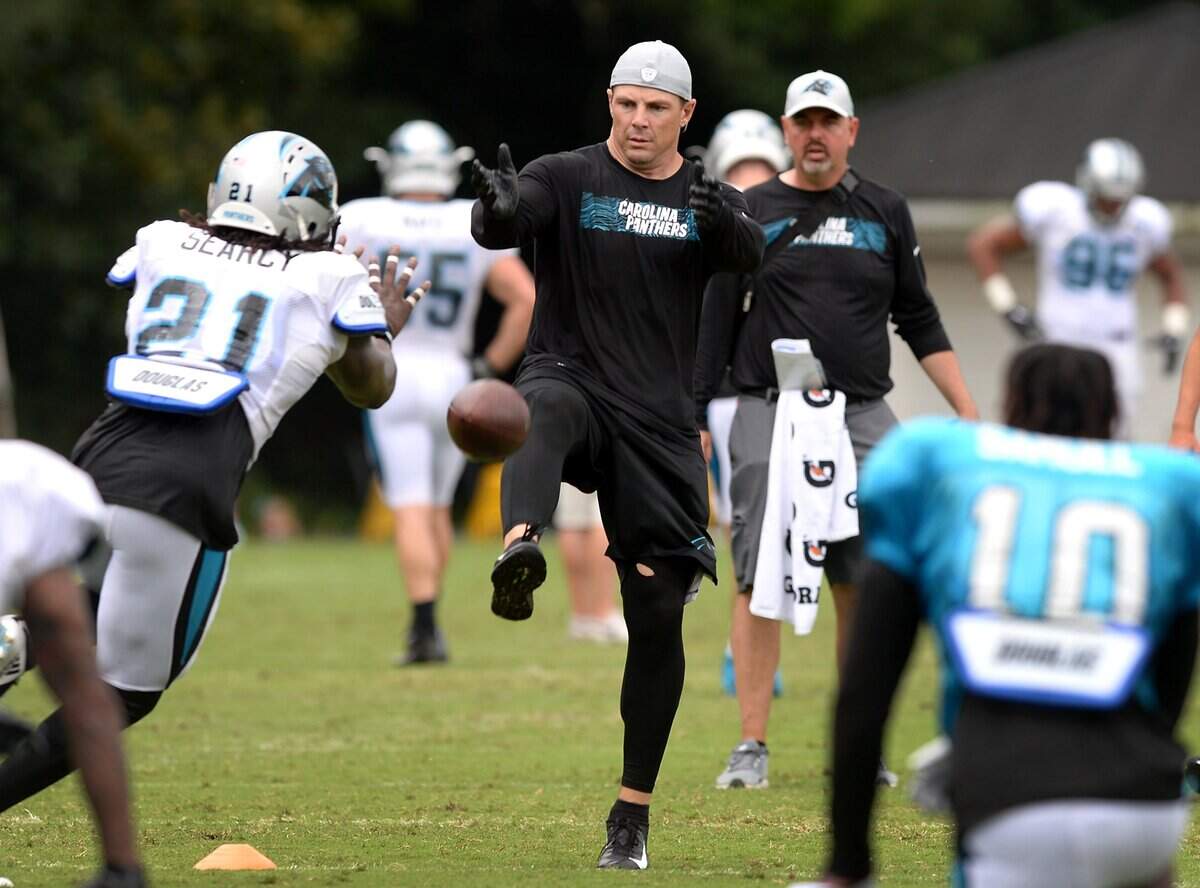
In last Sunday’s practice, Blackburn stationed himself directly behind a returner and ran with him as he navigated the coverage.
He wanted to see what the returner saw, and direct the details: the first step, the angles. The layout of the blocks ahead. He shouted instructions as he saw the field.
“I’m trying to see the return because I want to see how the returner feels it,” Blackburn said. “Can that guy make the play? Keep working (the block)? ...
“A lot of these players are visual, and there are lots of way to learn. Audio, visual, repetition, writing it down. ... All of those things we try to implement with the guys and try to touch on all the different aspects of learning.”
By the end of practices, the sleeves on Blackburn and Farwell’s black shirts are usually crusted over with powdery white salt, from sweat that has dried and been replaced by new sweat.
It’s a little gnarly. The players love it.
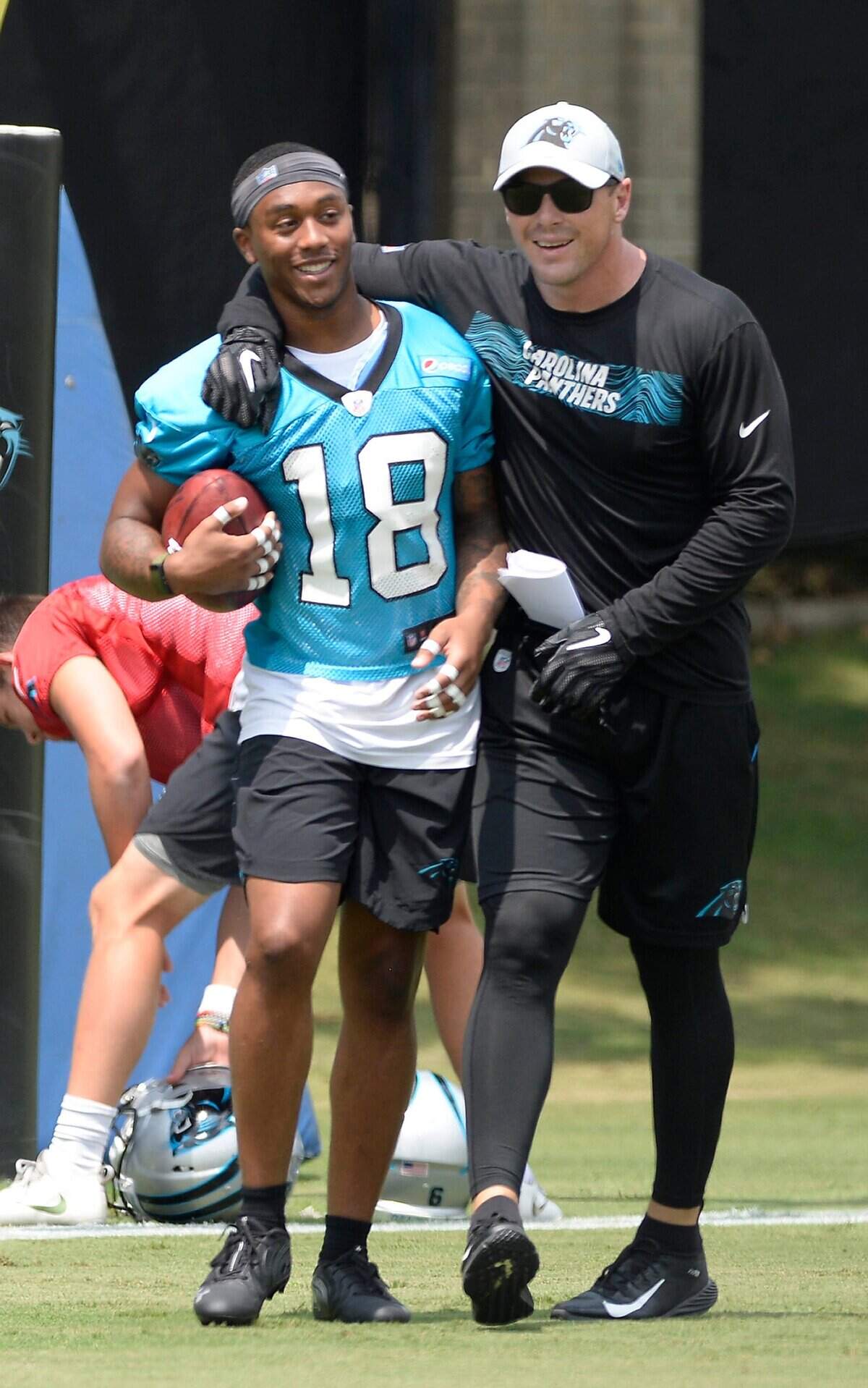
“They take their jobs super seriously, but they don’t take themselves seriously,” Jansen said. “That creates an environment in which guys aren’t afraid of their coaches, but they want to perform for their coach. And I think that’s a pretty unique thing.
“A lot of coaches coach with fear. A lot of coaches who want to be your buddy get run over by the players.
“I remember Jeff Saturday said something about Tony Dungy that I think about when I think of these two guys: You don’t worry about getting yelled at. You worry about letting them down.
“And their energy, and how much they want to put us in a good position, I think it encourages all of us to make sure we don’t let them down.”
Changing the game
In practices, special teams doesn’t have a scripted playbook like the offense or defense.
“Offense and defense works off of a play script. Nine plays, 12 plays, 18 plays, we are going to get through all of those plays,” Jansen said. “(But) special teams is always timed. So if we’re on punt, and we get 10 minutes, the amount of reps we get is totally up to our own pace.”
Blackburn and Farwell must be efficient, and prepared. Jansen said they run through their classroom presentations four or five times before showing the team, even spell-checking and testing sound and links, because they want perfection.
Specifically, perfection from themselves. They actually encourage troubleshooting of mistakes from their players. The meeting room is a high-energy, open environment, and rookies learn very quickly that they must always speak up if they have a query, no matter how small.
Blackburn does things this way because when he was a player, he always wanted to know the “why” behind a coach’s decision. What were the situational factors involved?
So Blackburn doesn’t base his evaluation of his players by the normal common denominators of the league: Net punt, net return.
Instead, he coaches situationally.
“Ours is more about maximizing each individual play for the situation given as opposed to having the best net, having a zero-yard return or a 25-yard kickoff return average,” he said.
Blackburn works to cover details that most don’t even think about — like hash-mark placement, how to most efficiently get on and off the field, where to put the ball, where the official will be and situational strategy. What are the offensive plays that lead to a hurry-up punt or kick? What are the in-game percentages a player must know to decide whether to take a knee in the end zone or return a kick?
“One of the big things we’ve emphasized this year is that because Chase played defense, he could see that special teams is not just a transition from offense to defense but that it can really have a profound impact on the game,” Jansen said.
“Understanding the ‘why’ behind (the situations) really helps get guys up to speed.”
Farwell and Blackburn love to see the light bulb switch on for players.
“When I was a player, I got the thrill of winning and doing what I was supposed to do,” Farwell said. “And now for me it’s seeing those players execute what we taught them all week.
“That’s my thrill. I get the most out of that. That means so much to me.”
Their own ‘why’
“Well put, man,” Blackburn said as he bumped Farwell’s fist.
The two coaches sat under a tent outside of the fields at Wofford College, following a Panthers’ training camp practice.
Both were sweating profusely. Grinning widely. Pounding water.
Chase, what’s your step count so far today?
“I’m only at 10,000,” Blackburn said, glancing down at his Apple watch. “I mean, normally I’m at like 15,000 or more by now. Nine-hundred calories. So I hit my calories, I guess.
“I wasn’t doing a whole lot out there today. You should have put a tracker on Heath instead, he was running around catching punts.”
Ten thousand steps. By noon.
The two got up from their seats a little creakily. Farwell’s knees protested loudly and Blackburns legs were stiff as they headed inside, where Blackburn’s wife and young children were waiting.
Their muscles reminded them why they don’t like to sit still for very long. But they were still grinning. The fact that they still can run around, participate in drills and sweat alongside the players provides joy to them, and purpose.
As they move, they teach. They can be present in every moment each player sees.
They can demonstrate the small details that might create a game-changing shift.
It’s their “why.”
Does that sound insane?
No.
It sounds like special teams.
This story was originally published August 17, 2018 at 2:41 PM.