
Panthers’ pass rush is missing ‘gaudy stats’, but that doesn’t tell the full story
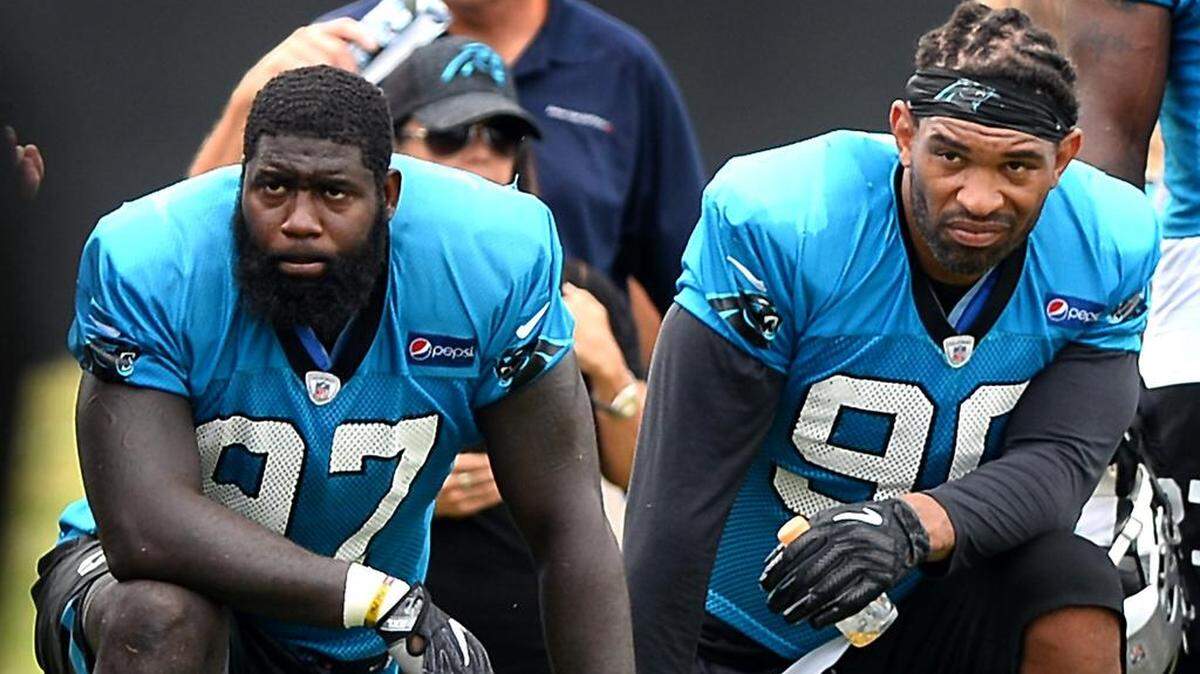
For everything we did see during the Carolina Panthers’ 33-31 victory over the New York Giants on Sunday — antics from Giants receiver Odell Beckham Jr., broken tackles and sensational touchdowns, not to mention a near NFL-record kick to win it at the last whistle — there was one thing clearly missing:
Carolina’s vaunted pass rush.
Or, at least that’s how it may have appeared.
The Panthers only sacked quarterback Eli Manning once - really he dove to the ground when he saw linebacker Luke Kuechly barreling toward him. But that statistic doesn’t necessarily tell the full story about the team’s pass rush. In fact, although Carolina only has nine sacks (compared to 11 through four games in 2017), there’s much to understanding how the team pressures the quarterback than just that lone statistic.
“They’re gaudy stats, obviously (everyone talks about) sacks, but the first thing we have to do is affect the quarterback,” defensive coordinator Eric Washington said Monday. “Sometimes that means he throws it away before we have a chance to hit him.
“It’s a combination of several factors: the tempo of the passing play, some of the quick slants, some of the extra guys used in protection. And those are factors, but I won’t make any excuses about why we don’t rush the way we are capable of rushing.
“And we have a very high standard where that is concerned.”
‘We have to be on the scene’
Pressuring the quarterback has always been a staple of the Panthers’ defense.
Led by 11 sacks each from Julius Peppers and Mario Addison, Carolina’s 50 overall sacks last season trailed only Pittsburgh (56) and Jacksonville (55) across the NFL. And that’s only evidence of a greater trend, as over the past three regular seasons, Carolina has never finished a season lower than sixth in sacks league-wide.
But through four games this season — remember, a small sample size — the team is tied for 23rd in that category, with 10 fewer sacks than the top-ranked Steelers.
“We need to be better,” Washington said. “You want to try and get your hands up, collapse the pocket as much as possible because that affects the quarterback’s accuracy, but when he’s throwing the ball deep, when he’s taking a true five- or seven-step drop and he’s trying to push the ball down the field, we have to be on the scene.
“We have to show up, especially with our four-man rush. That starts it off.”
But while sacks are the ultimate goal in rushing the passer, it’s not the only positive outcome.
Take, for instance, the Giants’ game. New York finished 0-for-7 on third-down conversions. Those are drive-killing, momentum-halting plays for the opposing offense... and the exact opposite for Washington’s defense.
And they’re also the product of pass-rushing success.
Coach Ron Rivera explained Monday the numerous reasons the Giants were so apt in protecting Manning. First, the team max-protected for him, a la what you’d see for a team’s punt-protection unit. That means a team’s five-down linemen also have wingers next to them to push a defense’s ends or other blitzers out even wider than normal.
“One of the things we tried to counter that was we tried to drop eight (defenders into coverage) at one time and only rush three,” Rivera said. “We were close too, let’s be honest about that. (Manning) threw a lot of early balls and a lot of their protections were designed to slow us down.”
Rivera’s other point there, that Manning was throwing balls early in the play, also explains part of the reason for fewer “gaudy stats.” With extra men in blocking for Manning and intentionally getting the ball out of his hands quicker, that mitigates some of what a pass-rushing unit can do.
But even for as effective as those strategies were for the Giants, they aren’t anything this defensive line isn’t equipped to overcome.
‘A defensive line that can take over a game’
There’s another aspect of the Panthers’ pass rush - or any team’s for that matter - that has to be factored in here:
The direct correlation between pass coverage and pass rushing.
“I think rushing and coverage go hand in hand,” cornerback Captain Munnerlyn said Monday. “If we’re doing our job on the back end, that means they’re doing their job on the front end. If we can just make the quarterback hold the ball for a split second, those guys can get there — we’ve got a defensive line that can take over a game, and we know that.”
Only so far... the coverage aspect of that relationship hasn’t held up. The Panthers have allowed Manning and the Bengals’ Andy Dalton to throw for more than 300 yards in back-to-back games, and the team’s overall pass defense ranked 26th in the NFL after Sunday’s games.
So, not great.
But factor in that the team has a rookie starting at one cornerback spot and now a newly-signed safety who hadn’t played in seven months, and that makes a little more sense. As Donte Jackson and Eric Reid, respectively, learn more about this Panthers’ defensive scheme and get better conditioned to handle a rigorous remaining schedule, that coverage should continue improving.
And as it does, for each extra second the secondary forced a quarterback to hold onto the ball, that’s one step closer Peppers or Addison or one of Carolina’s other rotational players are to getting those sacks.
Then account for Peppers still working his way back from offseason shoulder surgery, the development of Efe Obada, and oh yeah, Thomas Davis’ return from a four-game suspension?
“We had a couple of opportunities to rush where we didn’t necessarily get to them, but I think overall it was decent,” Peppers said after Sunday’s game. “We didn’t get the sacks and the hits like we wanted to, but overall I think we played solid up front.”
That’s a fair assessment, particularly considering the max protection from the Giants, their quick-passing game plan, and the Panthers’ still-meshing secondary. The 0-for-7 third-down conversions, the improving run defense — they’re all signs that this defensive line group, with its reputation around the league, is well on its way.
Now just keep it up, and the gaudy stats should follow.
Brendan Marks: 704-358-5889, @brendanrmarks
This story was originally published October 9, 2018 at 7:00 AM.