The bottom line on the Panthers’ 2019 draft class and what Carolina can learn from it
There has been no shortage of conversation about the start of a new era for the Carolina Panthers. Leaders on both sides of the ball are gone, and a new coaching staff is in.
For a variety of reasons., 2020 will likely be used as a marker in Panthers’ history for years to come. But before we move on to what’s to come, and analysis over this year’s selections and how they fit with what Carolina is doing going forward, it’s important to look back.
What lessons can be taken from the 2019 draft? General manager Marty Hurney and the front office were drafting for a different team with its own priorities and needs. And the results were certainly a mixed bag. It’s too early to grade how these picks panned out in the long-term or if other moves would have been wiser. Only time truly allows for that. But that doesn’t mean we can’t learn from it.
First round — No. 16 Brian Burns
Hitting picks in the first round hasn’t been a problem for Hurney in his most recent drafts. That trend continued with Burns. He started off his rookie season with 4.5 sacks and a fumble return for a touchdown in the first six games.
Burns’ playing time decreased over the second half of the year, partly due to an injury that came from punching the field in frustration, which forced him to wear a hard wrist cast for part of the season. After being in the early conversation for Defensive Rookie of the Year, Burns had a midseason slump, but then ended the year on a positive note with a sack in each of the last two games of the season.
Bottom line: The Panthers got a much-needed pass rusher at the time, and Burns will have a big role to play in the years to come in Phil Snow’s new defense that will feature a lot of different looks. They were patient and let a solid player fall to them at No. 16. The team addressed both a need and got one of the best players on the board at the time. Burns will likely be used in different ways depending on the situation with coach Matt Rhule’s desire to have position versatility. He is currently listed on the team’s roster as a linebacker/defensive end.
During free agency, Carolina lost its two sack leaders. With all the turnover the Panthers had, it’s easy to forget the splash Burns made at the beginning of last season. He will have a big opportunity to prove himself in 2020.
Second round — No. 37 Greg Little
The second day of the 2019 draft was certainly … interesting. The Panthers moved up from pick No. 47 to 37 (and traded the 77th overall pick) to select Ole Miss offensive lineman Little, envisioning him as the left tackle of the future. Flash forward a year, and Little has suffered two concussions and dealt with an ankle injury that restricted him to just four games in 2019. Carolina also traded for left tackle Russell Okung this offseason to bring a veteran presence to the position and help Little develop, while not ruling out the possibility of developing Little at the spot he was drafted to fill and with more position versatility.
Bottom line: Trading up in this year’s draft makes far less sense for the Panthers in most circumstances compared with moving back to acquire more picks. Right now, the move up to get Little doesn’t look so great. But it’s far too early to make a statement about whether that was the right draft move overall or not. Perhaps a year of learning and development behind Okung will help Little grow in the long-term.
It was also clear last year, as it has been for Carolina, just how important left tackle is. Getting Okung for a single year cost them Trai Turner. Moving up for players at the important positions should always be considered, which is why the Little pick shouldn’t be discounted. Prior to his rookie season, he hadn’t experienced many injuries in his football career. There are things that can’t be planned for.
Third round — No. 100 Will Grier
Looking back at the 2019 draft, this is the most fascinating pick with everything that has happened in the past year. Grier is the only quarterback still on the roster from last season with Cam Newton currently a free agent and Kyle Allen traded to Washington. The Charlotte native lost the backup job to Allen before the season and then watched him play from the sidelines until Grier started the last two games of the year once everything had gone off the rails.
In those starts, Grier completed 53.8 percent of his passes for 228 yards, zero touchdowns and four interceptions before leaving the final game of the year early with an injury. However, it’s hard to blame his performance all on him. The team was in the middle of an eventual eight-game losing streak, and Grier had not practiced with the first-team offense until Week 16.
Bottom line: The Panthers’ quarterback room now consists of Teddy Bridgewater, P.J. Walker and Grier going into the draft. There’s a lot of talk about the addition of Bridgewater, deservedly so, and the excitement of adding an XFL star in Walker. What about Grier? Will all of this shake-up end up benefiting him? It’s hard to see that being the case right now. He’s the only quarterback who the coaching staff doesn’t know well in a shortened offseason.
If the team had more confidence in Grier last year, he would have gotten more of an opportunity to start deep into the losing streak. He’s not the quarterback for the future of this rebuilding team, and if Bridgewater doesn’t work out, they will have to take a quarterback in the draft sooner rather than later. Maybe he’ll develop into the team’s long-term backup, who knows.
Grier was brought in as someone to develop behind Newton. That’s not happening. But if there is a quarterback the Panthers love in the draft, they shouldn’t be held back from going after him. With so many needs in this year’s draft, however, addressing the position only at the end of the draft or with undrafted free agents would be wise unless the top players fall to them.
Fourth round — No. 115 Christian Miller
Miller just wasn’t used very much last year, playing in only seven games, partly due to injuring his ankle in Week 5. But once healthy, he continued to be inactive even with the team out of playoff contention. Giving Miller more opportunities at the end of the season would have helped the new coaching staff get a better sense of what to expect from him, especially with the reduced offseason programs.
Bottom line: Despite his playing time, or lack thereof, taking Miller in the fourth round still makes sense. He provided the Panthers with depth at linebacker, and it will be interesting to see how the new coaching staff takes advantage of his potential. Ultimately, this is somewhat similar to Grier in that it’s hard to have a takeaway from this pick because he didn’t play very much. Part of it was injury and some of it was him still developing. How he fits in going forward this year will tell more about his future in Carolina.
Fifth round — No. 154 Jordan Scarlett
Scarlett didn’t play much of a role in 2019 with Reggie Bonnafon taking on the role of Christian McCafrey’s backup. But he did participate on special teams during the middle of the season. Scarlett’s selection ended up being a good depth move for the running back room.
Bottom line: The Panthers may address running back late again in this year’s draft — they’ve talked with multiple running back prospects over the draft process the past couple months. Looking back now, there might have been slightly better ways this pick could have been used, but whoever they selected would have likely been a special teams contributor and keeping a solid group of backup running backs is important. Not using McCaffrey too often to prevent wear and tear over time should be a priority.
Sixth round — No. 212 Dennis Daley
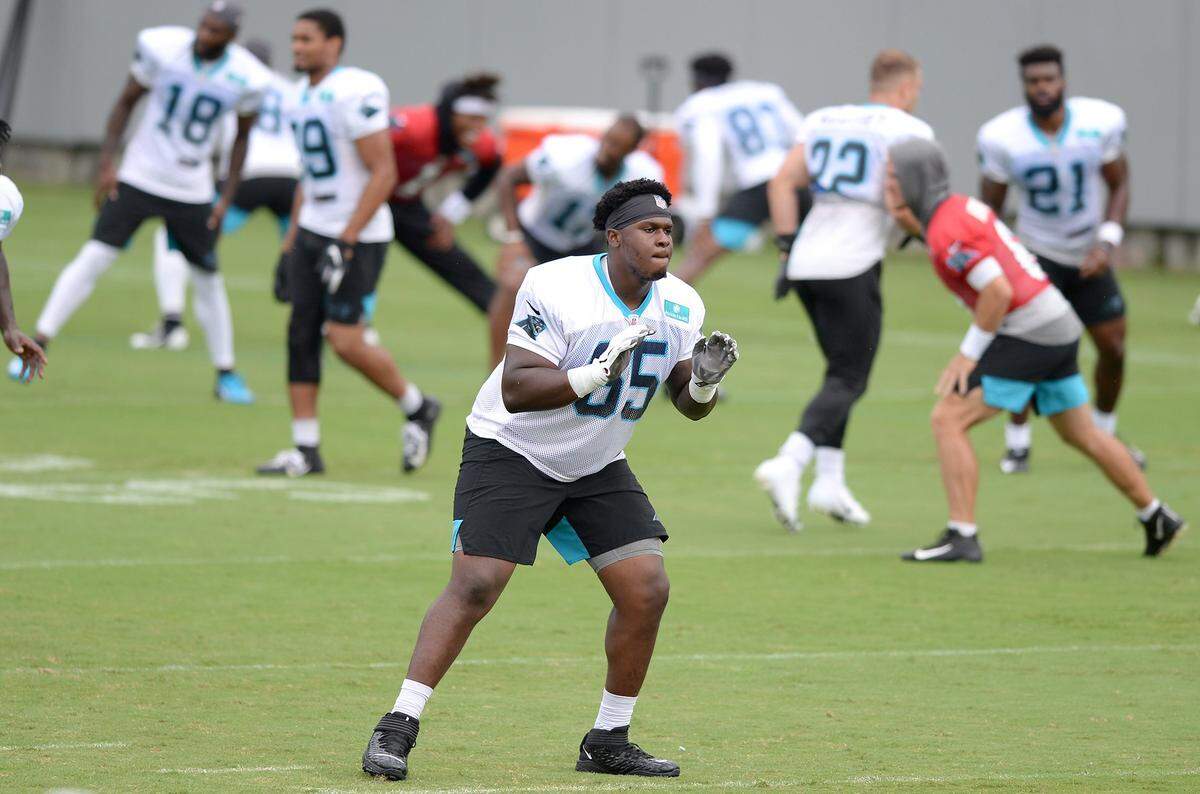
The Panthers drafted Daley in the sixth round and he ended up starting six more games than Little, who they moved up to draft in the second round. He played well at times and not as well at others as the offensive dealt with multiple injuries throughout the season. As things stand now, Daley will likely be a starting guard in 2020 and have the opportunity to develop at one position.
Bottom line: All NFL teams should take a big lesson from this pick, and fans should be reminded as well. Anything can happen, and injuries can result in players having to step up in unexpected ways (just ask Allen). Drafting players that can serve as reliable backups is incredibly important. That’s why the Grier pick could end up being successful in the long run.
Daley was put in an incredibly tough situation and played as well as could be expected playing out of position and in various spots. It’s a reminder that the picks in the last two rounds can’t be discounted, because you never know what role they’ll have to play.
Seventh round — No. 237 WR Terry Godwin (released before the season)