Why half of Panthers roster is at risk for severe COVID-19 symptoms — and why they risk it
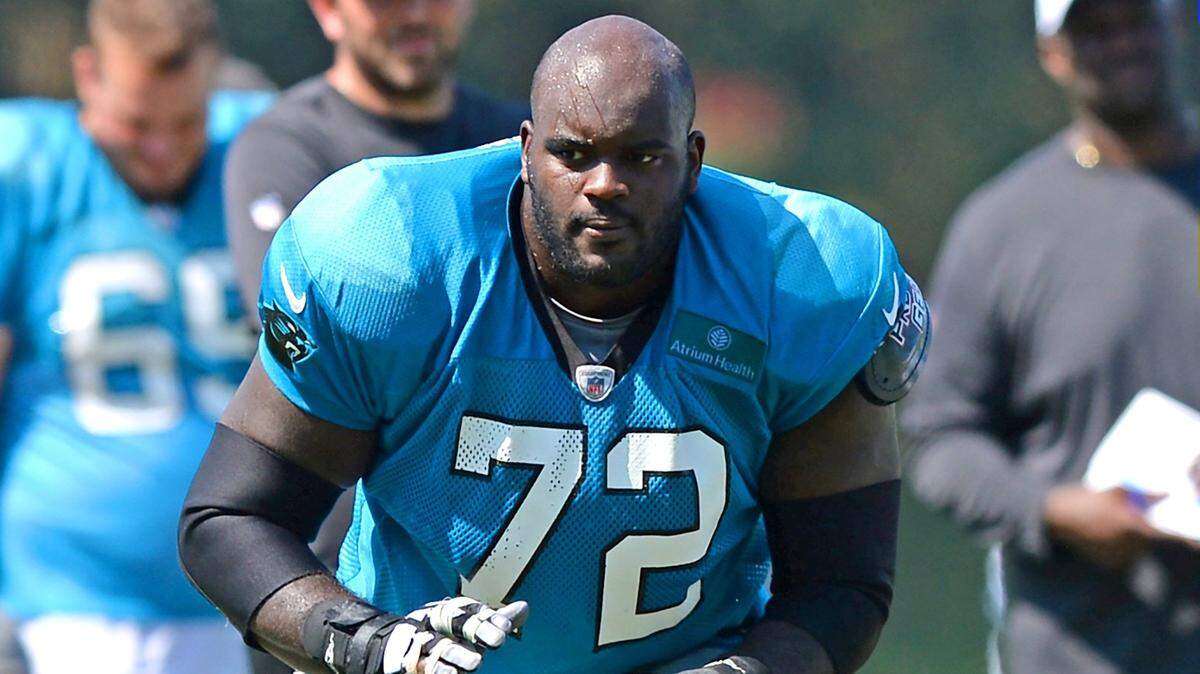
When Carolina Panthers left tackle Russell Okung retires, whenever that may be, he wants to lose weight.
He gained 50 pounds his freshman year at Oklahoma State to become a starting offensive tackle in 2006. Since then, he has been at least 270 pounds.
Okung recalls spending most days in the weight room before his freshman season.
“And I remember trying to chug as many protein shakes as I could,” Okung told The Observer. “Looking back on it, it was not a smart thing for me to do at all.”
But with the novel coronavirus, this pandemic brings new concerns for heavier football players, like Okung, who, because of his 6-foot-5, 310-pound frame, has a 36.8 Body Mass Index. Researchers know that people with BMIs 30 or higher, which is considered obese, are susceptible to severe symptoms of COVID-19. For the NFL, that includes at least 70 percent of its more than 2,500 athletes, said Thom Mayer, the NFLPA’s medical director. Yet, as training camps get underway, the vast majority of these players will continue on with the 2020 NFL season without knowing what may happen to them.
“Our men are at risk by the nature of what they do, and by the nature of who they are,” Mayer said. “It’s the responsibility of the NFL as the employer to provide a safe workplace. It’s the responsibility of the Players Association as a union to hold them accountable for that.”
Mayer said some players also suffer from sleep apnea, asthma, hypertension and diabetes. According to the Centers for Disease Control and Prevention, people with those particular conditions are at an increased risk of suffering from severe symptoms of COVID-19 if they were to contract it.
Of the 83 players listed on the Panthers’ roster as of Friday, 42 have a BMI of 30 or greater. Two have BMIs greater than 40, and the average BMI listed is 31.1.
(If the searchable database of Panthers players’ BMI isn’t working on mobile, please try here)
Mayer also said the idea that professional athletes won’t experience symptoms from COVID-19 because they are in shape is a myth.
In April, Denver Broncos linebacker Von Miller became one of the first NFL stars to announce he had contracted the coronavirus, telling The Washington Post he struggled to breathe.
“I got asthma, but it was past the asthma attack — like my lungs were constricting,” Miller told The Post. “My asthma nebulizer helped, but it still didn’t feel like it was supposed to. That was the most frightening part. Just going to sleep knowing that my oxygen level could drop and I could wake up and have to go to the hospital.”
For many NFL players, deciding on whether to play this season put them at a crossroads.
Play the season and risk contracting COVID-19, potentially spreading it to your family. Or opt out the season, and potentially give up millions of dollars — the same money that feeds those families.
While most NFL players chose the former, 66 players — including Panthers defensive end Christian Miller and linebacker Jordan Mack — opted out of the 2020 season before the league’s Aug. 6 deadline because of concerns for COVID-19.
Football’s inevitable risks
Before training camp began, the NFL implemented a number of protocols to ensure players were safe at each team’s facility. Players are tested daily. They must physically distance in the facility and wear face masks. And each player and coach is given a contact tracer that lights red when someone is within six feet of another person.
Every player made available by the Panthers to the media during the first weeks of training camp has said they feel safe at the facility.
“We all know we’re big, we certainly weigh over 300 pounds,” Panthers’ defensive tackle Kawann Short, who is 6-3, 315 pounds, said when asked whether he was worried about the risks associated with bigger players and COVID-19. “We don’t know what will happen on the field. We’re tackling, we’re pushing. Sweat is dripping.
“You just got to be cautious, and we feel that our organization has (taken) a lot of precaution on that side of the field when we get off.”
Panthers’ rookie defensive tackle Derrick Brown (6-5, 326 pounds) echoed Short’s sentiments.
“I think everybody thinks about it, but all we can do at this point is, if you’re chosen to play ball, you got to play ball,” Brown said.
As of Wednesday, no Panthers players have tested positive since mandatory testing began. But there’s no guarantee that won’t change throughout training camp or once games begin — especially given the NFL’s lack of a “bubble” environment the NBA, WNBA and NHL have.
Jim Thomas, an associate professor of epidemiology at UNC-Chapel Hill and expert on infectious diseases, said the risks on the field will be impossible to avoid.
“If (linemen) get a test, and test negative, they could just get infected an hour later, and be asymptomatic and hitting each other,” Thomas said. “So when they are hitting each other, I imagine there is some saliva and spray in the air. That increases the possibly of transmission.”
The lack of a bubble will be the biggest issue facing the NFL. Players will be traveling from city to city, and they are allowed to go back home after work — or wherever else they choose.
In Major League Baseball, which is also operating without a bubble, the St. Louis Cardinals and Miami Marlins have had outbreaks among their clubs and were forced to postpone multiple games. Cardinals manager Mike Shildt revealed last week that some players needed to go to the ER because of coronavirus symptoms.
When asked whether he was concerned about players who are at risk of severe symptoms of COVID-19, Panthers coach Matt Rhule said his concern extended to everyone at the team’s facility.
“I’m concerned with the people that are downstairs that made lunch for us,” Rhule said. “As I said, I think everyone has to make their own decisions in terms of what they want to do.
“I think what we’re seeing is the testing works when someone tests positive. We’re able to keep them out of the building. We’re able to isolate them. We’re able to keep them safe. Let them recover. So everyone has to make their own personal decisions.”
Gaining and maintaining weight
Gaining weight is part of the job of being an NFL offensive lineman. It’s necessary to keep 300-pound defensive linemen away from quarterbacks and to block for running backs.
And as a former starting NFL center, gaining weight and maintaining it, was constantly on Jeff Saturday’s mind. He needed to be strong and nimble in order to play in the Indianapolis Colts’ offense and protect Peyton Manning.
His diet was high in calories. Eating a 3,000-calorie breakfast that included waffles, bacon, grits and oatmeal was normal. On road trips, he and his fellow offensive lineman would go out to eat together. At home, they’d have cookouts, and the grill would be stacked with meat. Saturday nights, the offensive linemen drank vanilla, chocolate and strawberry shakes and talked about Sunday’s game.
“It was nice from the perspective you didn’t have to count calories, but I did have to force-feed,” Saturday said. “At one point in the offseason, I was too little of a man to play. You drop this weight and that becomes a concern from your offensive line coach or (offensive coordinator).”
So he ate until he could get to his 285-pound playing weight.
Saturday said the weight could make him feel sluggish. He often worried about developing health issues, and it’s why he was intent on losing the weight when he retired.
“I knew, two or three years before I retired, my wife and I would talk about, ‘There aren’t many folks with this weight that live a long time,’ ” Saturday said.
Since retiring, he has lost 65 pounds.
Frank Garcia, who played offensive line for the Panthers from 1995 to 2000, said while he didn’t develop any health issues due to his size, some players developed eating disorders as a result of gaining weight. He said playing this season should be a personal decision for players. But if he were playing today, he would not opt out.
“I’m playing a high-risk game where I might die,” Garcia said. “We as athletes know what we’re signing up for ... I think the same thing would apply to me as an athlete. There’s a lot of money available to me. COVID is the potential for anybody. I could get it walking down the street and me playing football is not going to change that.”
Mayer, the NFLPA’s medical director, says he encourages players to sit with their families and talk about playing this season because not only are the athletes at risk, but their parents, siblings, children and spouses are as well.
“There are incredible athletes that have a BMI of 40 and they just have to look at that calculus,” Mayer said. “So the more risk factors you have, the more I encourage (athletes to do) everything you can to protect yourself. It’s going to protect your family. It’s going to protect your teammates. It’s going to protect football, the ability to start a season and finish the season.”
Thomas, who is advising government planning groups on pandemic ethics, said though playing football has its risks, face shields on helmets are a possible option to mitigate the spread.
Some Panthers players like offensive lineman Matt Paradis and Brown, a defensive tackle, say they plan to experiment with the face shields in camp, but are unsure whether they will actually wear them during the season.
Thomas suggested teams could also buy out hotels so teams could isolate if players were concerned with taking the virus home.
“That’s going to be a hardship on the family, but that could be step to take to limit the transmission of the disease,” Thomas said.
The Panthers have offered to allow their players to stay at a hotel during training camp, which is being held in Charlotte for the first time in franchise history rather than at Wofford College in Spartanburg, S.C. But players are expected to return home after training camp.
Taking a chance
Okung dealt with a pulmonary embolism in 2019 caused by blood clots. He called it a “near-death experience.” He recalled talking with a couple of former teammates who said they were having heart troubles because of their weight.
“We’re seeing a lot of these issues, which many doctors can’t figure out,” Okung said. “They are seeing the pounds and our diets, and it may just be the perfect storm to set us back, health-wise.”
“I’d love to be in a world where I’m sub-260, much more lighter, healthier and eating much more naturally, as opposed to the cramming I do now.” He said he eats natural and organic foods, but has a high-caloric diet.
Okung, who the Panthers acquired via a trade this offseason in exchange for Trai Turner, weighed his options of opting out before the Aug. 6 deadline, but he is committed to the Panthers, his agent J.I. Halsell told The Observer last week.
Okung said he believed in the resiliency of the human body.
“Especially it’s application with nature,” he said. “And I try my best to be grounded and eat organically, eat extremely well.
“Whether I get sick or not, I’m going to do my best to overcome it. That’s a long way of saying, I am not terrified of the coronavirus. I’d much rather continue to live life as best as I’m allowed to.”
It’s a chance he’s willing to take.
This story was originally published August 14, 2020 at 6:00 AM.