Teddy Bridgewater is done trying to be someone he’s not. This is who the Panthers’ QB is
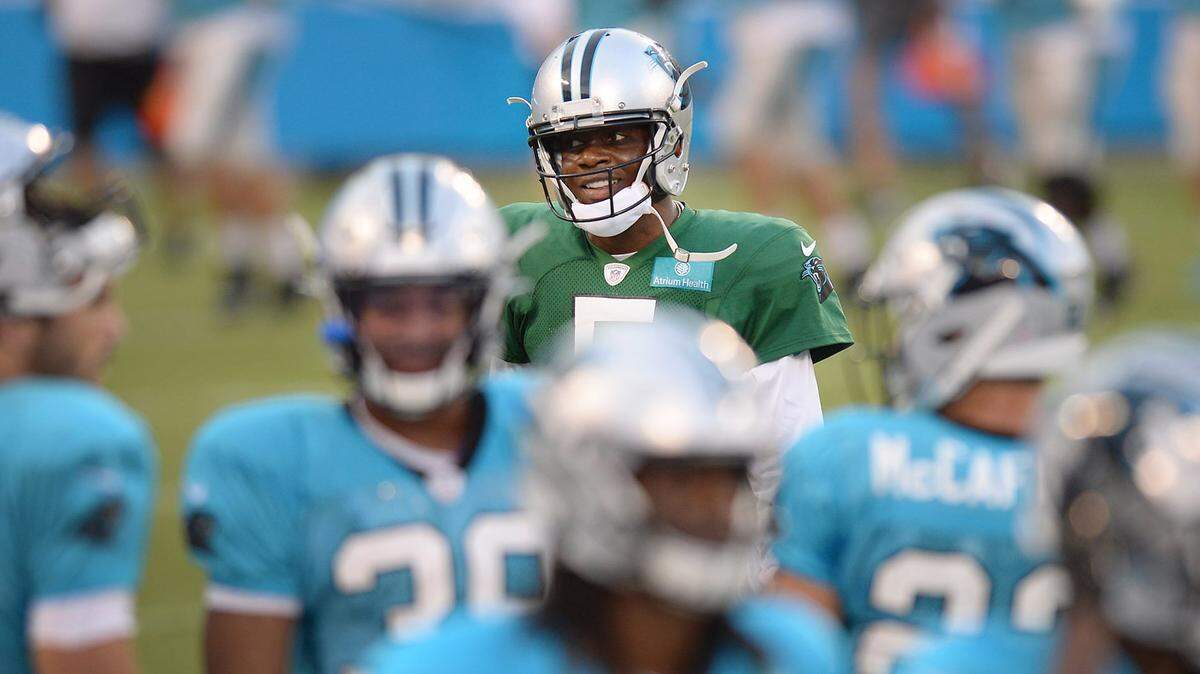
On a recent August morning, Panthers quarterback Teddy Bridgewater arrived at practice with a smile. He cracked a joke at his offensive coordinator, Joe Brady, for wearing his socks too low.
He’s showing too much leg, Bridgewater said.
Then he tells an equipment manager to play some Yo Gotti, “the clean version.” As the beat drops, he sways back and forth, crossing his arms. His shoulders bounce and his head moves from side to side.
The way Bridgewater handles practice isn’t dissimilar to the Panthers’ former franchise quarterback. Like Cam Newton, Bridgewater likes to keep the mood light.
He earned the nickname “Neighborhood Hope Dealer” because he gives back to children in the community. Newton was also known for his affinity for kids.
But this is Teddy Bridgewater. And in more ways than not, he’s different from anyone. Even when he tries not to be.
When the Panthers host the Las Vegas Raiders on Sunday, it will be the first time Bridgewater, a seven-year veteran, has been a starter for the season opener since 2015, before a knee injury changed the trajectory of his career.
But when asked about this, he replies confidently. He’s at peace, as if there’s nothing to worry about. At peace with his game. At peace with his team. At peace with himself.
When the Panthers signed him to a three-year, $63 million contract this offseason, they handed him the keys to the franchise. From that point on, the Panthers became Bridgewater’s team. And it was his job to be a captain as the Panthers try to rebuild from scratch in Matt Rhule’s first season as head coach.
With the job came criticism and grumblings from fans who disagreed with the Panthers’ decision to cut ties with Newton.
Bridgewater understood the flak. But this is his time, and he says he doesn’t feel the pressure of replacing Newton, who led the Panthers to Super Bowl 50.
“Cam, he’s done some unbelievable things around here,” Bridgewater told The Observer. “He was a freaking MVP. You can’t do nothing but respect that. And I respect everything about Cam. His game, things that he did in Charlotte, the way he interacted with the community, his personality.
“I understand that fans are loyal to players, some are loyal to organizations, but at the end of the day, I’m Teddy Bridgewater. If no one likes that, who I am, I can’t change anything about myself for them. Because when I look in that mirror, I ask myself am I being real with myself, or am I conforming to the likes of others? If I stay true to myself, eventually people will gravitate toward me.”
Never too high, never too low
“Who is Teddy?” he’s asked.
When he ponders the question, he folds his arms, leans back in his chair, and his eyes wander into space as if searching for the answer. He pauses before responding.
“Teddy is a guy who is always even-keeled,” he said. “Never too high, never too low.”
He’s not the loudest in the group. His pregame speeches are not Ray Lewis-like. He’s certainly not Cam Newton. He’s soft-spoken and calm, yet sure of himself.
Those who know him best call him an “old soul.”
Miami is home. It’s his comfort zone. And when he goes back — he did so as recently as last Saturday — he always goes to the same place for breakfast, MLK Restaurant. He orders the same thing every time: Either the catfish and grits, or the grilled shrimp and grits.
Always grits. But those grits aren’t complete without syrup.
He’s the youngest of four children. He grew up in Bunche Park, a predominately Black neighborhood in Miami Gardens, where he was raised by a single mother who always made sure her children knew right from wrong and the importance of hard work.
Bunche Park was where Bridgewater first learned how to play football. His older brother, Harry Gathers, who was eight years his elder, also played, and when Teddy went to his games, it wasn’t Dan Marino he tried to emulate throwing the ball around with his friends, it was Harry.
Lee Jones, a youth football and baseball coach, recalls sitting at the park with another coach in the 1990s and seeing a group of kids playing catch. One boy made a diving catch in the dirt. It was Teddy Bridgewater, and he was 5 years old.
“That’s when (the other coach) said, ‘We need to get him in football,’ ” Jones recalled. “We got him in football, and the rest is history.”
Bridgewater was just as good in baseball, too, Jones said.
He said the 5-year-old Bridgewater hit line drives from the tee to the outfield consistently, but it was his arm, even back then, that stood out.
“You could put Teddy on the field, and he could play all nine positions, and when you put him in there, he would change the whole game,” Jones said. “Pitch, catch, shortstop, second, outfield. There wasn’t nothing he couldn’t play.”
In football, it was the same. He played quarterback, receiver, punter and placekicker.
He wasn’t like anyone else.
When Bridgewater reached high school age, he wanted to play for Miami Northwestern Senior High — a school known for its football program. So his mother, Rose Murphy, who worked in the public school system, moved the family to Liberty City, a predominately Black and low-income neighborhood in Miami.
It’s where Luke Campbell (Uncle Luke), Chad “Ocho Cinco” Johnson and Antonio Brown are from.
Liberty City was different than Bunche Park. Two-parent households were less common. It wasn’t out of the ordinary to see someone out on the street gambling or selling drugs. Shootings were prevalent.
“It was something that I wanted him to know that this is reality, this is real life,” Murphy said. “This is happening out here. Everything isn’t peaches and cream because you live in Bunche Park. I want you to see how other people live, and what kids go through who are less fortunate than you.”
She added: “And because you’re in Liberty City, that doesn’t define who you are or where you’re going or who you are going to become. That makes you push even harder.”
‘A gift’
At Miami Northwestern, Bridgewater pursued his passion and joined the football team. But when he was about 14, he learned his mother had been diagnosed with breast cancer. He remembers coming home from football practice and seeing a crowd of cars at his house.
When he walked inside, it was quiet. All eyes were on him. His mom stopped him and said she needed to talk to him alone in her room.
“She sat me on the bed and said, ‘Teddy, look. Your mom has breast cancer,’ ” Bridgewater recalled.
He was devastated. As Murphy underwent cancer treatments, she started to lose her hair. Her nails turned black and she became too sick to work.
Bridgewater offered to quit football and get a full-time job to support the family. But Murphy assured her son that she would beat the disease and encouraged him to keep playing football.
“God gave you a gift,” Murphy told him. “He wants you, and I want you, to take advantage of that gift and use it to the best of your ability.”
Bridgewater listened. He used that as motivation to become the starting quarterback at Miami Northwestern during his sophomore season. After three years of varsity football, he earned a scholarship to Louisville.
And his mom beat breast cancer.
Jeremiah 29:11
Bridgewater’s trips back to Miami, like the one he took last week, remind him his purpose extends beyond football.
When George Floyd was killed by a Minnesota police officer in May, many athletes used their social media platforms to voice their displeasure with police brutality. Bridgewater, however, kept a low profile, and worked behind the scenes, reaching out directly to the victim’s family. He said he was able to “do some things for them.”
He said he wanted to do the same for the family of Jacob Blake — a Black man in Wisconsin who was shot by a police officer.
“For me, I like to get right to the source,” Bridgewater said. “The families of those victims. And then, next, how can we get to the higher authorities and fix these issues?”
This is his purpose, inspired by the Bible verse Jeremiah 29:11, which states “ ’For I know the plans I have for you,’ declares the Lord, ‘plans to prosper you and not to harm you, plans to give you hope and a future.’ ”
The passage, Bridgewater said, helped him get through the tough times, like when his mom battled cancer, and when he suffered through a serious injury of his own.
Two years into his NFL career, Bridgewater, was becoming the face of the Vikings. Their 2014 first-round pick was fresh off leading the Vikings to an 11-5 record and playoff berth, when his knee blew out in a non-contact accident in practice during the 2016 preseason. MRI results revealed he tore his ACL and fractured his knee joint.
Bridgewater didn’t know what his football future had in store for him. There were doctors who suspected he’d never play again.
His mother reminded him of Jeremiah 29:11.
After making his return two years later, watching from the sideline as his starting job in Minnesota was taken away, Bridgewater read that verse each night and prayed for another opportunity.
And three years after that injury — the one that almost derailed his career — he got it.
Bridgewater at his best
When Drew Brees injured his thumb in the first quarter of the Saints’ game against the Rams last September, Bridgewater, the second-string quarterback, immediately grabbed his helmet.
He sensed something was wrong.
“He has this look in his eye, like ‘I can’t go back in,’ ” Bridgewater recalled of Brees. “But it’s Drew, I’m like, ‘No this is Drew. The ultimate competitor. He’s going to find a way to get back in.’ ”
Brees hadn’t missed a game to injury in more than 10 years.
But it was clear from Bridgewater’s view from the sideline that this injury was serious. The Saints needed Bridgewater to take over the offense.
The problem?
He wasn’t ready. He hadn’t prepared like he should have. He said for the first time in his career, he felt nervous. His heart pounded. There was a tightness in his chest.
“What am I going to do?” he recalled asking himself. He tried to recreate what Brees did in practice. He tried to make the same throws that Brees made. He tried to be a first-ballot Hall-of-Famer.
He couldn’t. The Saints fell flat.
Bridgewater completed 17 of his 30 passes for 165 yards and no touchdowns, and the Rams beat the Saints, 27-9.
He heard about his performance from fans. He heard it from family members. He heard it from friends and the kids back home at Bunche Park.
“I failed, and I failed bad,” Bridgewater said. “It was embarrassing.”
He had always talked about staying ready, but he said never truly knew what it meant until he wasn’t.
That failure changed him. He studied extra film, communicated better with teammates and coaches to make sure they were on the same page and, most importantly, he was himself. He didn’t try to be Brees.
The extra preparation paid off. Bridgewater started the next five weeks before Brees returned, and won all five games. He threw nine touchdowns to only two interceptions. He finished the season with 1,384 passing yards.
“At the end of the day, when you’re the guy in there, you have to be you,” Brees told The Observer. “And I felt like Teddy was himself, and Teddy won ballgames.”
Bridgewater has used that story as a cautionary tale for backup quarterbacks Will Grier and P.J. Walker so that they can stay ready if he needs to come out.
When Bridgewater takes the field for the Panthers on Sunday, he says he’ll take that same approach he took in New Orleans. He won’t try to be like Drew Brees. He won’t try to be like Cam Newton.
He’ll be Teddy Bridgewater.
Never too high. Never too low.
“That’s when I’m at my best,” he said.
This story was originally published September 13, 2020 at 6:00 AM.