Scott Fitterer found his way to Panthers by learning, listening and communicating
“What do you know about Scott Fitterer?”
Scot McCloughan can still recall the phone call when Ted Thompson asked his opinion about a young scout in 2001.
Thompson, the Seattle Seahawks’ vice president of football operations at the time, told McCloughan, Seattle’s then-director of college scouting, that he was hiring some new area scouts and wanted to know if he had heard anything about one he was considering.
At the time, the answer was not much. And in terms of his history as an NFL scout, there wasn’t much to know. Fitterer had been in the league with the New York Giants since 1998 and had only been promoted to a full-time position just a year prior.
But what McCloughan did know about Fitterer was that they shared a common past. Both had played minor league baseball in the Toronto Blue Jays organization, spending time with the Dunedin Blue Jays, the High-A team, just a couple of years apart.
“He’s gotta be a good dude (because of his baseball history). There’s no way he cannot be but a great guy,” McCloughan joked with Thompson.
Fitterer was hired for that job and spent the next 20 seasons with the Seahawks organization, rising up the personnel ladder, working with three different head coaches and seeing people come and go from the organization.
It was an indication of Fitterer’s abilities that he survived new executives taking over the team, said Tim Ruskell, the Seahawks’ general manager from 2005-09.
“If you’re going to be there that long, you’re surviving regimes, and you’re surviving somebody coming in like I was and not wiping out the group,” Ruskell said. “That’s very hard to do. And so that’s a credit to him.”
Now Fitterer, 47, is settling into a role as Carolina Panthers general manager that by most accounts is long overdue.
More people than ever before want that question answered — “What do you know about Scott Fitterer?” — to find out more about the new Panthers GM. Google searches for his name today bring thousands of results, when just days prior, finding a bio on the former Seahawks executive was a tall task.
He’ll be in charge of assisting coach Matt Rhule in taking the Panthers to the next step in the “process” and putting to the test owner David Tepper’s vision of building sustained NFL success and stringing together consecutive winning seasons, something that has never been done in Carolina.
Step one is figuring out the future at quarterback, but after that, it’s the goal of consistent success that other franchises have seen — teams like Seattle. After a period of transition, the task of putting words into action is all that is left. But those who have seen Fitterer contribute to the Seahawks for the past 20 years say he’s ready for what’s ahead.
Scott Fitterer’s sports background
During his introductory news conference Friday, Fitterer thanked a lot of people, from former co-workers in Seattle to a list of mentors that included Thompson and McCloughan.
He also recalled one of his two older sisters, Lisa, complaining to their mother about him watching football too much.
“ ’What’s Scott gonna do? He sits in front of the TV and watches football all day. How’s he ever gonna make a life for himself?’ ” Fitterer recalled her asking.
But the Fitterers are a well-known sports family in the Seattle area. His dad, Jack, was a three-sport athlete in high school himself and played both basketball and baseball at Seattle University. Two of his nephews have played baseball at Washington State. His uncle, Pat, was a high school basketball coach in Seattle and a member of the National High School Basketball Association Hall of Fame. His grandfather, George Fitterer, played golf at the University of Washington. And those are just a few examples.
In 1992, Fitterer was a high school quarterback (and a pitcher and basketball player) in Burien, Washington, a suburb just south of Seattle. He played at two different high schools and was a four-year starter in all three sports.
Former Seahawks offensive coordinator Steve Moore was a friend and co-worker of Fitterer’s father. He spent time throwing with the young quarterback before he went off to UCLA at Jack’s request. Moore recalls him having a strong arm, but also something perhaps more important: He had a drive to work harder than anyone else.
Looking back, Moore compares that quality to what he saw in Pro Football Hall of Fame wide receiver Steve Largent.
“The best ones,” Moore said, “they have fantastic talent, but they also have an incredible work ethic. And Scott had that.”
At UCLA, Fitterer played football and baseball, then transferred to LSU and played just a semester of baseball after sitting out the 1994 football season due to transfer rules.
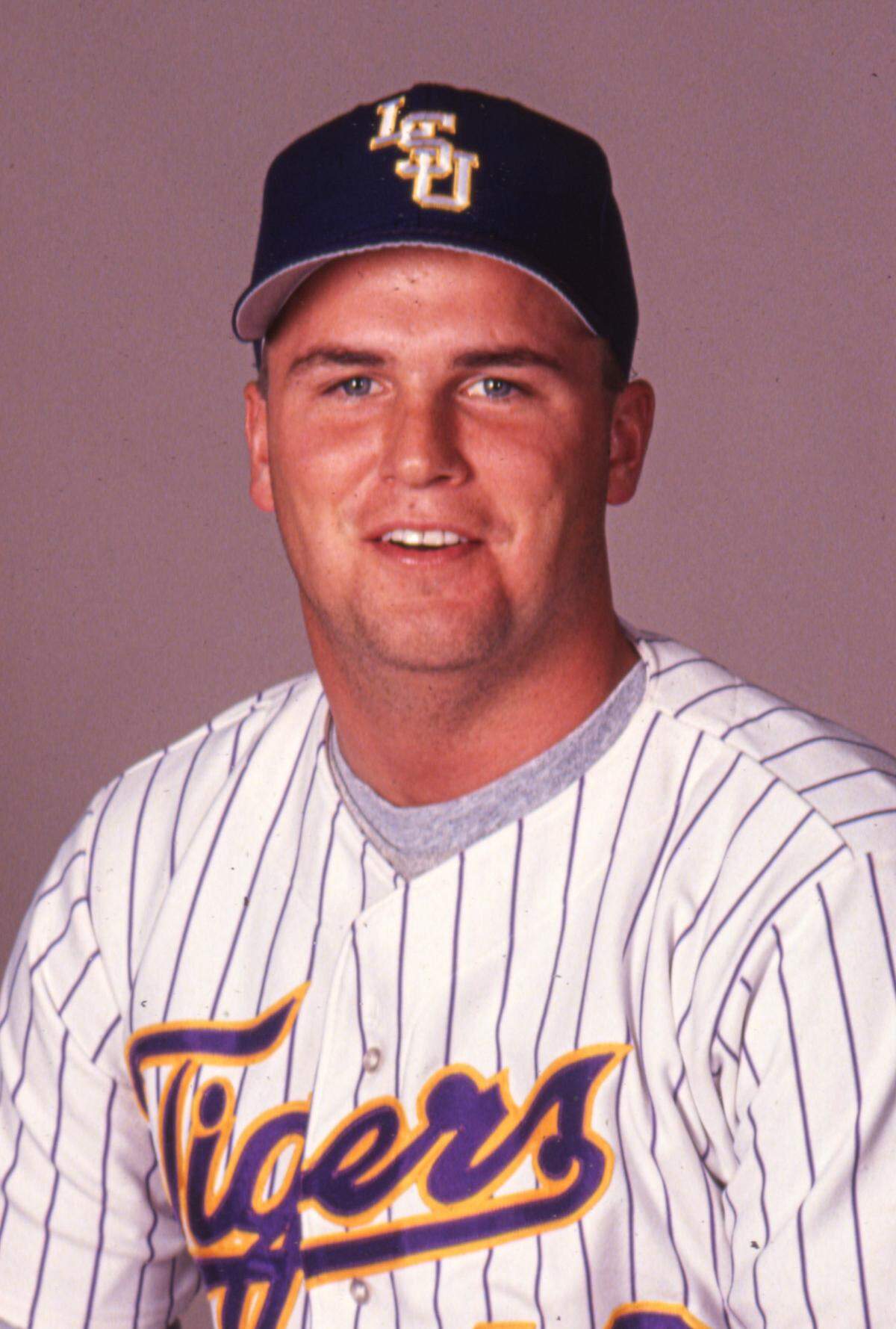
Playing football on a professional level wasn’t necessarily the final dream. In a 1992 interview with The Seattle Times, Fitterer shared how he felt his future was in baseball instead.
“I see myself playing baseball four years from now,” he said. “Playing college football is important to me, but there are too many opportunities to get hurt in football.”
Fitterer was eventually selected in the 22nd round of the 1995 MLB Draft by the Blue Jays. He played three years in the minor leagues, pitched in 44 games and logged 52 2/3 innings with a 4.10 ERA, 41 strikeouts and one home run allowed. But his career as a closer came to an end because of shoulder injuries.
He then transitioned to football scouting, working in the sport he says had his heart.
A calm presence
Fitterer isn’t the “stand-on-a-table, fight-for-a-player-by-shouting” kind of guy. That’s not his style.
Instead, he is even keeled and doesn’t get overwhelmed mid-draft or in high-pressure situations. He has been known to crack a sarcastic comment or two.
Former Seahawks head coach Mike Holmgren remembers Fitterer being one of the scouts who made him take note.
“There are some scouts ... that you trust in their judgments and you kind of agree with how they view players and just how they would fit into the culture of the team. And Scott right away, I just knew that about him,” Holmgren said. “It’s just not how good an athlete (a player) is — there’s a lot of other things that go into that and he was a good judge of that. And so I trusted him.”
If he disagreed with another scout’s opinion, Fitterer would take McCloughan or someone else to the side to share his thoughts, or suggest watching more tape as a group or individually. Cutting someone off or exhibiting negative body language aren’t his approach.
Part of that demeanor came from how he was raised.
“I grew up in a positive environment, where goal-setting and all their teachings really changed my life and put direction in my life,” Fitterer said in 1992.
In 2010, Pete Carroll was hired as Seahawks head coach, and he and the team brought in John Schneider to be the general manager, although Carroll maintained final decision-making power. Fitterer was retained and promoted to director of college scouting just a year later.
Many of the people Fitterer has worked for have been influenced directly or indirectly by former Packers Hall of Fame GM Ron Wolf’s “system.” One of the reasons why Fitterer has had success in that system is his ability to understand what a certain coaching staff is looking for and then identify someone who could fit.
“ ‘OK, what I see on tape, this skill set, I can project to this role,’ and he really understands how to do that,” Seahawks director of college scouting Matt Berry said. “(It’s) one of the reasons he’s been so successful and so, so good for us.”
Finding talent late in the draft has been a hallmark of Seattle the past decade, as is trading back in the first round. With just under 20 players graded as top picks, the Seahawks don’t view picking late in the first round that different from early in the second. With the eighth overall pick this year, that approach will be less in play for the Panthers.
In those high-pressure draft day situations such as when a trade is made, Fitterer’s presence stands out.
“Inside the building in Seattle, (he is) the person that was described as a calming force between Schneider and Carroll,” Tepper said of what he learned about Fitterer. “The guy that can calm down the room, so to speak.”
One consistent about Fitterer, outside of those draft rooms, is his ability to communicate. Former Panthers linebacker and Seahawks director of pro personnel Dan Morgan described him as a boss whose name you don’t dread seeing pop up on your phone, and anyone you ask says talking to him is easy.
Morgan, like many others who have worked with Fitterer, consider him a friend as well, attending barbecues with each other’s families. Now the Buffalo Bills director of player personnel, Morgan’s future could very well be joining Fitterer in Carolina.
Away from football, he’s focused on his family — wife Cherish and children Ella and Cole. He’s dependable, from coming back to work to jump-start Berry’s car to always being reachable.
“He’s just a genuinely good human being. He’s low-ego, smart. He’s really well-suited to the position,” Berry said. “We’re sad to lose him.”
An important marriage
A low-ego approach brought success in Seattle. Schneider will go up to the scout who spent the most time with a player right before a pick to ask if he’s OK with the team making that selection, an all-inclusive perspective that Senior Bowl executive director and former Seahawks scout Jim Nagy says is far too rare. But that approach is something Fitterer will be extending to Carolina.
“This is something we’re going to do together, and we’re gonna make the best decision for the Carolina Panthers. We’re going to work through this, we’re going to challenge each other, we’re going to study and in the end, we’re going to be combined in our decisions,” Fitterer said.
“Collaborative” is a word that has been throw out a lot in the past month. Rhule used it in reference to what he was looking for in a new general manager. Tepper used it to describe the relationship between the two.
That relationship, between Rhule and Fitterer, will be key.
“I see it being a really good fit. Coach Rhule is so energetic, aggressive in his mindset and energetic. He knows his vision. He’s high tempo,” said Berry, who is close with Rhule from his time as a college coach. “(Scott’s) going to be able to handle that energy, absorb it and keep everything on task. He’s more laid-back, but in a way that he keeps a big picture view of what’s going on and can handle that.”
The new general manager was a late addition to Carolina’s interview process, speaking with Tepper last Sunday, doing a virtual interview Monday and then a three-hour, in-person interview Wednesday. He was hired Thursday.
When asked if it was an immediate fit like Rhule had been, Tepper said Fitterer was immediately a top choice, but didn’t say he was the choice, also mentioning that other candidates had backed out of the process.
Now that marriage, with less than a week of dating prior to the wedding day, has to work.
“It’s such a unique thing, because this is someone you’re working like hand-in-hand with, the future of football is determined by this relationship,” Rhule said. “... I want someone that I can argue with, want someone that I can disagree with. I want someone that’s gonna come in to me and say like, ‘Why aren’t we playing so-and-so at free safety’?
“... Collaborative doesn’t mean like, ‘Hey, you do your thing and I’ll do mine.’ It means that we run into it together.”
That relationship will be tested in the months to come. Words and effusive praise from the NFL world help answer a question about what to know about someone, but they don’t build success on their own. Now is this time for Fitterer to put everything he’s learned to the test and work with Rhule to build this team their way.
“Nothing’s going be status quo,” Fitterer said. “It’s all about building and moving forward.”
This story was originally published January 24, 2021 at 6:00 AM.