What are the Panthers’ chances of success in trying to find their QB in the NFL draft?
With the first pick of the 2011 NFL draft, the Carolina Panthers selected quarterback Cam Newton.
The Panthers were torn between Newton and another quarterback, Blaine Gabbert. The Jacksonville Jaguars eventually selected Gabbert with the 10th overall pick after trading the 16th overall pick and their second-round pick that summer to Washington to move up.
Newton won an MVP award with Carolina and helped guide the team to a Super Bowl appearance. Gabbert spent three seasons on a struggling Jaguars team, three more with San Francisco and one each with Arizona and Tennessee before finding his current home as Tom Brady’s backup with Tampa Bay.
What if the Panthers had selected Gabbert? How would Newton’s career have developed if he’d started off as a Jaguar? These are a pair of questions to which we’ll never have an answer.
The current iteration of the Panthers is among a number of NFL teams currently searching for a franchise quarterback.
For a team sitting just outside the top five picks but still with many needs to fill — including at the most important position — the Panthers face big decisions. Among the questions: Is there a quarterback the team believes in enough to trade up for? Will a quarterback who the team likes fall to No. 8?
There are multiple positions the Panthers could logically address in the first round of this year’s NFL draft: quarterback, tackle, cornerback and tight end among them. A quarterback won’t fix the team on his own. There isn’t necessarily urgency to find one.
What has trading up to draft a quarterback or the success of picking one in the first-round looked like in recent years? Far from a guarantee.
Even odds
“Fifty percent of all first-round quarterbacks fail.”
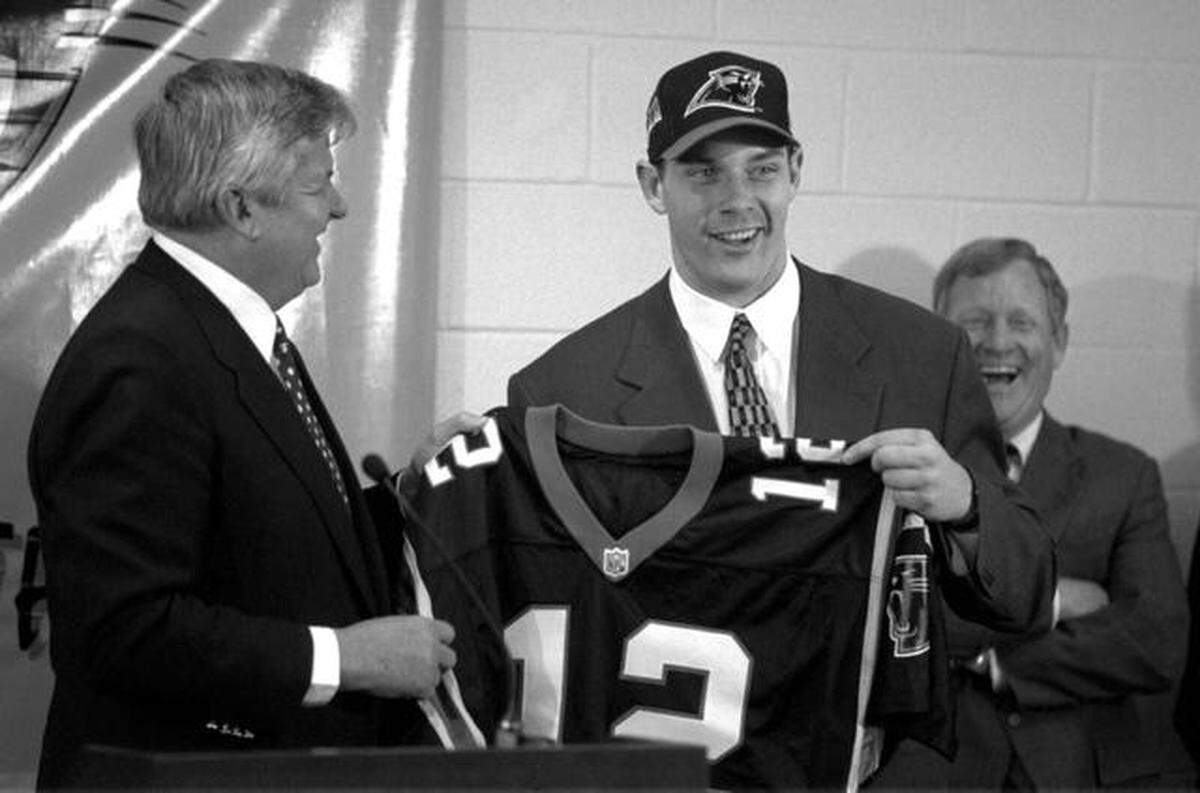
Bill Polian has been through his fair share of quarterback decision-making. The former general manager of the Panthers, Buffalo Bills and Indianapolis Colts helped make Kerry Collins the first quarterback in Carolina, and drafted Peyton Manning a couple years later.
Why is there such a low success rate on quarterbacks selected early?
“We’re human, and we’re not infallible. We can only judge the best way we can. For a number of different reasons, any number of reasons they don’t succeed,” Polian said. “Now, some go on and have success, or a modicum of success elsewhere, others simply disappear from the scene, but the fact is the failure rate is right around 50 percent.”
This isn’t a new statistic, nor something that has been happening more as of late. Quarterback selections have always held mixed results.
Twenty of the 32 current starting quarterbacks around the NFL are still on the team that drafted them. Fourteen of those quarterbacks were selected in the first-round, though among that group is Sam Darnold, with whom the New York Jets appear closer to parting ways than continuing to build around.
No quarterback drafted in the first round from 2010-16 remains with their original team. Ben Roethlisberger, Matt Ryan and Aaron Rodgers are the only first-round quarterbacks from 2000-16 still with the team that drafted them. That’s what made Deshaun Watson so appealing to teams this offseason. A top known commodity at quarterback entering the peak of his career.
As Polian referenced, a variety of factors contribute to this perception of failure: Injuries, lack of talent around the quarterback and a bad scheme fit can all play a role. Players like Jim Plunkett, who found success with the Raiders in the 1980s after struggling with the Patriots and 49ers, and more recently Ryan Tannehill with the Titans, were able to reestablish their careers with new teams after a rough start with the team that drafted them in the top 10.
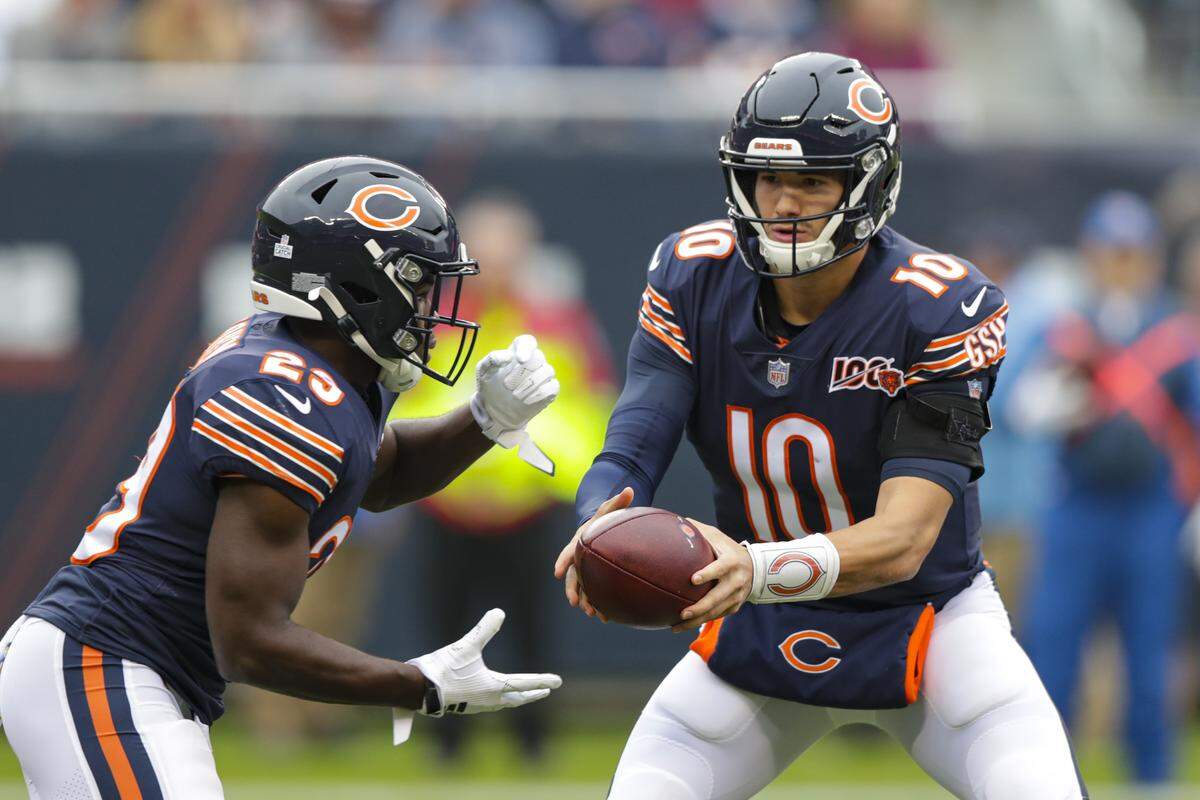
More recent top quarterback picks — and particularly those teams traded up for — have yet to find their footing. In 2017, the Chicago Bears gave up the No. 3 pick, a third-round and fourth-round pick that year and a 2018 third-round pick to draft Mitch Trubisky, who is now Josh Allen’s backup in Buffalo. Chicago still does not have a long-term answer at quarterback.
Eight picks later, the Kansas City Chiefs traded the 27th overall pick, a third-round selection and their 2018 first-round pick to the Bills for Patrick Mahomes. The Texans then traded their 2017 and 2018 first-round picks to the Cleveland Browns to grab Watson at No. 12. Trading up wasn’t the issue. It was trading up for the right player.
“The best you can hope to do is trust your process, assuming you have a good solid process and a good solid base of knowledge, you trust it and you make the best decision you can,” Polian said. “But there’s no guarantee that you’re going to be successful.”
Trading into the top five for a quarterback
The current expectation for the 2021 NFL draft is that there will be a early run on quarterbacks, with the potential for four to be chosen with the top four picks. The San Francisco 49ers have already traded up to No. 3 in a deal with the Miami Dolphins. This leaves other teams interested in top quarterbacks to try and find a way to trade into that select group, which seems difficult at this point, or to wait and see which players will fall.
There is no exact science to support that moving up or down in the draft is good or bad. In fact, Polian and the Panthers elected to move back in 1995 because they were OK with either Steve McNair or Kerry Collins as their new starting quarterback.
Measuring success is another matter, because of the subjectivity. Were the trades and selections of Jared Goff and Carson Wentz in the 2017 draft failures because they have been traded to other teams after being signed to huge contracts? Both the Rams and Eagles reached Super Bowls with them on the roster, although Wentz missed the playoff run due to injury.
Washington traded significant assets to move from No. 6 to No. 2 in the 2012 draft to select Robert Griffin III, and then also took Kirk Cousins in the fourth-round. Griffin’s success with the team was short-lived and Cousins’ time didn’t end on a positive note, either.
There is a reason, however, why teams invest so much to try and draft “the” quarterback. When you get it right, so much else can fall in place. The four winningest teams from the past decade all drafted a quarterback who they were able to build around — the Patriots, Packers, Seahawks and Steelers. Two of those quarterbacks were taken after the first-round — Tom Brady and Russell Wilson. While most of the quarterbacks that find success in the NFL are taken early, it’s far from always the case.
‘Let the board speak to you’
If there’s a lesson to be learned from these big moves, perhaps it is that reaching for a quarterback isn’t always the answer to building a roster. Sometimes it will work out, sometimes it won’t. Scouring and analyzing NFL trade history wouldn’t yield a simple, steadfast rule, either: Too many factors are involved.
Trusting evaluations is key, but it doesn’t bring all of the answers. And those observing this year’s proceedings needn’t sound alarm bells if the Panthers don’t take a quarterback.
“You take the best player, take your highest-rated player. It’s really simple,” Polian said. “The terminology we used was, ‘Let the board speak to you.’ ”
That philosophy resulted in the Colts drafting wide receiver Reggie Wayne in the first-round of the 2001 NFL draft after trading down due to a lack of consensus on who to pick, despite having more glaring needs and having Marvin Harrison on the roster.
However new general manager Scott Fitterer and head coach Matt Rhule approach their first draft together, the duo — and its staff — will be informed. Given Rhule and his staff’s recent experience with college coaching and recruiting, they’ll be able to make informed decisions on little access. With the reduced in-person contact this year, that is even more valuable.
The final choice — quarterback or not — will come down to making the best decisions possible. And even if it is a quarterback, it’s still a calculated 50-50 chance.
This story was originally published April 5, 2021 at 7:00 AM.