Why the Panthers might trade the No. 8 pick in the NFL draft, or select a quarterback
From thousands of players evaluated, the Carolina Panthers’ draft board is down to just 155 players. The team has completed more than 75 Zoom meetings with prospects, with additional interviews to come. A week from now, seven of those players — for now, at least — will join the team.
The Panthers have to prepare for every possibility, with no certainty of how the draft will play out from picks 3-7, ahead of their scheduled selection at No. 8.
Coach Matt Rhule and general manager Scott Fitterer sat down for their first combined press conference with less than a week to go until the start of the draft.
Let’s get into some takeaways.
Plenty of flexibility at No. 8
The phone lines are open at Bank of America Stadium.
As we’ve been discussing for months, trading down from the No. 8 pick is a real possibility for the Panthers. The team has spoken to at least five teams about the possibility of moving, and by sharing that information publicly, Fitterer reinforced that the team is open to hearing what teams have to offer.
“We’ve talked to several, actually, already. I’d say at least five, all in different parts of the draft,” Fitterer said. “There will be a lot more calls this week. We’re very open to moving back or open to picking, it just depends on how the board falls, those first seven picks in front of us.”
Just how far back would the Panthers be willing to go?
Right now they have 16 players ranked with first-round grades from 1 to 16, how the team would select if they had the opportunity. That number is not abnormal for NFL teams and indicates how there are multiple players the Panthers would be happy to get in the first round.
Fitterer spent nearly two decades working in the Seattle Seahawks personnel department, and the team would often trade out of the first round. Why? There were only so many players that the team had that high of a grade on, and with the Seahawks typically picking so late in the first round, it made sense to move back and get an extra pick.
The Panthers, however, will likely want to take advantage of having a top-10 pick this year and not move back too far, if a good offer presents itself. There could be some flexibility in the second round, as well.
“It seems like that every year between 15 and 19, and it’s right in that range once again this year,” Fitterer said. ”Then beyond that, it’s a really strong second round, like kind of the next, 30 to 40 players, it’s a really good group, but there is a drop-off, and it seems to be consistent every year, and same this year.”
Drafting a quarterback on the table
It’s not a no.
Again asked about picking up quarterback Sam Darnold’s fifth-year option, which the team has not yet done, Fitterer declined to say what the team’s plan is. The Panthers have until May 3 to pick up the additional year, which would net Darnold $18.9 million.
“That’s something we’ll address after the draft and that’s where we’re focused on right now, but we have a plan in place,” Fitterer said.
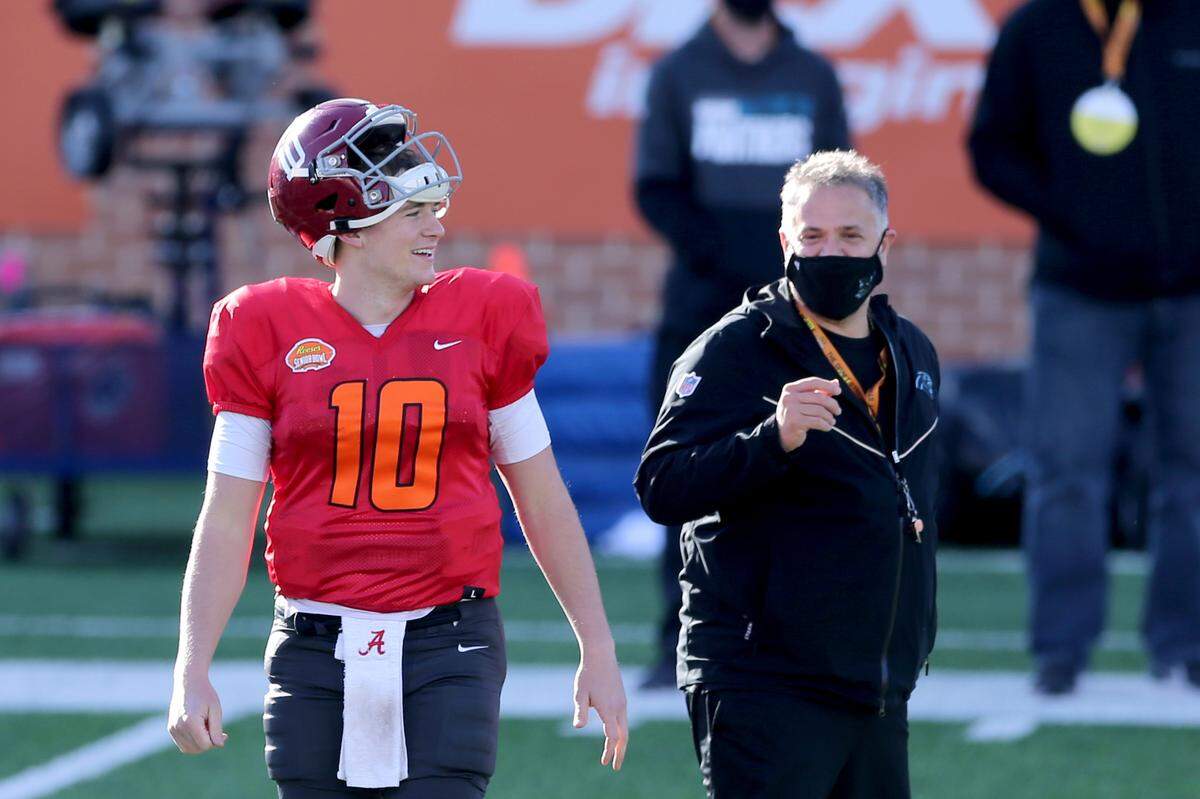
It benefits the Panthers for teams to think they are interested in taking a quarterback at No. 8 and to not do anything with Darnold’s option until after the draft. It could create a better trade market. The team drafting a quarterback like Ohio State’s Justin Fields, as The Observer has reported, is not off the table because of the Darnold trade.
Quarterbacks falling in the first round could benefit the Panthers in multiple ways. Either a player they like falls to them, or they have an increased opportunity to trade further back and pick up more selections. Don’t rule either option.
.JPG "CLT_CLEMGAMER_17 (1).JPG")
Depth of draft fits Panthers
Fitterer was asked what the deepest positions in the draft are. He listed press cornerback, offensive tackle and wide receiver.
Two of those are glaring needs for the Panthers — cornerback and tackle. Wide receiver is certainly also still a concern with Robby Anderson set to become a free agent next offseason and Curtis Samuel now playing in Washington.
All three of the positions have strong first-round talent this year. The Panthers like the top three corners in the draft — Alabama’s Patrick Surtain II, South Carolina’s Jaycee Horn and Virginia Tech’s Caleb Farley, and many organizations share similar thoughts. Farley has some documented injury concerns, which can more complicated to nail down due to the restrictions in the draft process related to COVID-19.
Tackle possibilities in the first round include Penei Sewell and Rashawn Slater, though many teams view the latter as more of a guard. What the Cincinnati Bengals do with the fifth pick could play a big role in which players drop to the Panthers, whether it is Sewell or someone like LSU wide receiver Ja’Marr Chase, with whom offensive coordinator Joe Brady is very familiar.
“What we want to do is, we wanna be able to look back in like five or six years and say, ’Hey, we have a couple of great players that came out of this draft,’ and so if we look at it from that perspective, it’s not necessarily about a need for this season, it’s really trying to build the team, the team that can compete, year in and year out,” Rhule said. “We’ll just try to pick the best players and know that we have a roster that allows us to do that.”
Inside jokes
This press conference featured inside jokes on Rhule not liking deviled eggs from their trip to Fargo, North Dakota, to see quarterback Trey Lance, and learning that the coach asks each draft pick he interviews, “If you’re on a desert island you can listen to one artist, what would it be?”
Basically, the Panthers weren’t giving away too much.
Draft logistics
After having to draft from home separately last year, the Panthers will have a war room in the 300 level of Bank of America Stadium next week. Ten people will be allowed in the room, all who have received the COVID-19 vaccine. Masks will not be required, physical distancing will be relaxed and eating/drinking allowed, per NFL policy this year.
This story was originally published April 23, 2021 at 4:59 PM.