Future of Panthers facility, in Rock Hill or elsewhere, could be influenced by new bill
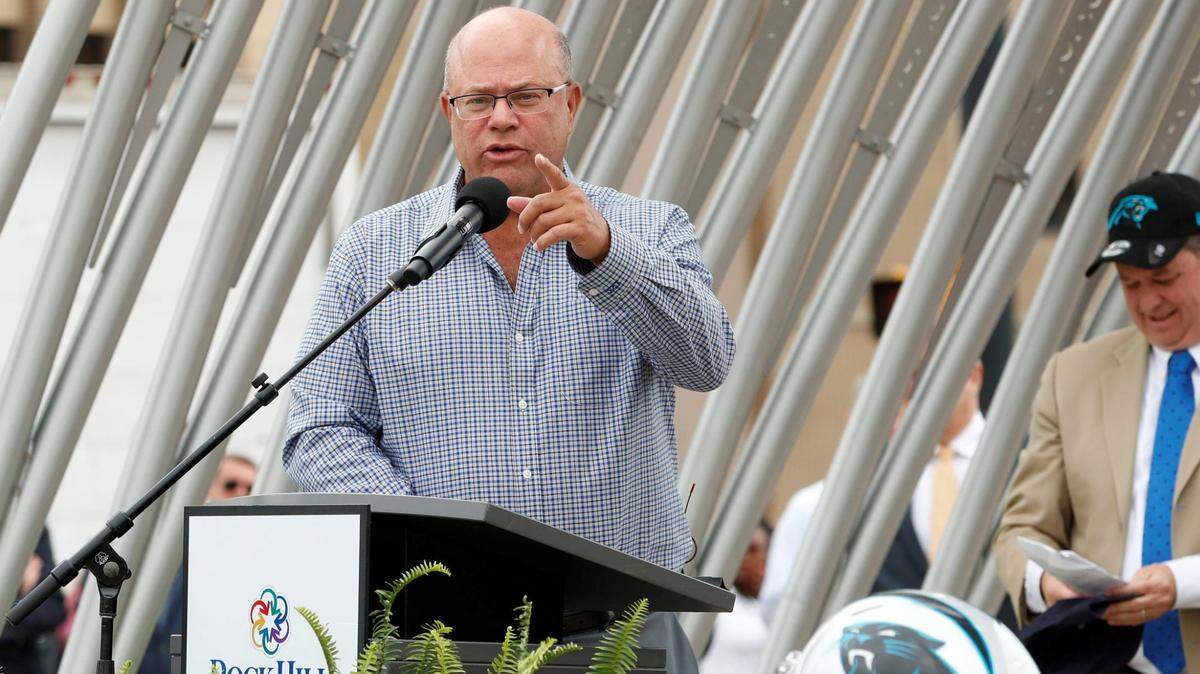
New legislation is making its way through Congress that could influence the future of the Carolina Panthers’ training facility or a new stadium.
In February, Congress introduced a bill aimed at eliminating subsidies for professional stadiums, which are routinely used to help fund the construction of such venues.
Reps. Jackie Speier (D-Calif.), Don Beyer (D-Va.) and Earl Blumenauer (D-Ore.) crafted the “No Tax Subsidies for Stadiums Act” to immediately eliminate a tax break used by professional sports teams.
The bill, H.R.6808, “denies an exclusion from tax of the interest on professional stadium bonds (i.e., bonds used to finance or refinance capital expenditures for a stadium or arena used for professional sports exhibitions, games, or training).”
When asked whether the bill would apply to future state-of-the-art pro sports practice facilities and team headquarters, such as the recently terminated $800 million Panthers’ complex in Rock Hill, Beyer’s Deputy Chief of Staff Aaron Fritschner said, “The simple answer here is that the bill text includes training facilities, so it would also encompass practice fields.”
That means it would benefit Tepper and the Panthers to reconcile their abandoned plans for a new practice facility 30 minutes south of their Charlotte stadium.
“In the original drafting, they were thinking that teams and team owners seek perks where these wealthy team owners would kind of blackmail local jurisdictions into, if you don’t spend X amount of money or build a stadium or whatever, I’m going to move my team to some other place,” Fritschner told The Charlotte Observer. “And they recognize that the perks that team owners might seek under those kinds of conditions wouldn’t necessarily be limited to a stadium itself.”
The catalyst for this new legislation spans from allegations of widespread sexual harassment in the Washington Commanders workplace and dissatisfaction with the NFL’s response. This bill would signal that Congress will not tolerate workplace sexual harassment nor stand idly by as serious allegations are swept under the rug by the NFL and Commanders owner Daniel Snyder.
“There is no justification for these multibillion-dollar franchises to be eligible for tax-exempt municipal bonds,” Speier told The Washington Post. “This is tax dollars that could be used for any number of really important public-interest programs. Over the course of 20 years, it (represents a loss of) $4 billion — and probably much more.”

The bill does not apply retroactively to tax-free municipal bonds that have already been allocated for construction or major renovation projects. Instead, it only applies to new bonds going forward for stadium projects in all pro sports. If the bill gains traction, it could make Tepper inclined to push forward with his Rock Hill plans to ensure his $115 million in tax breaks from South Carolina and $225 million in relief from York County remain.
Tepper, the richest owner in the NFL worth an estimated $16.7 billion, according to Forbes, has no interest in funding Panthers facilities on his own.
In June 2021, Tepper addressed the possibility of building a new venue to replace Bank of America Stadium, home of the Panthers and Charlotte FC, saying, “At some point, that building will fall down. Like I said before and I’ll say it again, I’m not building a stadium alone,” referring to his financial commitment.
“The community is going to have to want it,” he said. “If I’m a third, and the community’s a third, and eventually in the future, personal seat license (owners) are a third, or whatever we do, it’s a partnership.”
New extravagant NFL practice facilities with large price tags are popping up around the NFL. In 2018, the Minnesota Vikings opened Twin Cities Orthopedics Performance Center. The project cost about $90 million and spans 546,488 square feet.
But the Vikings’ home is 100 percent privately financed, a team spokesman told the Pioneer Press in 2017 before the project was complete. Dakota County officials (where the facility is built) figured since they have the lowest property taxes per capita in Minnesota, there was no reason to offer additional subsidies.
The Dolphins opened their new practice facility in 2019. Baptist Health Training Complex is worth $135 million and spreads 217,200 square feet. According to reports, the Miami-Dade County Commission agreed to increase subsidies by $750,000 per year to the Dolphins. Under a separate agreement, Miami Gardens will provide the team an additional $500,000 per year. The subsidies are funded entirely by the county’s tourist tax.
These massive complexes double as team headquarters as well and are often filled with offices for coaches, team officials and executives while also featuring multiple fields, gyms, locker rooms and training rooms for players.
This story was originally published April 20, 2022 at 2:57 PM.