How did the Predators’ Erik Haula become Public Enemy No. 56 against his former team?
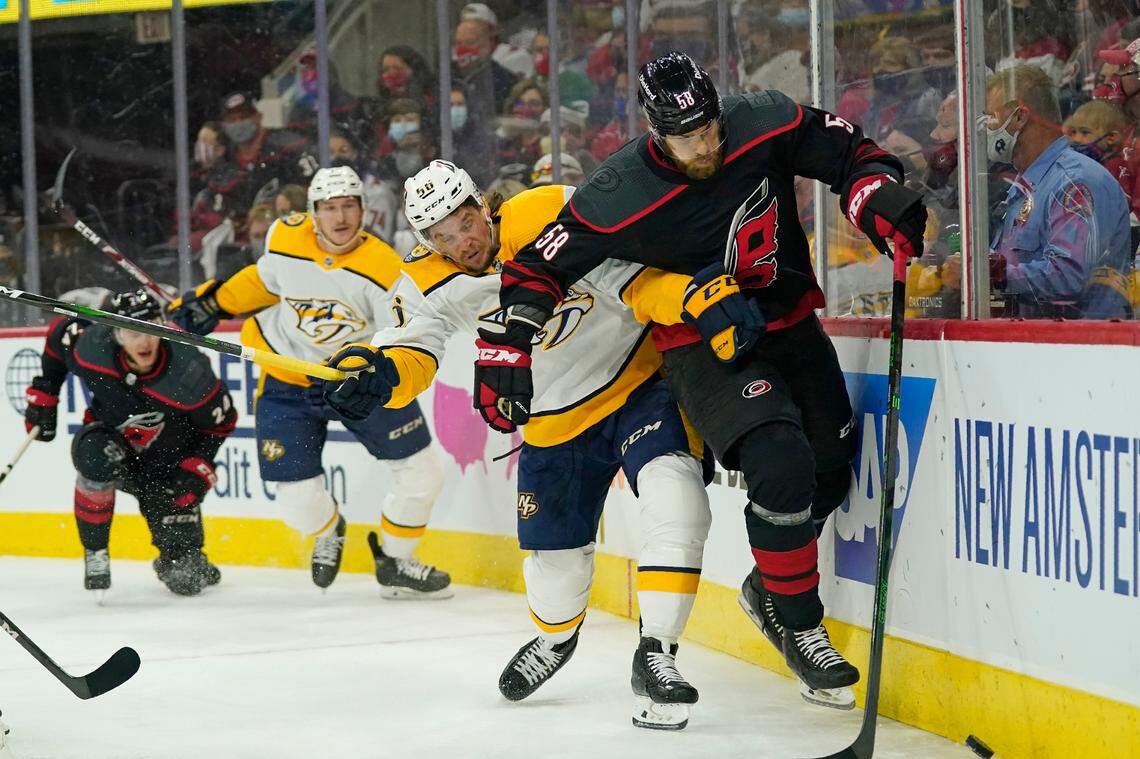
Erik Haula started Game 2 the way he finished Game 1: Resuming a running debate with Martin Necas after the whistle, then later drawing a retaliation penalty on Sebastian Aho to give the Nashville Predators one of their seven power plays Wednesday night.
Whether Haula intended to go into this series as the Predators’ primary antagonist against his former team or not, that’s the way things have turned out. For chunks of the Carolina Hurricanes’ 3-0 win, Haula was booed not only when he had the puck but merely when he stepped on the ice.
“That booing and yelling, all those things, honestly I love it,” Haula said after Game 1.
But now that he has, it’s worth looking back heading into Friday’s Game 3 in Nashville at Haula’s departure from the Hurricanes last season, and where all the acrimony -- on both sides -- that has bubbled to the surface on the ice in this series actually arose.
“There’s a big reason Erik Haula was traded,” Bally Sports South analyst Shane Willis said during Wednesday’s broadcast. “It’s not because of his skill. I’ll leave it at that.”
A trade acquisition during the summer of 2019, Haula had a productive start to his Hurricanes career before he was slowed by a persistent knee injury. As the trade deadline approached, and Haula’s ice time dwindled, the Hurricanes made it clear they were not interested in offering the impending free agent a new contract. The circumstances led to at least one shouting match in a back hallway of the dressing room during a media access period.
Amid concerns over Haula’s fit in the dressing room, the Hurricanes included him in the deadline trade with the Florida Panthers for center Vincent Trocheck, a flat-out steal of a deal that in recent history ranks only behind the grand larceny that was Nino Niederreiter for Victor Rask. Haula ended up signing with the Predators this season on a cut-rate $1.75 million, one-year deal.
In an interview Thursday, Willis elaborated on his comments about Haula, whose skill level Willis said he admires.
“I always go back to what Rod (Brind’Amour) wants in the locker room,” Willis said. “He just wasn’t one of those guys. That’s just how I was commenting on it. When you look at a room of guys like (Jordan) Staal, (Brett) Pesce, (Jaccob) Slavin and their attitudes, it just doesn’t work.”
Conversely, it would be easy to see why Haula might harbor bad feelings about not being offered a new contract, not to mention the kind of residual gripes with former teammates that tend to be quickly forgotten only to resurface during a playoff series.
Whether Haula’s antagonistic behavior in Game 1 set off the home fans or they were picking up on his former teammates’ apparent dislike for him on the ice -- and there were plenty of words exchanged after the whistle, without any smiles -- the Finnish center has certainly embraced the role of pantomime villain in the series.
“I must be doing something right,” Haula said.
As Brind’Amour said earlier this week, “(Haula) can handle that. I think he likes that.”
*extreme chuck amato voice* discipline
While there was no question the Predators goaded the officials into two of the seven penalties that went against the Hurricanes and led to Nashville power plays on Wednesday, Brind’Amour was unhappy that the Predators goaded the Hurricanes into those kinds of retaliation plays at all.
In the NHL, as in fights between siblings, it’s always the second guy that gets caught.
“We don’t want to get involved in all that stuff,” Brind’Amour said. “It opens up, whether you think they’re penalties or not, embellishment or not, it opens up to have that be called. You’ve got to take a cheap shot. You just have to. We didn’t tonight. We wanted to give it back and those were the ones getting called. You can’t get engaged in that kind of stuff. It just doesn’t help.”
Still, there was clearly some frustration over an 18-12 penalty differential in favor of the visiting team through two games, not the way it usually works in the postseason. That remains an area to watch because there have been times where the Hurricanes let concerns with the officiating affect their focus, at times during the Washington Capitals series in 2019 and certainly in both of the recent series with the Boston Bruins. They maintained their composure in Game 1 against Nashville; they were less successful in Game 2.
Man disadvantage advantage
Then again, none of that mattered thanks to the penalty kill that is now 10-for-10 in the series and, while shorthanded, outchanced the Predators’ power play Wednesday night. That’s not out of the norm for an attacking, aggressive PK unit that ranked third in the league and scored seven short-handed goals in the 56-game regular season.
The Hurricanes nearly had their first of the postseason but Juuse Saros was able to stop a Aho breakaway and deny Trocheck on a two-on-one.
“The way I like to play PK is puck pressure, and sometimes there’s bounces, and it doesn’t matter if it’s PK, PP, five-on-five, if there’s a breakaway chance I’m going for it,” Aho said. “I guess it just happens. It’s not something I’m thinking about when I’m out there, that I’ve got to get the breakaway on PK, no. It’s from the puck pressure and sometimes you get little lucky bounces.”
Hurricanes vs. Predators
What: Game 3, Stanley Cup playoff first-round series.
When: Friday, 7 p.m.
Where: Bridgestone Arena, Nashville, Tenn.
TV: BSSO (Bally)
This story was originally published May 20, 2021 at 2:22 PM with the headline "How did the Predators’ Erik Haula become Public Enemy No. 56 against his former team?."